Clear Sky Science · en
Negativity percolation in continuous-variable quantum networks
Why quantum webs of light matter
Modern quantum technologies, from ultra-secure communication to future quantum computers, all depend on a fragile resource called entanglement—deep correlations linking distant particles. Most research so far has treated entanglement as if it lived in tiny on–off switches called qubits. But many of the most practical optical devices work instead with smooth, continuous properties of light, such as its brightness and phase. This paper asks: when we build large quantum networks out of such continuous “beams of light,” do they behave like their qubit-based cousins, or do they obey new rules entirely?
Building a quantum network from gentle light
The authors focus on continuous-variable quantum networks, where connections between network nodes are made from special light states called two-mode squeezed vacuum states. Unlike single-photon sources, these light states can be produced steadily and on demand using standard nonlinear optics, making them attractive for scaling up to chip-level or even internet-scale quantum systems. A key step is to define a practical way to move and reshape entanglement across a network using only local operations and classical communication, in a way that always works rather than succeeding only with some probability.
Rules for combining quantum links
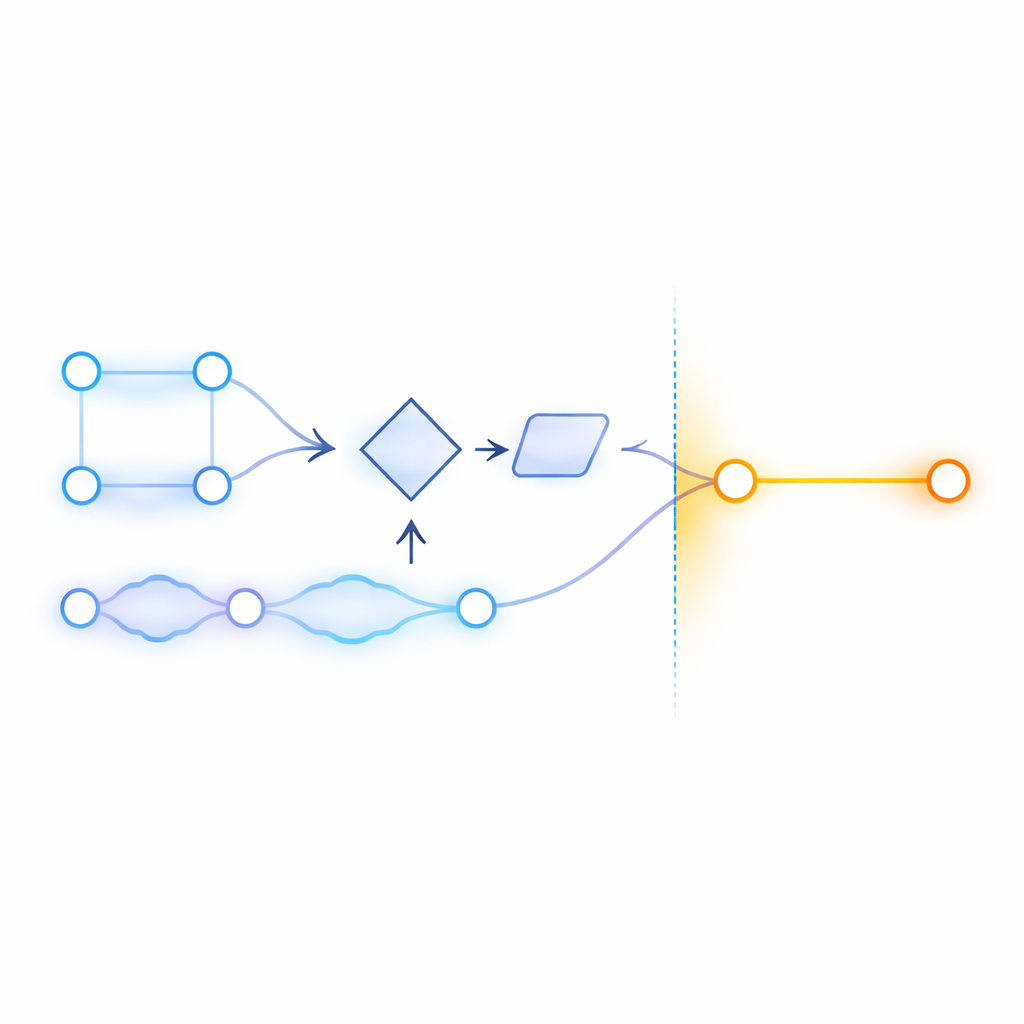
To do this, the team develops a Gaussian-to-Gaussian deterministic entanglement transmission scheme. In essence, they show that two basic operations—entanglement swapping in series and entanglement concentration in parallel—are enough to move entanglement across many different network shapes while keeping the states in the same Gaussian family. Swapping lets a relay node break and re-form links so that two distant parties become directly entangled, much like joining resistors in series. Concentration combines several weaker links between the same parties into a single stronger one, analogous to putting resistors in parallel. A specially chosen entanglement measure, called ratio negativity, behaves like a bounded “weight” for each link and makes these rules easy to express and generalize.
When entanglement spreads like a sudden flood
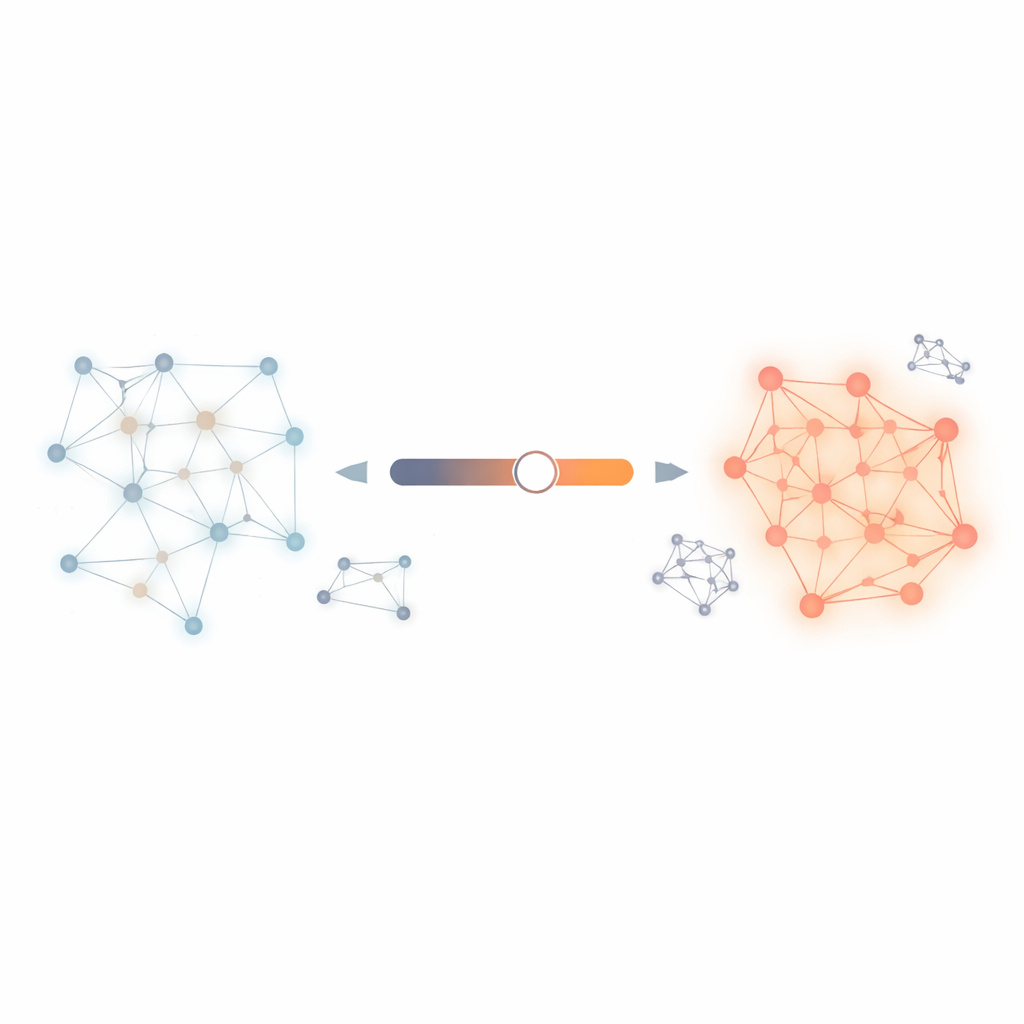
Armed with these rules, the authors reinterpret entanglement distribution as a kind of percolation problem—akin to asking when water poured onto a porous material finds a path all the way through. In classical and earlier quantum models, the growth of a large connected cluster is typically smooth: as link quality or connection probability slowly improves, long-range connectivity rises gradually. In contrast, the new negativity percolation theory reveals a mixed-order phase transition in continuous-variable networks. On idealized tree-like structures and in two-dimensional grids, the authors find that as the link entanglement passes a critical threshold, the global connectivity does not grow gently. Instead, it jumps abruptly from zero to a finite value while still exhibiting long-range correlations characteristic of continuous transitions. This combination of sudden change and extended influence places continuous-variable networks in a new universality class, distinct from both classical and qubit-based cases.
Hidden fragility near the brink
This abrupt behavior has direct engineering implications. In real devices, entanglement decays over time because of noise and loss, and operators typically use feedback control—constantly measuring performance and adjusting hardware—to keep a network in a working regime. The authors model how a large continuous-variable network behaves under such feedback when the link quality hovers near the critical threshold. Because the global connectivity responds in a jump-like fashion to tiny changes in link entanglement, standard feedback strategies that work well for qubit networks can push the system into unstable oscillations, with the network repeatedly flipping between “on” and “off” states of large-scale entanglement. This instability persists even when the underlying local entanglement is itself well controlled, highlighting a genuinely collective effect.
What this means for future quantum infrastructure
In summary, this work shows that large networks built from continuous light fields can exhibit a previously unseen kind of entanglement percolation, where global quantum connectivity switches on suddenly rather than rising smoothly. That sharp transition is both an opportunity and a warning: it marks a new regime of critical behavior that could be explored in optical-chip experiments, but it also signals that maintaining reliable operation near the “edge” of connectivity will demand more sophisticated, carefully tuned feedback strategies. As quantum technologies move from laboratory demonstrations to widespread infrastructure, understanding and taming this mixed-order behavior will be essential for building robust quantum networks of light.
Citation: Zhao, Y., He, K., Zhang, Y. et al. Negativity percolation in continuous-variable quantum networks. npj Quantum Inf 12, 77 (2026). https://doi.org/10.1038/s41534-026-01210-5
Keywords: quantum networks, continuous-variable optics, entanglement percolation, phase transitions, quantum feedback control