Clear Sky Science · en
Integration of a single photon source with a fibre-compatible photonic waveguide
Bringing Quantum Light to Everyday Fibers
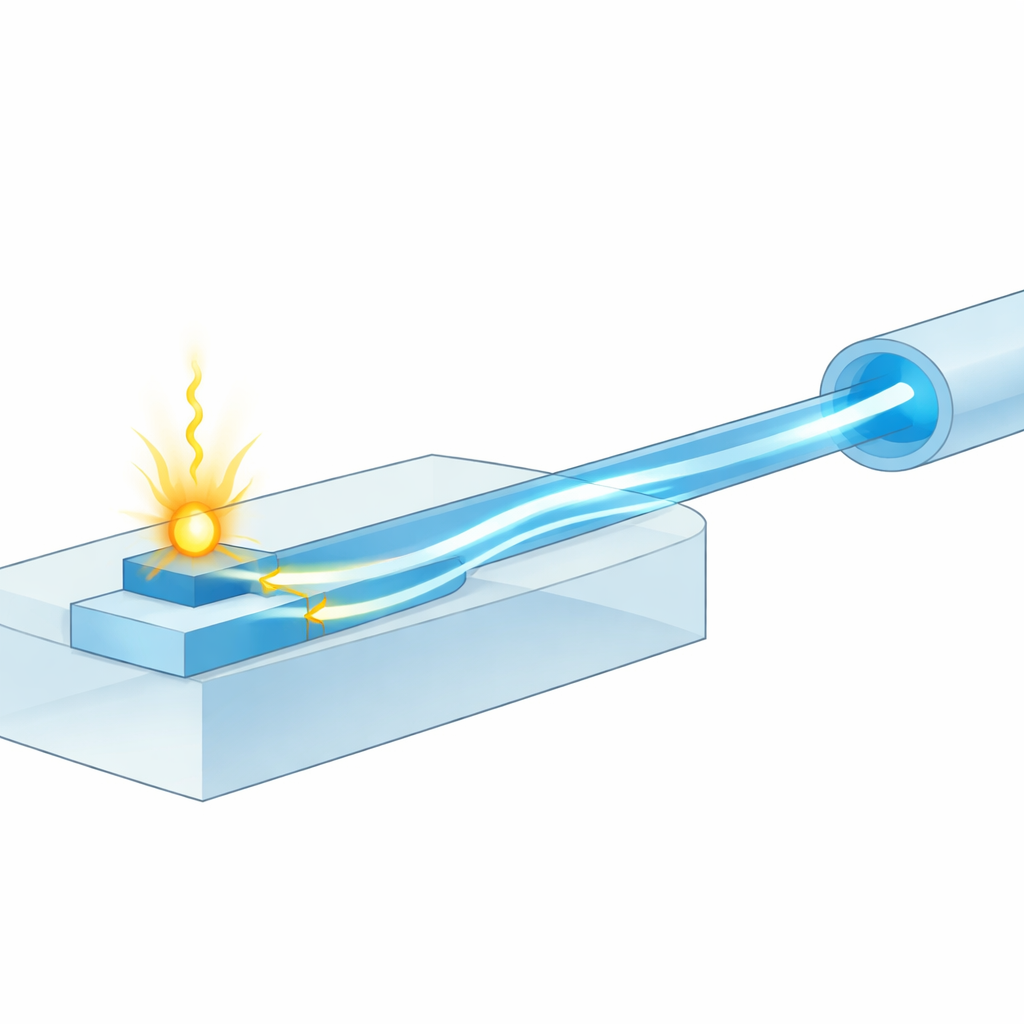
Future quantum networks will rely on streams of individual particles of light—single photons—to send perfectly secure messages and perform new kinds of computation. But most single-photon devices are tiny, fragile, and hard to connect to the ordinary glass fibers that carry light over long distances. This paper shows a practical way to bridge that gap, linking a nanoscale light source on a chip directly into a glass waveguide that is compatible with standard optical fiber, all working at room temperature.
A Tiny Light Source with a Big Job
The heart of the device is a single “nanocrystal,” a semiconductor particle only a few billionths of a meter across that can emit one photon at a time. These colloidal nanocrystals float in liquid during fabrication and can be deposited where needed, making them easier to handle than many other quantum-light sources that demand cryogenic temperatures or complex growth methods. The authors first verify that more than 90% of their nanocrystals behave as true single-photon emitters, using a standard test that looks for the telltale absence of photon pairs arriving together. Spectra of the tiny sources show clean, bright emission around 610 nanometers—red-orange light—with timing statistics that confirm the photons are released one by one.
Turning the Substrate into a Light Highway
Rather than treating the solid support under the nanocrystal as a passive platform, the team designs it as an active light-guiding structure. They use an established ion-exchange process in glass to make a semi-buried waveguide—essentially a narrow region inside the glass where the refractive index is slightly higher, so light prefers to travel there like in a fiber. Because this waveguide lies close to the surface, it can interact with objects placed on top. However, simulations show that if a nanocrystal is simply set on the glass above the guide, only about 1–2% of its emitted light is captured and guided. On its own, the buried waveguide is too far and too weakly linked to the nanoscale source.
A Stepping-Stone Layer for Better Coupling
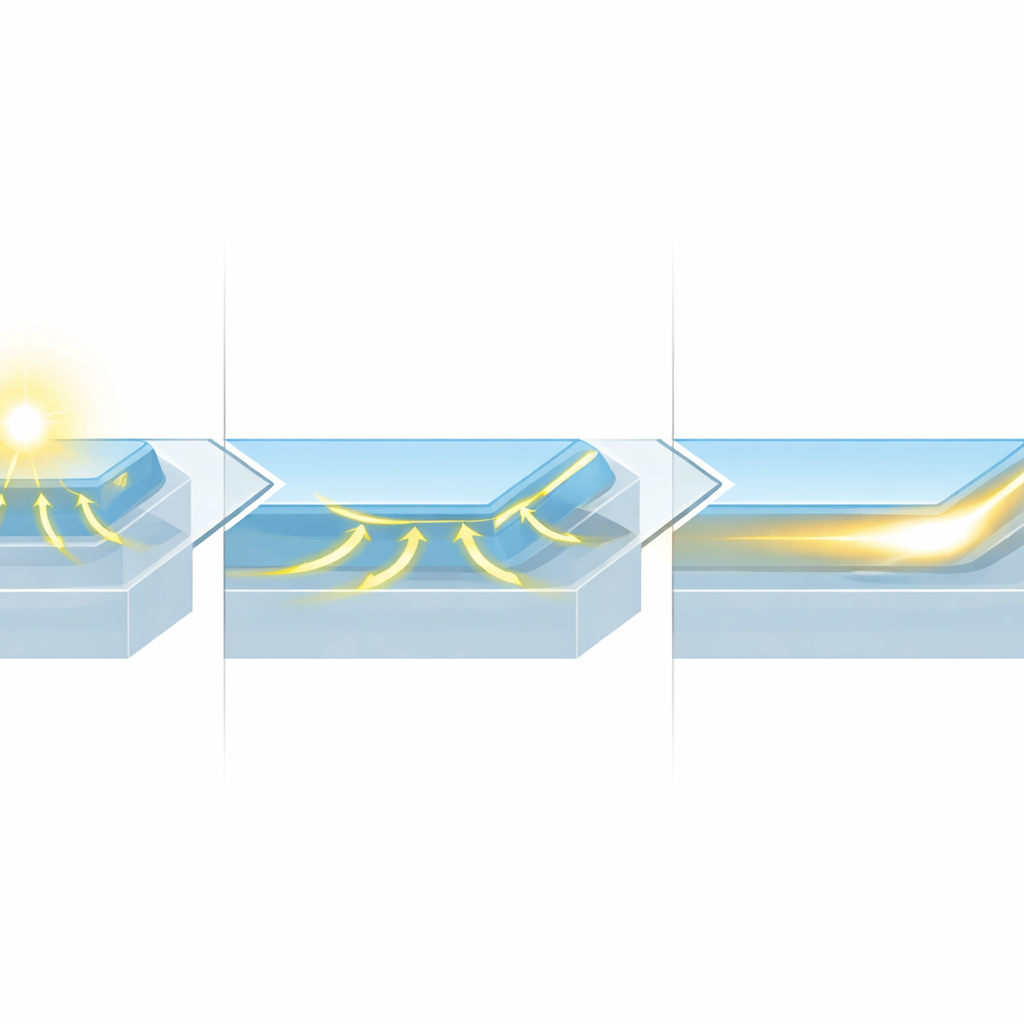
To solve this, the researchers add a very thin strip of titanium dioxide on the surface, directly above the glass waveguide. This material has a higher refractive index and acts as a stepping-stone or bridge between the nanocrystal and the deeper guide. Using three-dimensional computer simulations, they optimize the strip’s width, height, and length so that light from the nanocrystal first enters the surface strip and then gradually transfers into the buried glass guide without being lost. In the ideal design, this hybrid structure should capture roughly a quarter of the nanocrystal’s photons, a more than tenfold improvement over the bare glass. Real fabricated devices, affected by surface roughness and imperfections, still achieve a nearly threefold increase in collected light compared with the simple approach.
From Chip to Fiber at Room Temperature
The team goes beyond simulations and isolated measurements by attaching (“pigtailling”) an optical fiber directly to the output of the glass waveguide. They illuminate the nanocrystal from above and measure the light emerging from the fiber, confirming that the single-photon character survives the journey through the chip. Additional measurements of how quickly the nanocrystal’s excited state decays reveal a modest but clear speed-up—described by a Purcell factor of about 1.2—showing that the local photonic environment of the waveguide-and-strip combination subtly enhances the emission process. At the same time, the authors identify and analyze unwanted background glow from silver ions in the glass and from defects in the titanium dioxide, and they outline several practical strategies to reduce this noise in future designs.
Why This Matters for Quantum Networks
In accessible terms, this work demonstrates a working “socket” that lets a single-photon light bulb the size of a molecule plug directly into the same kind of glass technology used in telecommunications. The experiment proves that a single nanocrystal can send individual photons through a chip-scale glass waveguide and into a fiber, with significantly improved efficiency thanks to a carefully engineered intermediate layer. While the current device is a proof of principle and still suffers from some background light and fabrication limits, it opens a realistic path toward room-temperature quantum light sources that can be scaled up, duplicated, and eventually replaced by even better emitters such as color centers in diamond—without changing the overall photonic platform.
Citation: Broussier, A., Muhammad, M.H., Rahbany, N. et al. Integration of a single photon source with a fibre-compatible photonic waveguide. npj Quantum Inf 12, 67 (2026). https://doi.org/10.1038/s41534-026-01209-y
Keywords: single photon source, quantum communication, integrated photonics, optical waveguides, nanocrystals