Clear Sky Science · en
Digitized counterdiabatic quantum critical dynamics
Why this matters for future quantum machines
As quantum computers grow, they promise to solve hard problems in chemistry, materials, and optimization. But there is a catch: when a quantum system is driven too quickly through a delicate phase transition, it tends to “misstep,” leaving behind defects that spoil the final result. This paper shows that a clever control technique, called counterdiabatic driving, can sharply cut down those defects even when the system is rushed—offering a practical way to get better answers from today’s noisy quantum processors.
Crossing a fragile quantum tipping point
Many physical systems, from magnets in a solid to the early universe, undergo phase transitions where order suddenly appears. Near these tipping points, it becomes very hard for a system to keep up with changes. If you sweep control parameters too fast, different regions fall out of sync and form domains separated by topological defects—kinks or vortices that mark where the order changes direction. In quantum versions of these transitions, this behavior is captured by the quantum Kibble–Zurek mechanism, which predicts how the density of defects falls only slowly as you lengthen the time over which you perform the sweep. For realistic quantum computers, where operations must finish before noise takes over, simply going slower is not an option.
Guiding the system with an extra hand
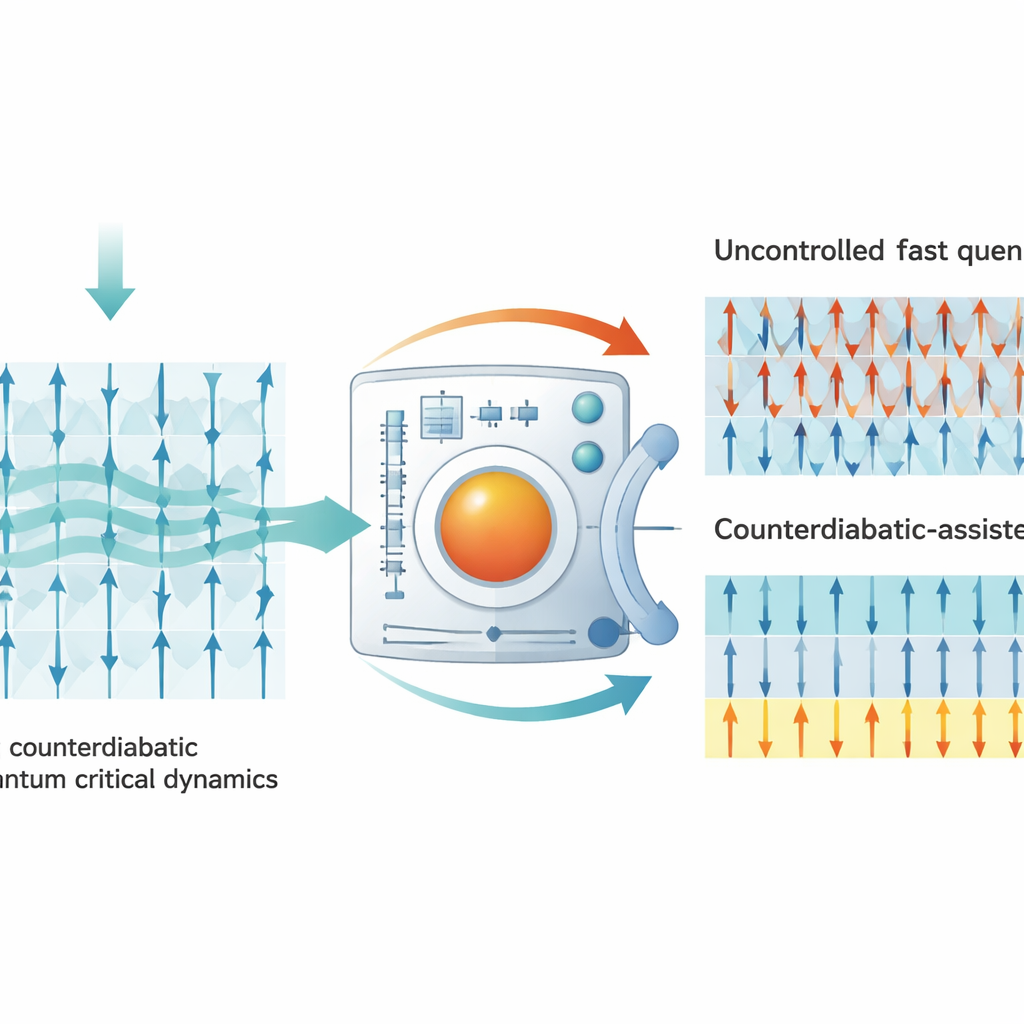
Instead of relying on slow evolution, the authors use a family of ideas known as shortcuts to adiabaticity. In particular, they implement counterdiabatic driving: an additional, carefully designed term in the quantum Hamiltonian that counteracts the unwanted excitations produced during a fast sweep. When this auxiliary control is chosen well, the system can follow the same path that an infinitely slow evolution would take, but in a much shorter time. Because real hardware cannot realize arbitrary interactions, the team uses an approximate, local version of this extra term, constructed so it can be compiled into gates on superconducting quantum chips.
Testing the idea on large quantum processors
The researchers study a workhorse model of quantum magnetism, the transverse-field Ising model, which undergoes a transition from a disordered paramagnetic phase to an ordered ferromagnetic phase. They implement this model digitally on IBM’s cloud quantum processors with up to 156 qubits, arranging the qubits in several geometries: a long one-dimensional chain, a ladder, a square grid, and IBM’s native heavy-hexagonal layout. For each case they rapidly sweep the system across the phase transition, with and without the counterdiabatic term, then count how many kinks appear in the final pattern of spins. Beyond just the average number of defects, they also examine how the full distribution behaves, including its variance and skewness, to probe the underlying dynamics.
Fewer defects, even when moving fast
The experiments show that in the fast-sweep regime, where the usual Kibble–Zurek scaling breaks down and defect densities normally saturate to a high plateau, counterdiabatic driving substantially lowers that plateau. In a 100-qubit chain, the average defect density is reduced by nearly half compared with standard digitized annealing. Similar, though geometry-dependent, reductions appear in two-dimensional layouts, where classical simulations are hard. For very rapid sweeps, the uncontrolled system barely leaves its initial state, while the counterdiabatic protocol still manages to nudge it toward the ordered phase, creating fewer domain walls. The measured trends agree closely with exact calculations in one dimension and with advanced matrix-product-state simulations in higher dimensions, at least up to times where hardware noise begins to dominate.
What this means for quantum technologies
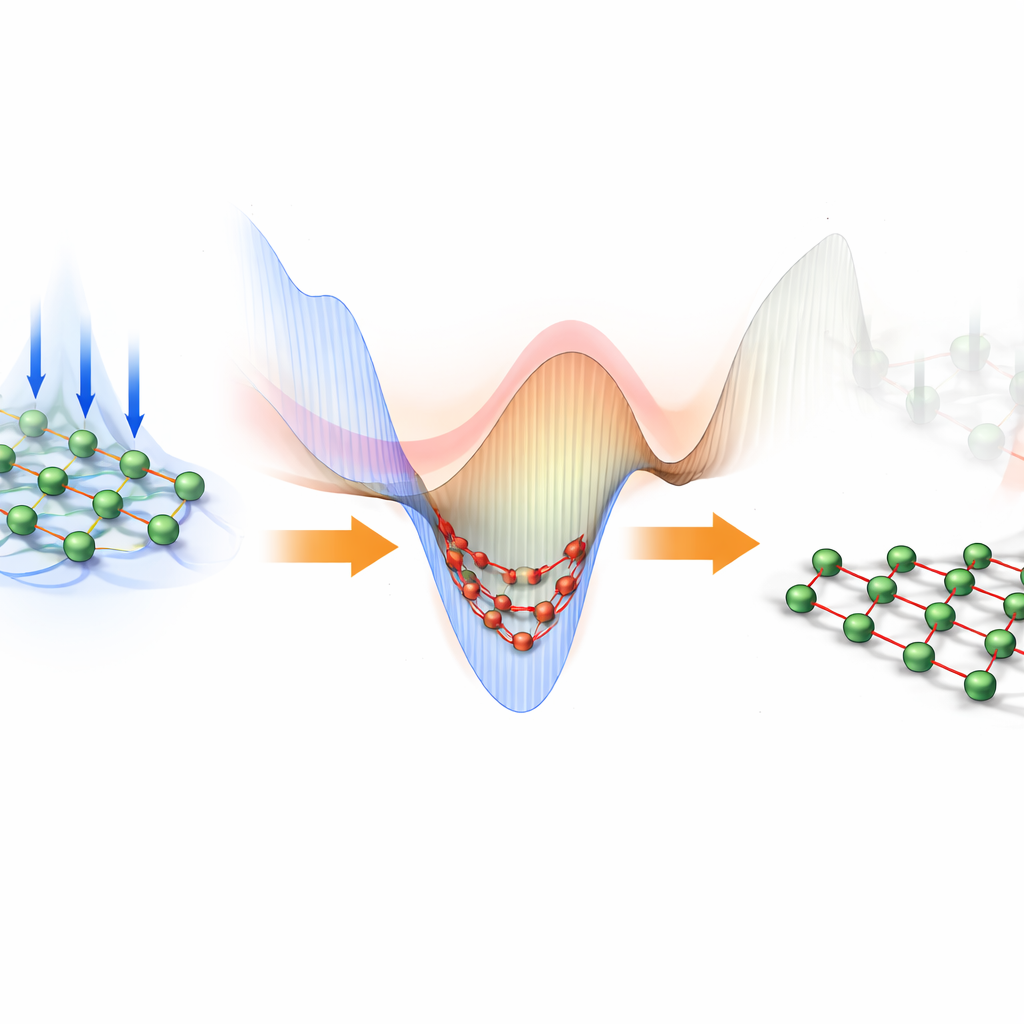
In plain terms, the study demonstrates that you can drive a quantum system quickly through a fragile transition and still end up with a much cleaner, more ordered state—if you add the right kind of guiding force. This makes counterdiabatic protocols a promising tool for quantum optimization and state preparation, where extra defects translate directly into wrong or low-quality answers. By validating these ideas on large, current-generation processors and in settings beyond the reach of straightforward classical simulation, the work suggests a practical route to more reliable quantum devices for exploring new materials and solving complex computational tasks.
Citation: Visuri, AM., Gomez Cadavid, A., Bhargava, B.A. et al. Digitized counterdiabatic quantum critical dynamics. npj Quantum Inf 12, 47 (2026). https://doi.org/10.1038/s41534-026-01208-z
Keywords: quantum phase transitions, counterdiabatic driving, quantum annealing, topological defects, superconducting qubits