Clear Sky Science · en
Layered KIK quantum error mitigation for dynamic circuits
Why taming quantum noise matters
Quantum computers are famously powerful on paper but notoriously fragile in practice. Every real device is bathed in noise that nudges delicate quantum states off course, threatening to erase any computational advantage. This article introduces a new strategy, called Layered KIK, that makes it easier to cancel out such errors even in the more flexible “dynamic” quantum circuits that future large-scale machines will rely on.
From quick fixes to lasting strategies
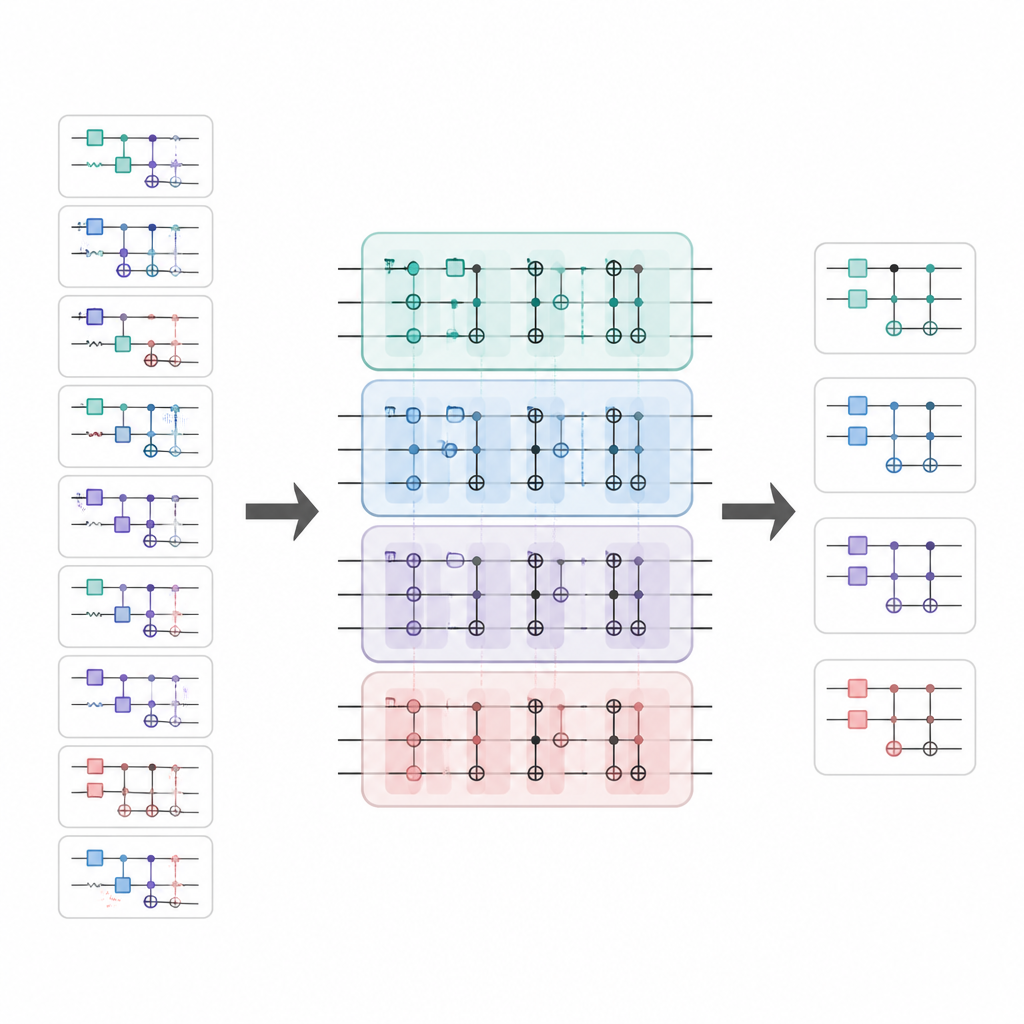
Today’s machines are too small and noisy to run full-blown quantum error correction, which demands many extra qubits. Instead, researchers often use quantum error mitigation, a family of techniques that mathematically removes part of the noise from measurement results at the cost of extra runs of the experiment. These methods help, but they are not a cure-all: as circuits get larger, the number of runs needed can explode, and many approaches assume that the noise stays unchanged over time. In real laboratories, however, noise slowly drifts as hardware warms up, drifts in calibration accumulate, or microscopic defects flicker in and out of action.
Why previous approaches fall short
A key divide in error mitigation is between schemes that first learn a detailed noise model and those that avoid learning the noise at all. Model-based schemes can be efficient when noise is stable, but become unreliable as soon as the hardware drifts, which is common during long experiments. Noise-agnostic methods instead artificially increase the noise in a controlled way and then use clever combinations of the results to infer what the outcome would have been with no noise at all. Earlier work introduced an approach called adaptive KIK, which uses a time-reversed “pulse inverse” version of the circuit to amplify errors while staying resilient to slow drifts. However, that original KIK method treated the whole circuit as one block, which clashes with mid-circuit measurements and more complex, branching quantum routines, and it left behind a small but conceptually important residual bias.
Layering the circuit to control errors
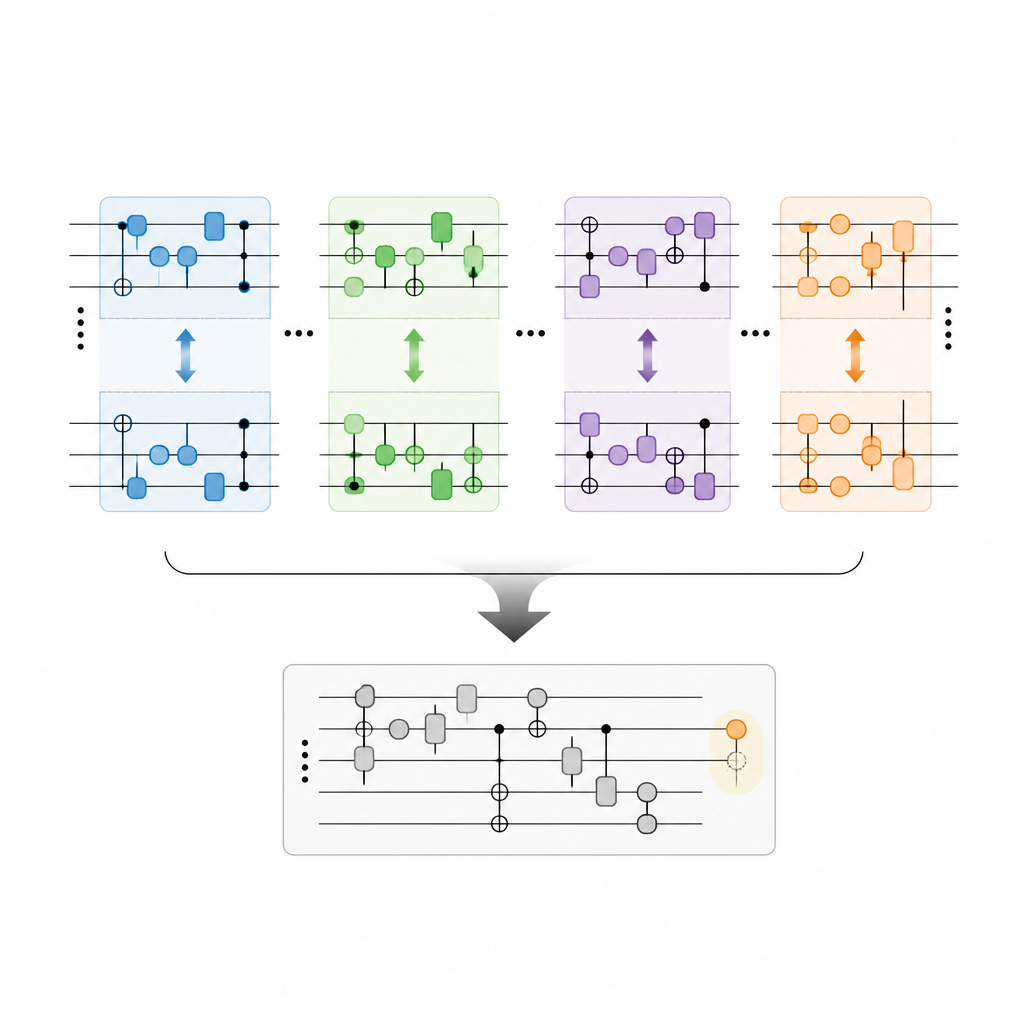
The new Layered KIK method solves these problems by slicing a circuit into multiple time-ordered layers and applying the KIK amplification to each layer separately rather than to the entire circuit at once. Each slice of the computation is run, followed by a carefully designed inverse of just that slice, which boosts the effect of noise in a predictable way without changing the ideal logic of the algorithm. By measuring how the output changes as the apparent noise level is increased, the method reconstructs a best estimate of the noise-free outcome. Remarkably, this can be done without adding extra hardware or more complex operations than the original global KIK approach. The key innovation lies in how the mathematics of the layered construction suppresses subtle higher-order error terms that previously introduced bias, especially when many layers are used.
Dynamic circuits and real-time decisions
Future quantum computers will rely heavily on dynamic circuits, where measurements taken in the middle of a computation steer what happens next. This is essential for advanced tasks such as quantum error correction itself, teleporting quantum information, and adaptive algorithms. Global KIK struggled here because treating the entire circuit as a single reversible block conflicts with irreversible measurements that collapse quantum states. The layered approach, by contrast, can treat measurement steps as special elements that are left untouched while the surrounding gate operations are still amplified and mitigated. The authors show mathematically and through simulations that Layered KIK remains effective even when circuits include mid-run measurements, feedback, and post-selection, where only a subset of outcomes is kept.
What this means for the road ahead
In simple terms, the paper shows that by carefully stacking and inverting pieces of a quantum circuit, one can cancel out noise more cleanly, even as the hardware drifts and the circuits themselves become more flexible. Layered KIK can work alongside quantum error correction: error-correcting codes remove the bulk of simple, local errors, while Layered KIK sweeps up the more stubborn correlated and coherent noise that remains. Because the method does not demand extra qubits and is compatible with existing pulse control on several platforms, it offers a practical tool for making early quantum processors more reliable and for boosting the performance of future error-corrected machines.
Citation: Bar, B., Santos, J.P. & Uzdin, R. Layered KIK quantum error mitigation for dynamic circuits. npj Quantum Inf 12, 79 (2026). https://doi.org/10.1038/s41534-026-01207-0
Keywords: quantum error mitigation, dynamic circuits, quantum error correction, noise drift, Layered KIK