Clear Sky Science · en
Towards telecom-compatible quantum nodes using erbium-doped stoichiometric EuCl3 ⋅ 6H2O crystals
Building the Future Quantum Internet
Today’s internet moves classical bits of information—ones and zeros—around the globe at the speed of light. A future “quantum internet” would instead distribute fragile quantum states, enabling ultra-secure communication and powerful distributed computing. To make this vision real, researchers need special hardware nodes that can reliably store quantum information and talk to existing fiber networks. This paper explores a promising solid-state material that could form the heart of such quantum nodes, bringing long-lived quantum memories and everyday telecom fiber closer together.
Two Helpful Atoms Working as a Team
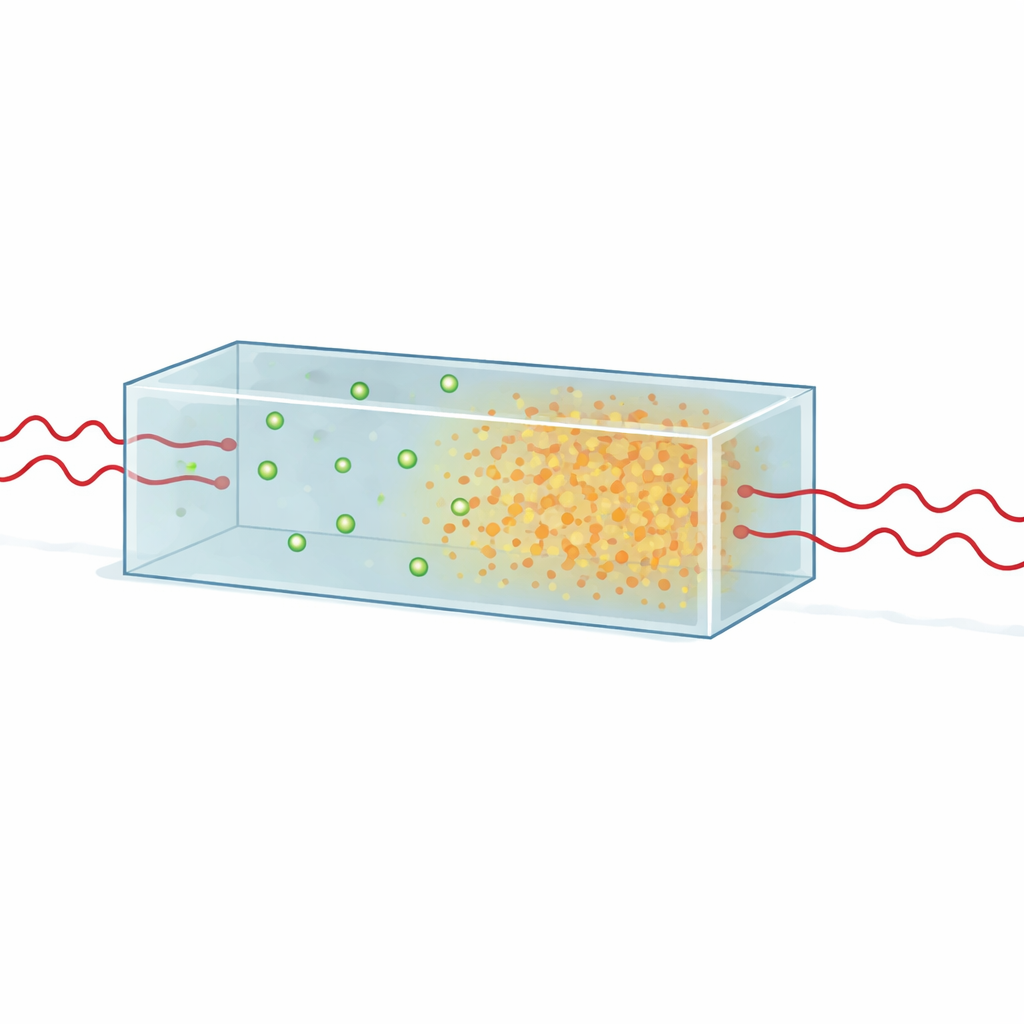
The work centers on a crystal made mostly of europium ions, into which a small number of erbium ions are deliberately inserted. Each ion acts like a tiny quantum system with energy levels that can store information. Europium is excellent at holding quantum states for a long time, but it does not naturally emit light at the wavelengths used in standard fiber-optic cables. Erbium is the opposite: it naturally emits and absorbs light around 1.5 micrometers, the same band used in long-distance telecom links, but typically has shorter coherence times. By combining these two species in a carefully controlled crystal, the team aims to use erbium as a light-friendly interface and europium as a robust quantum memory, all inside the same solid.
Seeing Local Changes Inside the Crystal
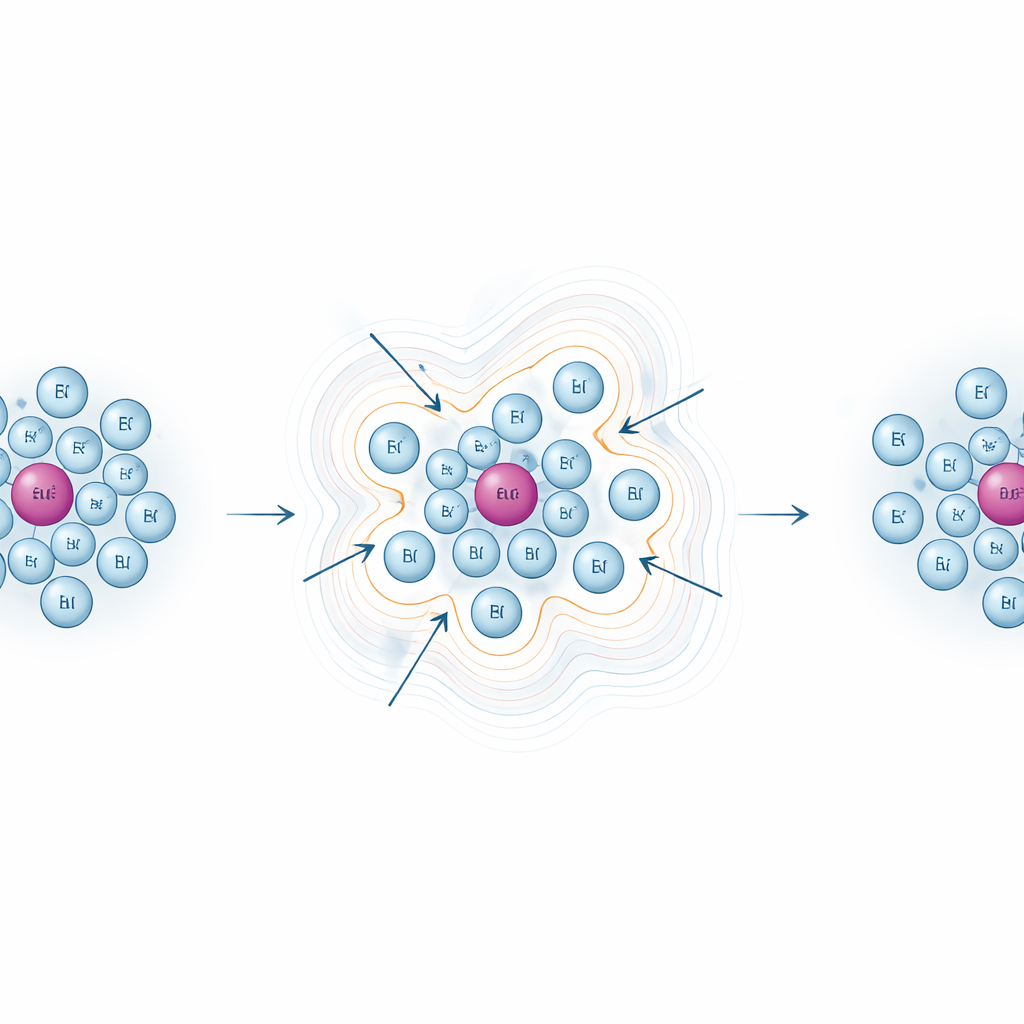
Adding erbium atoms slightly distorts the crystal around them, changing how nearby europium atoms absorb light. The researchers use very high-resolution laser spectroscopy to detect these tiny changes as “satellite lines” in the absorption spectrum—extra peaks shifted by only a few billionths of the optical frequency. Each satellite line corresponds to europium ions sitting in a specific position relative to an erbium neighbor. By measuring how these lines move and broaden with temperature and magnetic field, the team can map how strongly each europium group is influenced by its erbium partner and how that influence evolves under different conditions.
Keeping Quantum States Quiet and Stable
A central challenge is decoherence: random fluctuations in the local environment that scramble fragile quantum states. The authors probe this by using photon-echo techniques, in which pairs or triplets of short laser pulses rephase the atomic ensemble, producing an echo whose strength reveals how quickly coherence is lost. They find that, at ultralow temperatures around 60 millikelvin, europium ions close to an erbium still maintain optical coherence times comparable to a pure europium crystal, meaning the added erbium does not significantly damage performance. As the temperature increases above about 2 kelvin, motions of erbium electron spins introduce extra noise that speeds up decoherence, but in a way that can be quantitatively modeled.
Freezing Motion with Magnetic Fields
The team then turns on magnetic fields and rotates them around the crystal, taking advantage of the strong and highly directional magnetic response of erbium spins. At certain field strengths and angles, the energy splitting of erbium’s spin states becomes large enough that almost all spins settle into their lowest state and stop flipping. This “frozen core” quiets the magnetic environment around nearby europium ions. Under optimal conditions—about 0.1 tesla at a particular orientation—the europium optical coherence time stretches from roughly 60 microseconds to about 160 microseconds, very close to the limit set by the natural lifetime of the excited state. Even more striking, the lifetime of europium’s hyperfine states, which can serve as very long-term quantum memories, extends to more than an hour, implying potential coherence on the order of two hours.
Balancing Performance for Real Quantum Nodes
These results show that erbium-doped europium crystals can act as hybrid quantum nodes that are both friendly to telecom fibers and capable of storing quantum information for extraordinarily long times. The measured interactions between erbium and nearby europium ions—on the order of tens to hundreds of kilohertz—are strong enough to envision controlled quantum operations that transfer quantum states between a telecom photon interface and a dense europium memory. The authors also highlight practical trade-offs: increasing the amount of erbium improves how strongly the crystal couples to light but risks adding more noise and crystal strain that shorten coherence times. By carefully tuning dopant concentration, temperature, and magnetic field, engineers may be able to build solid-state devices that capture quantum signals arriving over ordinary optical fibers, store them deep inside a crystal for seconds or longer, and then faithfully release them on demand—key capabilities for a future global quantum network.
Citation: Guo, M., Xiao, W., Li, Z. et al. Towards telecom-compatible quantum nodes using erbium-doped stoichiometric EuCl3 ⋅ 6H2O crystals. npj Quantum Inf 12, 57 (2026). https://doi.org/10.1038/s41534-026-01203-4
Keywords: quantum memory, telecom photons, rare-earth ions, quantum repeaters, solid-state qubits