Clear Sky Science · en
QKAN: quantum Kolmogorov-Arnold networks with applications in machine learning and multivariate state preparation
Quantum Brains for Complex Patterns
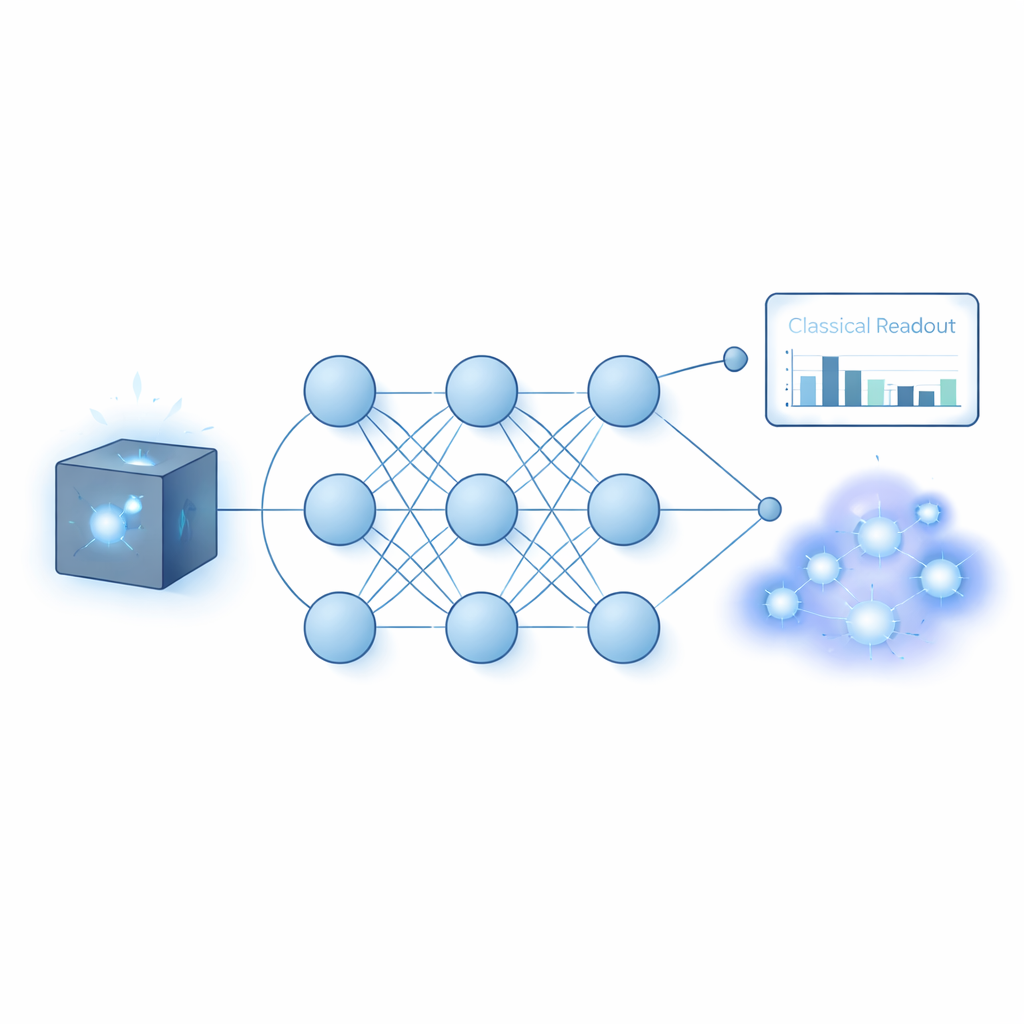
Many of today’s toughest problems – from understanding exotic materials to analyzing high‑dimensional data – involve patterns that are hard to capture with ordinary computers and neural networks. This paper introduces a new kind of “quantum brain,” called a Quantum Kolmogorov‑Arnold Network (QKAN), that is designed to run on future fault‑tolerant quantum computers. QKAN aims to process vast quantum data sets and even build complex quantum states more efficiently than classical methods, potentially opening new routes for quantum machine learning and quantum simulation.
From Classic Math Idea to Quantum Architecture
The work builds on a mathematical insight known as the Kolmogorov‑Arnold representation: in principle, any smooth function of many variables can be assembled from simple one‑variable pieces and sums. Recent “Kolmogorov‑Arnold Networks” (KANs) adapt this idea into a classical neural‑network design that wires together many simple one‑dimensional activation functions instead of relying mainly on matrix multiplications. KANs have shown promise in scientific problems where underlying formulas are structured and interpretable. The authors take this conceptual blueprint and ask: can we construct a purely quantum version that lives natively in the language of quantum circuits?
Turning Quantum Matrices into Neurons
In QKAN, the basic information carriers are not ordinary numbers but the eigenvalues of special quantum matrices. These matrices are stored inside larger unitary operations through a standard trick called block‑encoding. A powerful technique known as quantum singular value transformation lets the circuit apply tailored polynomial functions to those eigenvalues, effectively playing the role of activation functions in a neural network. By arranging these operations in a single or few “layers,” QKAN can simultaneously act on an exponentially large space of inputs – something classical networks cannot do within comparable resources when the inputs are themselves quantum.
A Wide‑But‑Shallow Quantum Network
The authors show that QKAN naturally realizes a “wide and shallow” architecture. If a quantum device can efficiently block‑encode an N‑dimensional input – for example, a quantum state prepared by another algorithm or a Hamiltonian describing a physical system – then a QKAN layer can implement extremely wide transformations using only polylogarithmic overhead in N. Stacking many such layers is costly, because the circuit depth grows roughly exponentially with the number of layers and small errors accumulate. As a result, QKAN is best used with only a few layers, trading depth for extreme parallelism in width. The paper analyzes how to parameterize these networks with quantum circuits, how to train them using gradient‑based strategies, and how to read out low‑dimensional outputs efficiently.
Quantum State Preparation as a Use Case
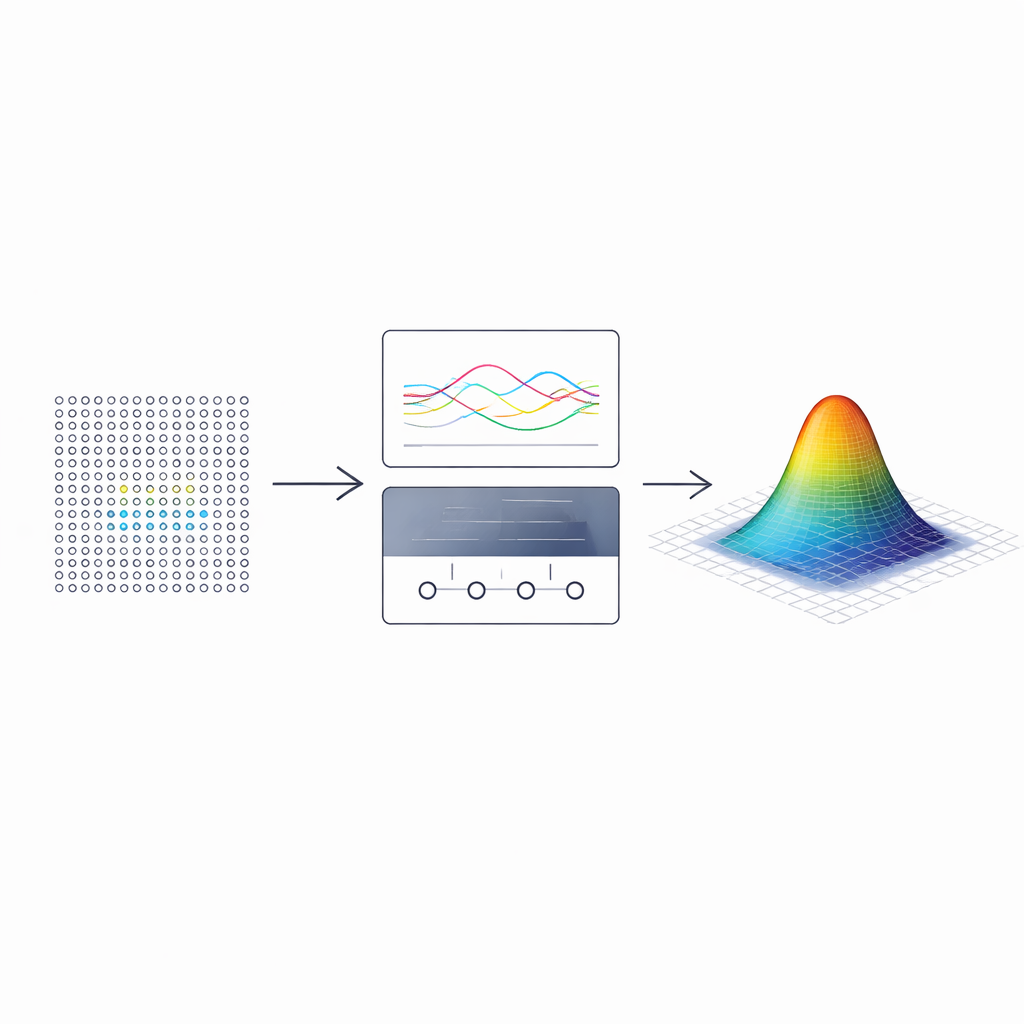
Beyond learning tasks, the same construction doubles as a tool for preparing intricate quantum states. The authors focus on a family of important examples: multivariate Gaussian distributions spread over a regular grid of points. They design a two‑layer QKAN that first computes the squared distance of each grid point from the origin using simple polynomial transformations, and then applies a carefully chosen polynomial approximation to mimic the exponential decay of a Gaussian. When this block‑encoded transformation is applied to a uniform superposition and amplified, the result is a quantum state whose amplitudes closely follow a high‑dimensional Gaussian profile. The analysis provides explicit bounds on the number of quantum gates and extra qubits required.
Opportunities and Limits for Quantum Learning
To a non‑specialist, the key takeaway is that QKAN offers a new structured language for quantum algorithms that blends ideas from interpretable neural networks with advanced quantum linear‑algebra tools. It can, in principle, compute complicated functions of quantum data and assemble multivariate probability landscapes with fewer steps than known classical methods, provided certain polynomial approximations are available and efficient block‑encodings exist. At the same time, QKAN is not a drop‑in universal solution: its depth must remain small, its performance hinges on good polynomial bases, and it inherits open questions from classical KANs about when this kind of architecture is truly superior. Still, QKAN expands the toolbox for quantum machine learning and state preparation, pointing toward quantum models that are both powerful and structurally transparent.
Citation: Ivashkov, P., Huang, PW., Koor, K. et al. QKAN: quantum Kolmogorov-Arnold networks with applications in machine learning and multivariate state preparation. npj Quantum Inf 12, 73 (2026). https://doi.org/10.1038/s41534-026-01202-5
Keywords: quantum machine learning, Kolmogorov-Arnold networks, quantum neural networks, quantum state preparation, quantum singular value transformation