Clear Sky Science · en
Superior frequency stability and long-lived state-swapping in cubic-SiC mechanical mode pairs
Listening to Tiny Vibrations
From the chips in our phones to the sensors in medical devices, modern technology increasingly relies on controlling motion on unimaginably small scales. This article explores how a wafer-thin membrane made of cubic silicon carbide can vibrate with extraordinary precision and stability, holding mechanical energy for tens of seconds and keeping its frequency steady for days. These advances point toward future quantum memories and signal processors that use sound-like vibrations instead of electrical currents or light pulses.
A Drumhead Made of Crystal
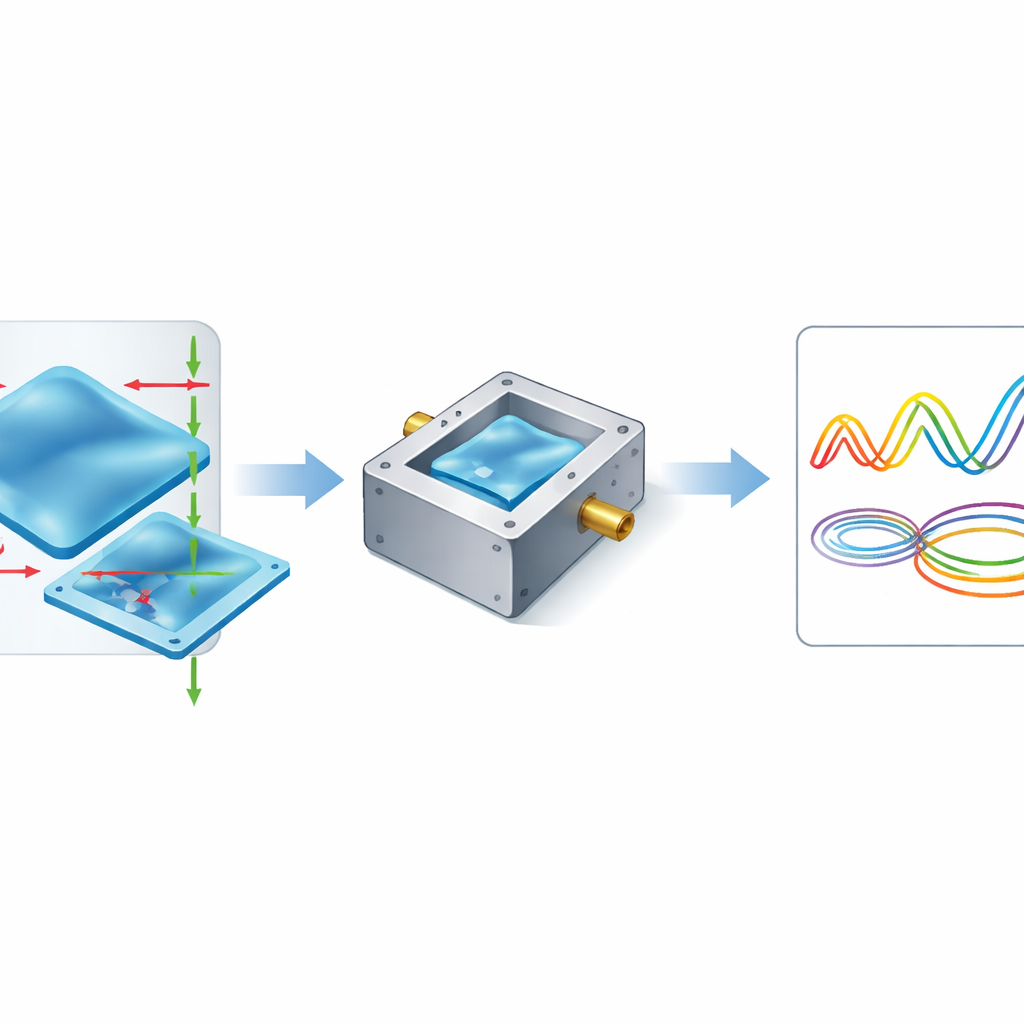
At the heart of the work is a square membrane of cubic silicon carbide, only 50 nanometers thick but half a millimeter wide, stretched across a silicon frame like a microscopic drumhead. When this membrane vibrates, it supports many distinct patterns of motion, or “modes,” each at its own frequency, much like the overtones of a musical instrument. The researchers carefully measured 57 such modes using a laser vibrometer that detects motion by tracking tiny shifts in reflected light. Unlike an ideal, perfectly uniform drum, this crystal carries slightly different internal tensions along two perpendicular directions, a built-in stress imbalance that subtly reshapes and separates these vibration patterns.
Turning Stress into a Precision Tool
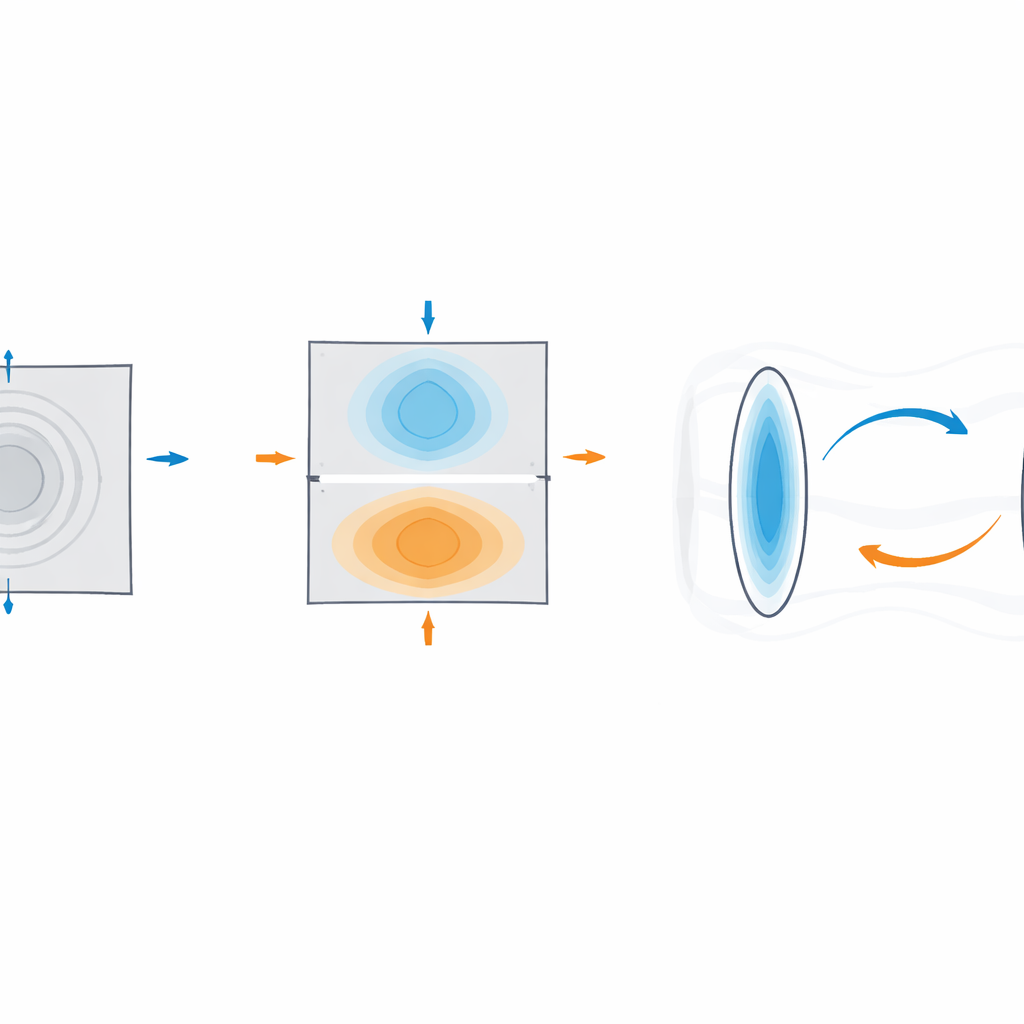
In a perfectly even membrane, some vibration patterns would naturally share the same frequency even though their shapes differ. This degeneracy can be a problem when trying to couple many modes to the same electromagnetic cavity, because often only one of the identical-frequency partners interacts strongly. Here, the team shows that a controlled imbalance of tension along two directions breaks this degeneracy in a useful way. They derive a simple formula that links each mode’s frequency to the stresses along the horizontal and vertical axes, then fit it to their measurements of all 57 modes. This global fit reveals that the tension differs by only a few megapascals between directions, and they can resolve this difference to within about 0.35 megapascals—far more precisely than common stress-measurement tools such as X-ray or Raman methods. At the same time, the stress pattern reshapes pairs of modes so that both partners now have strong motion at the center of the membrane, making them equally accessible to a single cavity.
Building an Ultra-Stable Vibrational Circuit
To harness these modes as information carriers, the membrane is integrated into a three-dimensional aluminum microwave cavity, forming a compact electromechanical circuit cooled to just 10 millikelvin. A thin metal coating turns the membrane into part of a capacitor whose spacing changes as the membrane moves, allowing microwaves in the cavity to sense and drive its motion. Using carefully timed microwave pulses, the authors observe how the vibration of two near-degenerate modes decays in time and how their thermally excited motion appears in the noise spectrum. They find astonishingly high quality factors, up to about one hundred million, meaning the vibrations persist for tens of seconds before losing their energy. Such long lifetimes are rare for micro- and nanoscale mechanical devices and are aided by both the high built-in stress, which dilutes losses, and the excellent thermal properties of silicon carbide at very low temperatures.
A Mechanical Clock That Barely Drifts
Beyond long lifetimes, a key requirement for using vibrations as information carriers is that their frequencies must be extremely stable over time. The team tracks the resonance frequencies of the two selected modes for nearly nine days and analyzes the fluctuations using a standard metric known as Allan deviation. The results show that the fractional frequency noise keeps decreasing with longer averaging time, following a pattern expected when random “white” frequency noise dominates. At an averaging time of about eight hours, the relative frequency uncertainty falls to six parts in ten billion—better than previously reported for similar membrane-based or beam-like mechanical resonators. This exceptional stability makes the device behave more like a precision clock than a fragile microstructure.
Swapping Vibrations Like Quantum Notes
With such stable and long-lived modes, the researchers demonstrate a controlled exchange of vibrational energy between the two nearly identical-frequency patterns. They use a technique inspired by a method in atomic and molecular physics called stimulated Raman adiabatic passage, implemented here with microwave tones. First, they cool both modes close to their lowest-energy states, then selectively excite one of them and apply a pair of carefully tuned tones that mediate an effective interaction between the modes through the cavity field. As the interaction time is varied, the vibrational energy sloshes back and forth between the two modes, with a full exchange taking just over two seconds. The first transfer reaches an efficiency greater than 78 percent, a performance made possible by the exceptionally low loss and dephasing of the modes.
Why This Matters for Future Quantum Devices
Together, these results show that a single, stress-engineered silicon carbide membrane can act as a versatile platform for multimode mechanical control, with precisely characterizable internal stress, record-high frequency stability, and long-lived pairs of coupled vibration modes. For a lay reader, the key takeaway is that the authors have built an extraordinarily quiet, stable, and controllable “mechanical orchestra” on a chip, where individual notes can be stored, moved, and swapped with high fidelity. Such devices could underpin future quantum technologies in which information is stored not only in electrons or photons but also in quantized vibrations—phonons—enabling compact quantum memories, interfaces between different types of quantum hardware, and new ways to simulate complex many-body systems using sound-like motion.
Citation: Sun, H., Chen, Y., Liu, Q. et al. Superior frequency stability and long-lived state-swapping in cubic-SiC mechanical mode pairs. npj Quantum Inf 12, 60 (2026). https://doi.org/10.1038/s41534-026-01200-7
Keywords: silicon carbide membrane, mechanical resonator, frequency stability, cavity electromechanics, quantum phononics