Clear Sky Science · en
Unfolded distillation: very low-cost magic state preparation for biased-noise qubits
Why this matters for future quantum computers
Today’s prototype quantum computers are remarkably fragile: even tiny errors quickly overwhelm their calculations. To run useful algorithms, engineers must surround every quantum bit with layers of error protection, which dramatically multiplies the hardware needed. A particularly costly ingredient is the production of special "magic" states required for the hardest quantum gates. This paper introduces a new way to prepare those states that cuts the cost by more than an order of magnitude, potentially bringing practical quantum computing closer.

The challenge of making special quantum states
Many error-correcting schemes can perform a limited family of "easy" operations very reliably, but they cannot by themselves realize all the gates needed for general-purpose quantum computing. To fill this gap, they rely on magic states: carefully crafted quantum states that, when consumed in a short circuit, effectively implement a difficult gate. The standard approach, called magic state distillation, uses many noisy copies of a magic state and processes them through a large three-dimensional coding structure so that only a few very clean states remain. While powerful, these factories consume thousands to millions of qubit–time steps, making them a dominant overhead in large-scale designs.
Taking advantage of lopsided noise
Not all quantum hardware suffers from errors in the same way. In several promising platforms, including so-called cat qubits built from microwave cavities, one kind of error—phase flips—is far more common than flips that swap the logical “0” and “1.” When this bias is large, engineers can encode information so that the rare bit-flip errors are strongly suppressed while still keeping the code lightweight. Earlier proposals tried to harness this bias using complicated three-qubit gates or heavy postselection, which work well only when the basic error rate is extremely low. The new work asks a sharper question: if the hardware already strongly favors one type of error, can we redesign magic state preparation from the ground up to exploit that structure?
Unfolding a 3D code into a flat sheet
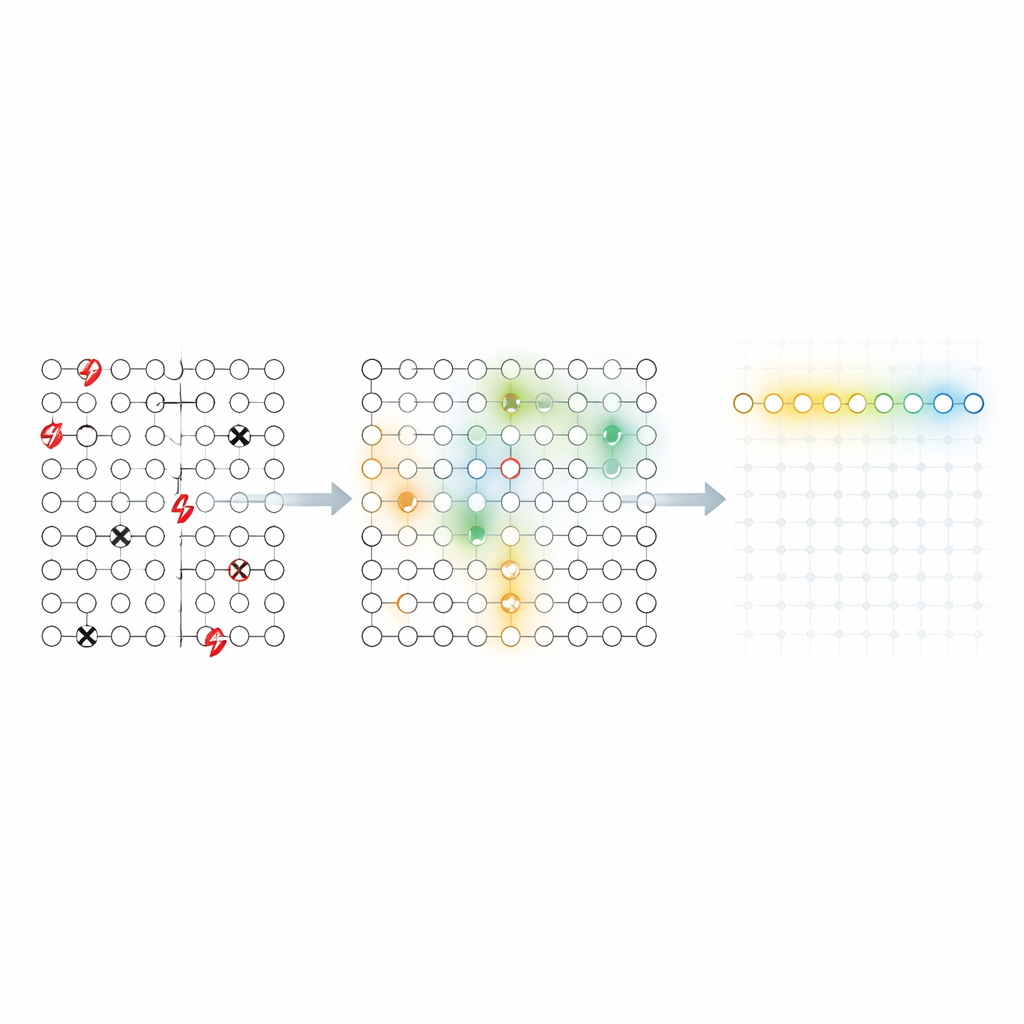
The authors’ key idea is to "unfold" a known three-dimensional quantum code, the Hadamard version of the Reed–Muller code, into a strictly two-dimensional layout. Instead of running distillation on large logical blocks, they operate directly on physical qubits arranged in a planar grid, augmented by a few extra "bus" qubits that ensure only nearest-neighbor interactions are needed. By focusing on the dominant phase-flip noise, they only have to measure one family of checks from the original 3D code. This allows them to prepare the code space, apply a special quarter-turn rotation to selected qubits, and then read out the result in just a handful of error-correction rounds. The outcome is a high-quality magic state encoded in a short repetition code, while the unfolded grid can be measured and discarded.
Keeping errors under control with modest resources
Because the unfolded scheme detects phase errors in clusters of three, the residual error in the final magic state scales roughly as the cube of the underlying gate error—a hallmark of genuine distillation. Under realistic assumptions of a 0.1% phase-flip rate and a very strong noise bias, the protocol produces a magic state with an error around three parts in ten million using only 53 qubits and about five to six rounds of syndrome measurements. Even when the bias is reduced to values plausible for current hybrid cat–transmon devices, the method still reaches similar accuracy with on the order of 175 qubits and fewer than ten rounds. The authors also show how to adapt the layout when bit-flip errors are more common, by merging the unfolded grid with a narrow surface code and using special "flag" qubits and smart postselection to catch problematic error patterns without excessive retries.
Building a full toolbox of quantum gates
Once one kind of magic state can be made cheaply, others become accessible. The paper extends the unfolding idea to different codes that have built-in versions of key gates. By swapping in suitable two-dimensional color codes, the same basic protocol can generate resource states for phase gates, controlled-phase gates, and even a three-qubit Toffoli-like operation, all while keeping the hardware strictly planar and restricted to two-qubit interactions plus single-qubit rotations. The authors sketch how these ingredients combine into a universal gate set tailored for biased-noise hardware, and how a hybrid architecture—using high-bias cat qubits as data and more conventional qubits as ancillas—could implement the crucial quarter-turn rotation with currently achievable fidelities.
What this means for the road ahead
In practical terms, the unfolded distillation scheme greatly shrinks the “magic state tax” that has long loomed over fault-tolerant quantum computing. By exploiting the natural imbalance of errors in certain devices and cleverly flattening a 3D code into a 2D layout, it prepares very clean non-Clifford resource states with far fewer qubits and time steps than standard factories. While further improvements are needed to reach the ultra-low error rates required for massive algorithms, this work shows that specialized hardware and tailored error correction can significantly ease one of the main bottlenecks on the path to scalable quantum computers.
Citation: Ruiz, D., Guillaud, J., Vuillot, C. et al. Unfolded distillation: very low-cost magic state preparation for biased-noise qubits. npj Quantum Inf 12, 53 (2026). https://doi.org/10.1038/s41534-026-01197-z
Keywords: magic state distillation, biased-noise qubits, quantum error correction, cat qubits, fault-tolerant quantum computing