Clear Sky Science · en
Improved quantum computation using operator backpropagation
Why shrinking quantum programs matters
Today’s quantum computers are powerful but fragile: their quantum bits lose their delicate state if we run programs that are too long. This paper tackles that bottleneck. The authors show how to offload part of a quantum computation to an ordinary computer in a clever way, so the quantum hardware only has to run a shorter, less noisy program while still delivering the same final answer for the quantity of interest. This hybrid strategy, called operator backpropagation, points toward getting more real scientific value out of imperfect quantum machines.
Sharing the work between two kinds of machines
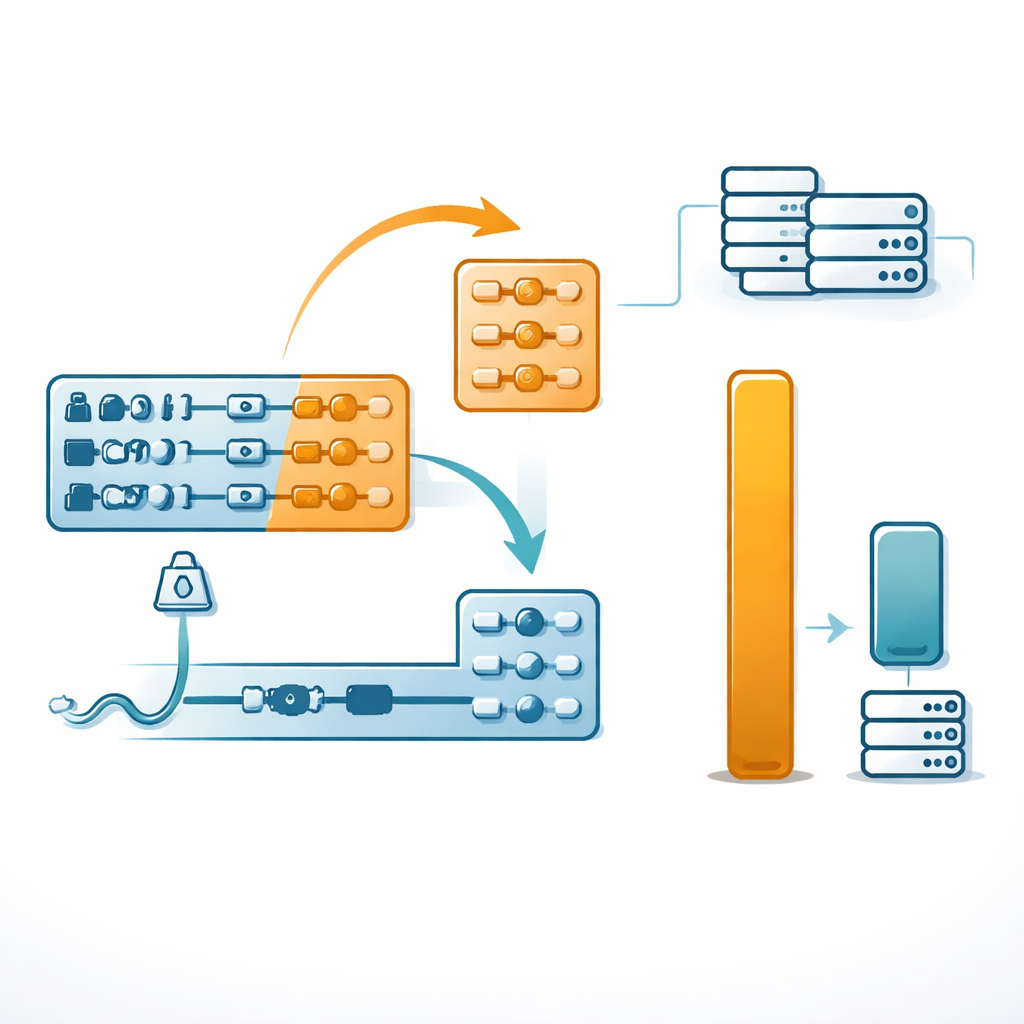
Many quantum algorithms boil down to the same task: prepare a quantum state with a circuit and then measure how strongly it responds to some probe, known as an observable. Normally, the whole circuit and the final measurement are carried out on the quantum device, so the hardware must stay coherent throughout every step. The new framework instead splits the original circuit into two parts. One part is still run on the quantum chip, but the other part is handled on a classical computer by mathematically “pushing” the observable backward through those gates. This turns one complicated final measurement into a collection of simpler measurements that can be made after a much shorter quantum program.
Turning one question into many simpler ones
The key idea is to view the problem from the perspective of the observable rather than the quantum state. On the classical computer, the observable is evolved backwards through the selected portion of the circuit, a process the authors call operator backpropagation. In doing so, it breaks up into a weighted sum of many basic building blocks known as Pauli operators. Each of these building blocks is easy to measure on the quantum device. The experimenter prepares the shortened circuit on the hardware, measures all the needed Pauli operators, and then combines the results using the precomputed weights. The trade-off is clear: the quantum circuits become shallower and thus less sensitive to noise, but more separate circuits and measurements are required.
Making the classical side fast enough
Naively pushing an observable backward through many quantum gates would explode in cost, because the number of Pauli building blocks can grow very quickly. To keep the classical workload under control, the authors build on a technique called Clifford perturbation theory. This method takes advantage of the structure of the gates to track how the observable changes and to safely discard terms whose contribution will be tiny. They develop practical rules to estimate and bound the error introduced by throwing away such small terms, and they explain how to organize the calculation so that it can be spread efficiently across many classical computing nodes, a setting they call quantum‑centric supercomputing.
Putting the method to the test on model magnets
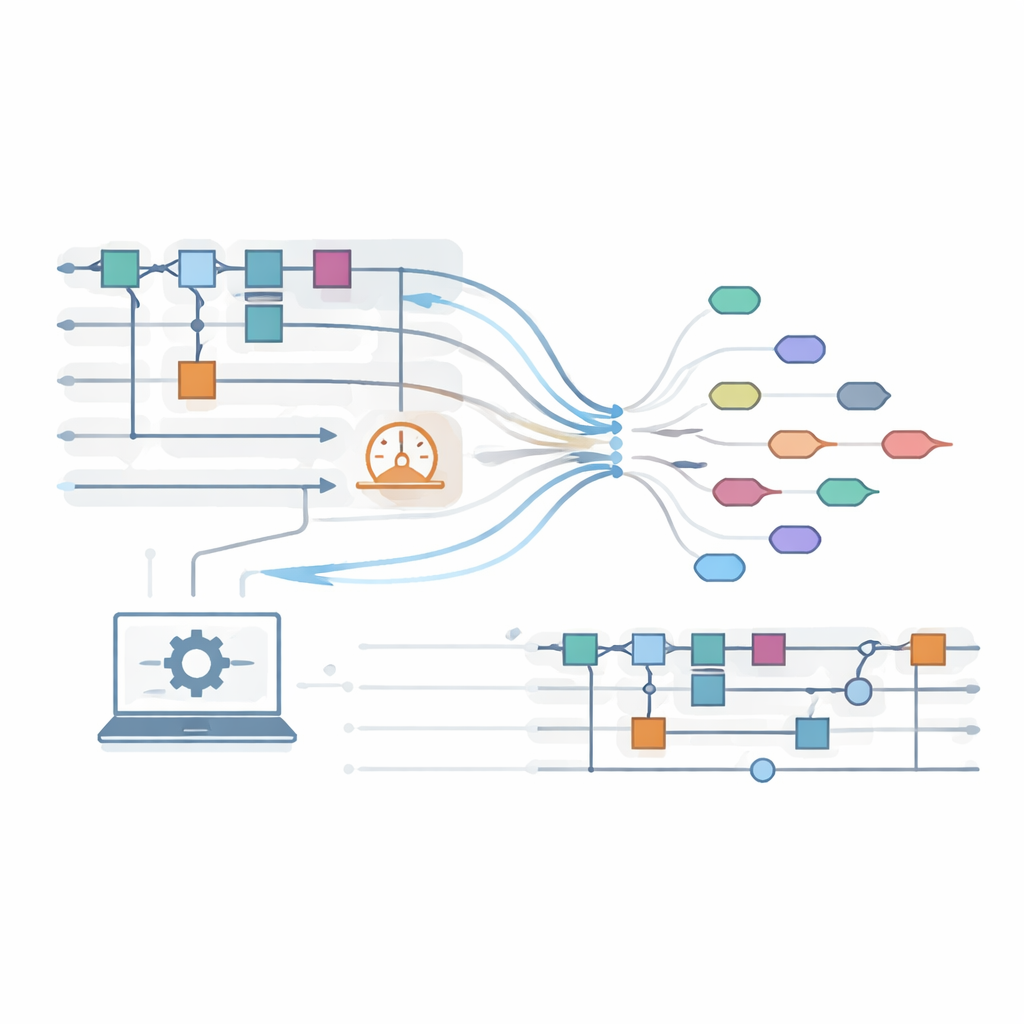
To see whether this strategy pays off in real hardware, the team applied it to a standard test problem in quantum physics: simulating a grid of quantum spins interacting like a magnet, known as the XY model. They considered systems of 75 and 127 spins mapped directly onto IBM superconducting quantum processors. The time evolution of these spins was approximated by a sequence of repeated blocks of gates, and the main quantity of interest was the average spin orientation, which should remain constant in an ideal, noiseless evolution. Using operator backpropagation, they shortened the quantum circuits by the equivalent of five of these blocks while using the classical side to account for the removed portion.
Sharper results and finer time snapshots
Across both the one‑dimensional and two‑dimensional spin models, the hybrid approach consistently produced more accurate estimates of the average spin orientation than running the full‑depth quantum circuits, even when both methods were given the same total number of experimental shots. The shortened circuits suffered less from hardware noise and required fewer total quantum operations per shot. A second benefit emerged as well: by reusing the same measurement data, the framework allowed the researchers to reconstruct how individual spins changed at many intermediate times, even though the hardware was only run at a few coarse time points. This ability to “fill in” the dynamics between measurements offers a richer picture of the simulated system without additional quantum runs.
What this means for the future of quantum computing
The work demonstrates that we can stretch the reach of today’s noisy quantum processors by pairing them tightly with smart classical algorithms. Instead of relying on ever more elaborate error‑correction codes, operator backpropagation reduces the time the quantum device must remain reliable and shifts part of the burden to classical computation, whose cost can be scaled with conventional supercomputers. While the method works best for circuits with certain structures and cannot offload everything, it already improves the accuracy of sizable physics simulations. As researchers refine these hybrid tricks and identify more suitable problems, we can expect quantum hardware to deliver useful scientific insights sooner than full fault‑tolerant machines become available.
Citation: Fuller, B., Tran, M.C., Lykov, D. et al. Improved quantum computation using operator backpropagation. npj Quantum Inf 12, 51 (2026). https://doi.org/10.1038/s41534-026-01196-0
Keywords: hybrid quantum computing, error mitigation, quantum simulation, operator backpropagation, noisy intermediate-scale quantum