Clear Sky Science · en
The Lie algebra of XY-mixer topologies and warm starting QAOA for constrained optimization
Smarter Starting Points for Quantum Problem Solving
Many real-world decisions, from choosing a stock portfolio to grouping objects in a network, boil down to searching through an enormous number of possibilities to find the best one. Quantum computers promise to speed up this search, but today’s devices struggle to train the quantum programs used for such tasks. This paper explores how a particular family of quantum circuits, built from so‑called XY interactions, can be organized and initialized so that they are both powerful and trainable, leading to better solutions of hard optimization problems with practical constraints.
Why the Shape of a Quantum Circuit Matters
Variational quantum algorithms work a bit like tuning the knobs on a musical instrument: you repeatedly adjust parameters in a quantum circuit to minimize a cost function that encodes your problem. The authors focus on the Quantum Approximate Optimization Algorithm (QAOA), which is widely studied for solving hard combinatorial tasks. A key ingredient in QAOA is the “mixer” part of the circuit, which moves quantum states around the space of possible answers. XY‑mixers are especially attractive when only certain answers are allowed, such as solutions that select exactly k items out of n. They automatically preserve this kind of “cardinality” constraint by only swapping excitations between qubits rather than creating or destroying them.
When Expressive Circuits Become Untrainable
There is a catch: very flexible quantum circuits tend to be hard to train. As circuits become more expressive, the landscape of the cost function over the parameters can become extremely flat, a problem known as a barren plateau. In this regime, gradients are exponentially small, and learning stalls. The paper studies this issue through the lens of the “dynamical Lie algebra” associated with a circuit, which captures all transformations reachable by combining its gates. If this algebra grows only polynomially with the number of qubits, gradients are typically healthy and training is efficient; if it grows exponentially, barren plateaus are expected. By systematically analyzing different ways of connecting XY gates—such as arranging them in a line, a ring, or connecting all qubits to each other—the authors show that simple one‑dimensional layouts lead to modest, polynomial‑sized algebras, while fully connected layouts or the addition of many two‑qubit Z‑type interactions quickly blow up the algebra to exponential size.
Using Simple Circuits to Warm Up Complex Ones
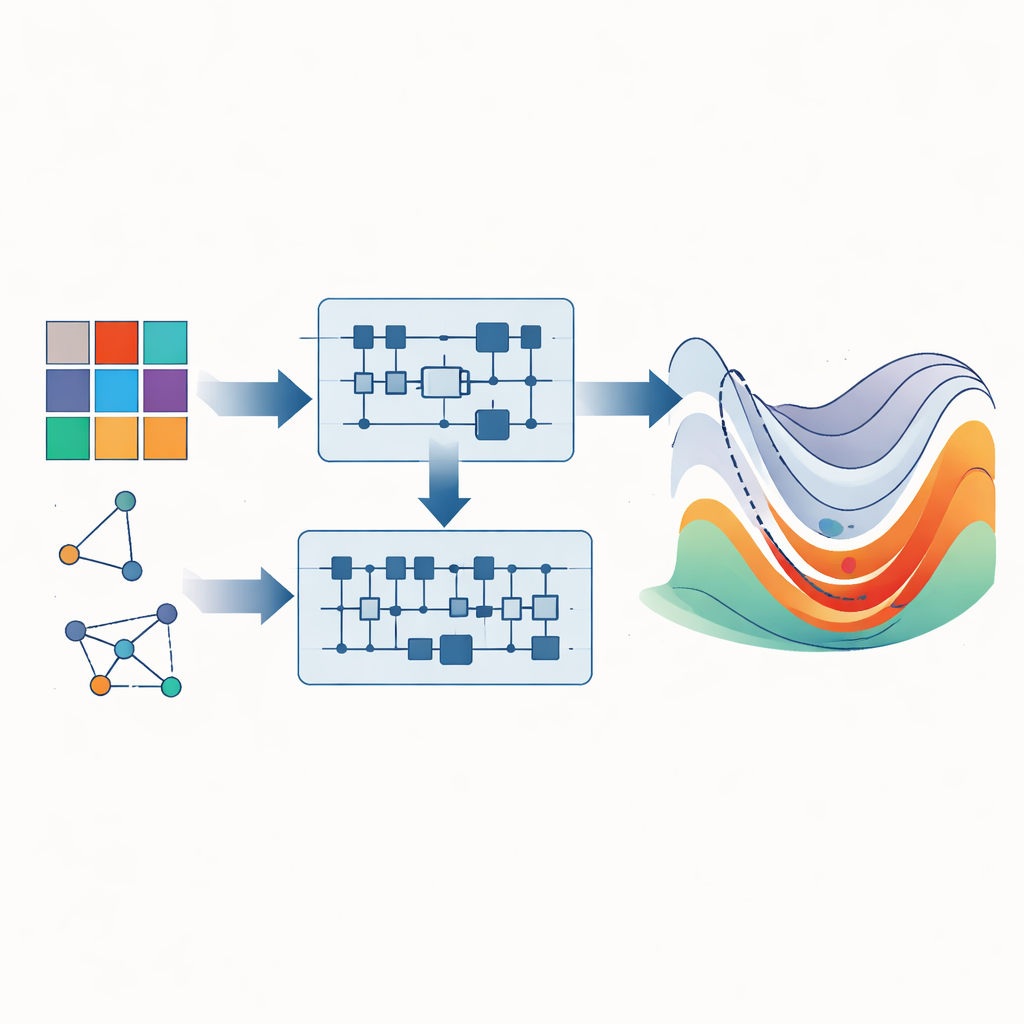
Rather than giving up on expressive circuits, the authors propose a “warm starting” strategy. They begin with a restricted QAOA circuit that uses XY gates arranged in a cycle, together with single‑qubit rotations around the Z axis. This restricted setup has a polynomially sized algebra, so it can be trained efficiently and even simulated classically for certain calculations. During this phase, the more problematic ingredients—especially a large number of ZZ interaction gates that make the circuit highly expressive—are kept effectively turned off. Once good parameters are found for the simple circuit, these values are transferred to the full, more powerful circuit, and only then are the additional gates activated and fine‑tuned.
Putting Warm Starts to the Test
The authors test this idea on three important families of constrained optimization problems. In portfolio optimization, the task is to pick a fixed number of assets to balance expected return and risk, using real market data from the S&P 500 index. In graph partitioning, one must split a network’s nodes into two equal halves while cutting as few links as possible. In the sparsest k-subgraph problem, the goal is to choose a fixed-size subset of nodes that has as few internal links as possible. For each task, they encode the cost function into a quantum Hamiltonian and use QAOA with XY‑mixers that preserve the required constraints. Across many instances and circuit depths, the warm‑started approach consistently reaches higher “approximation ratios” (energies closer to the best possible) and higher success probabilities (more weight on true optimal solutions) than circuits started from random parameters, with the advantage growing as problem size increases.
Better Quantum Answers from Better Beginnings
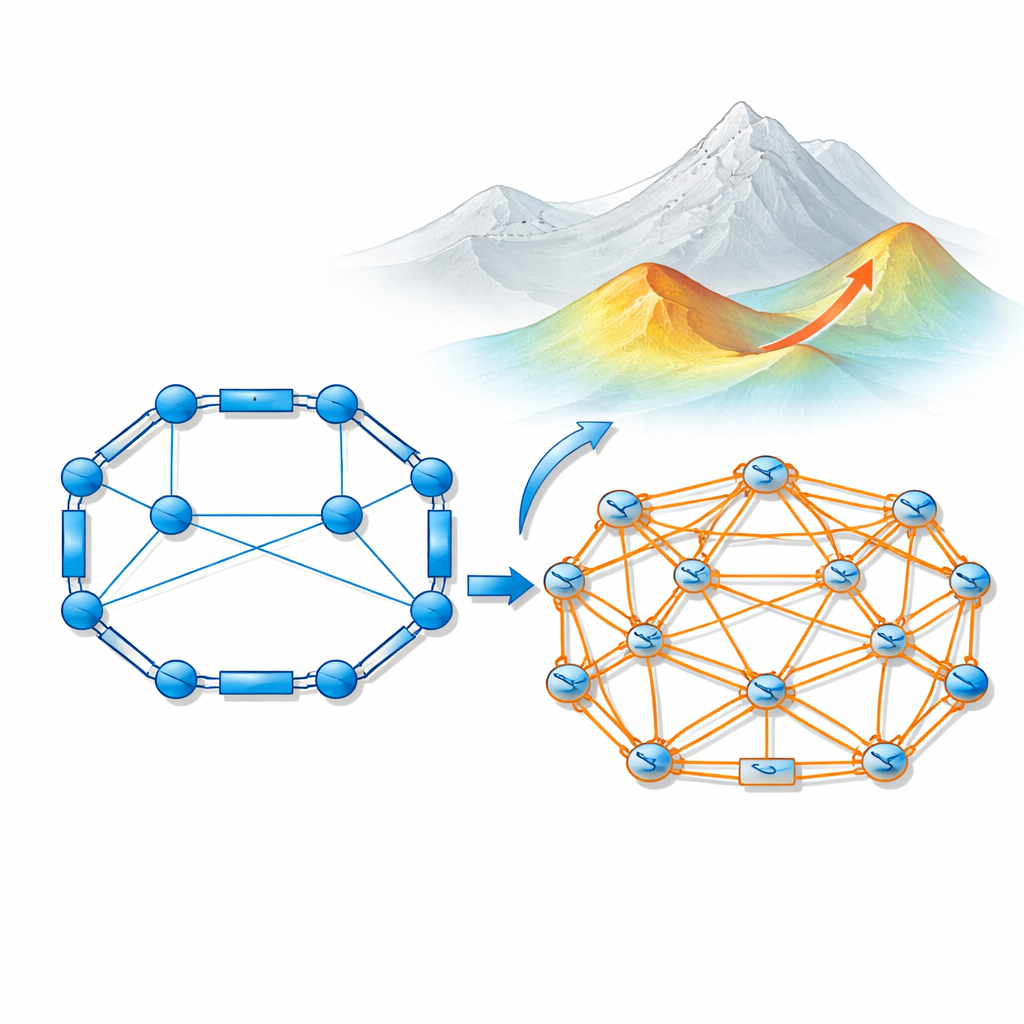
To a non‑specialist, the main message is that how you wire and initialize a quantum circuit can be just as important as how powerful it is on paper. By carefully choosing XY‑mixer layouts whose mathematical structure is relatively simple, and by first training in this gentler regime before moving to more complex circuits, the authors avoid some of the worst training pathologies that plague modern quantum algorithms. Their results show that warm‑starting QAOA in this manner can substantially improve the quality of solutions for realistic, constraint‑heavy problems, and they point toward a broader design principle: use mathematically tame subcircuits as stepping stones to tame otherwise unwieldy quantum computations.
Citation: Kordonowy, S., Leipold, H. The Lie algebra of XY-mixer topologies and warm starting QAOA for constrained optimization. npj Quantum Inf 12, 61 (2026). https://doi.org/10.1038/s41534-026-01192-4
Keywords: variational quantum algorithms, QAOA, XY mixer, constrained optimization, warm start