Clear Sky Science · en
Learning parameterized quantum circuits with quantum gradient
Why Quantum Circuits Need Better “Learning” Tricks
As quantum computers grow more powerful, scientists hope to use them to solve hard problems in chemistry, optimization, and machine learning. A key tool for this vision is the parameterized quantum circuit: a programmable quantum recipe whose knobs are tuned to achieve a desired task. But in practice, training these circuits often fails because the landscape of possible settings is full of flat plateaus and misleading traps, where conventional algorithms get stuck. This paper introduces a new way to learn such circuits by letting the quantum computer itself point the way downhill, helping to escape these dead zones and making quantum learning more reliable.
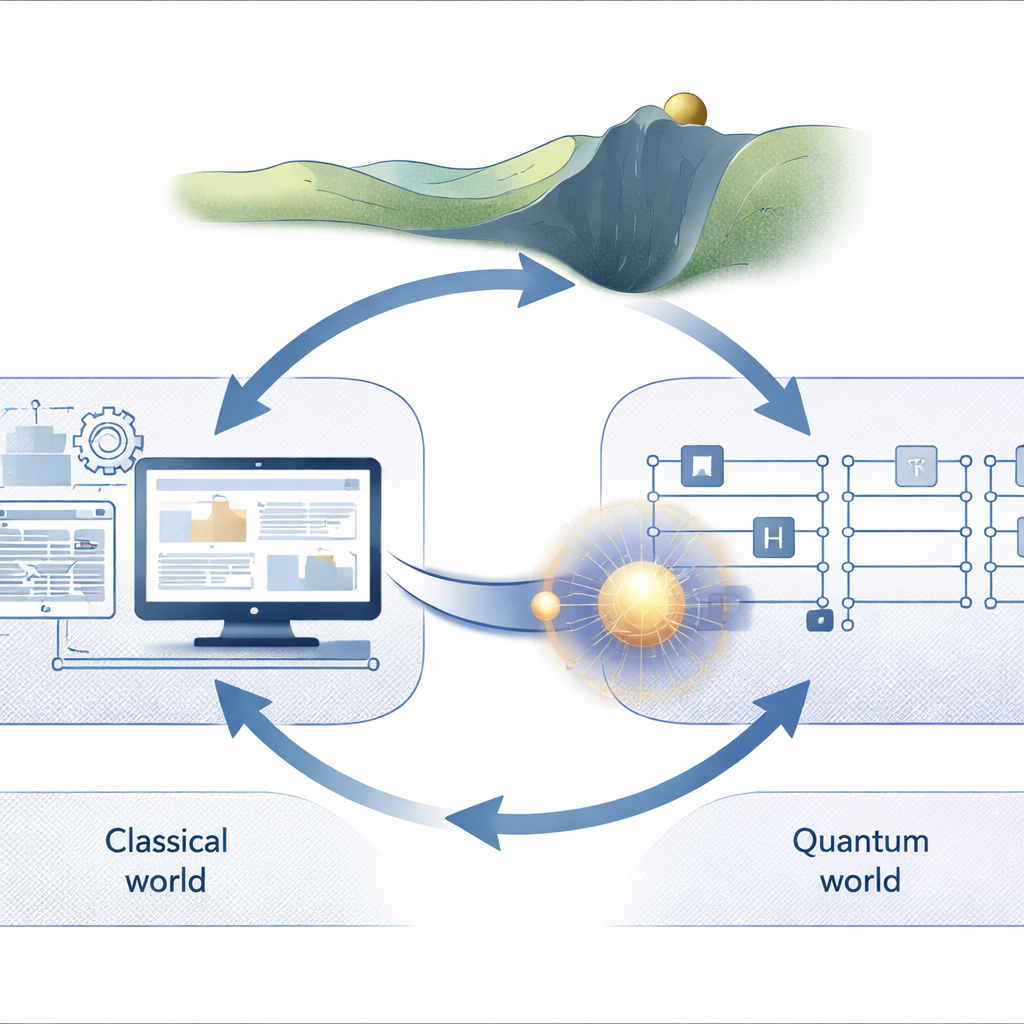
Where Quantum Learning Gets Stuck
Most current quantum learning methods rely on a classical computer to adjust the circuit’s parameters using gradients—tiny pushes in the direction that lowers a chosen cost, such as energy or error. However, in large quantum systems, these gradients tend to become extremely small almost everywhere. Two related problems appear. First, there are unfavorable local stationary points: spots where the gradient vanishes even though the solution is still far from optimal, including bad minima and saddle points. Second, there are barren plateaus: huge, nearly flat regions where the gradient is essentially zero across many directions. In both situations, the classical optimizer sees no useful signal and training grinds to a halt, especially when the number of tunable parameters is much smaller than the size of the quantum state space.
Letting the Quantum Device Provide the Direction
The authors propose a nested optimization model that blends quantum and classical steps in a loop. Instead of computing gradients only with respect to circuit parameters, the method uses a quantum-gradient algorithm to find the true steepest-descent direction directly in the space of quantum states. In each outer iteration, the quantum device generates a new “gradient state” that tells how the current state should change to reduce a general polynomial cost function. This state is not tied to any fixed circuit structure. A classical routine then tries to learn a new circuit layer that reproduces this gradient state as closely as possible, effectively steering the circuit in the direction the quantum device recommends.
An Adaptive Circuit That Knows When It’s Stuck
A central ingredient of the method is an indicator that checks whether the training is genuinely at a good minimum or merely stuck with vanishing parameter gradients. At the start of each iteration, the algorithm measures how close the current circuit output is to the quantum-derived gradient state. If they already match well, the indicator is nearly zero, signaling that both the state-space and parameter-space gradients have effectively vanished and a true optimum is likely reached. If not, the method automatically appends a new, shallow layer to the circuit and trains it to better approximate the gradient state. This warm-started, layer-by-layer growth keeps each new layer exploring only a small, relevant region instead of wandering randomly, which helps avoid barren plateaus caused by overly deep, randomly initialized circuits.
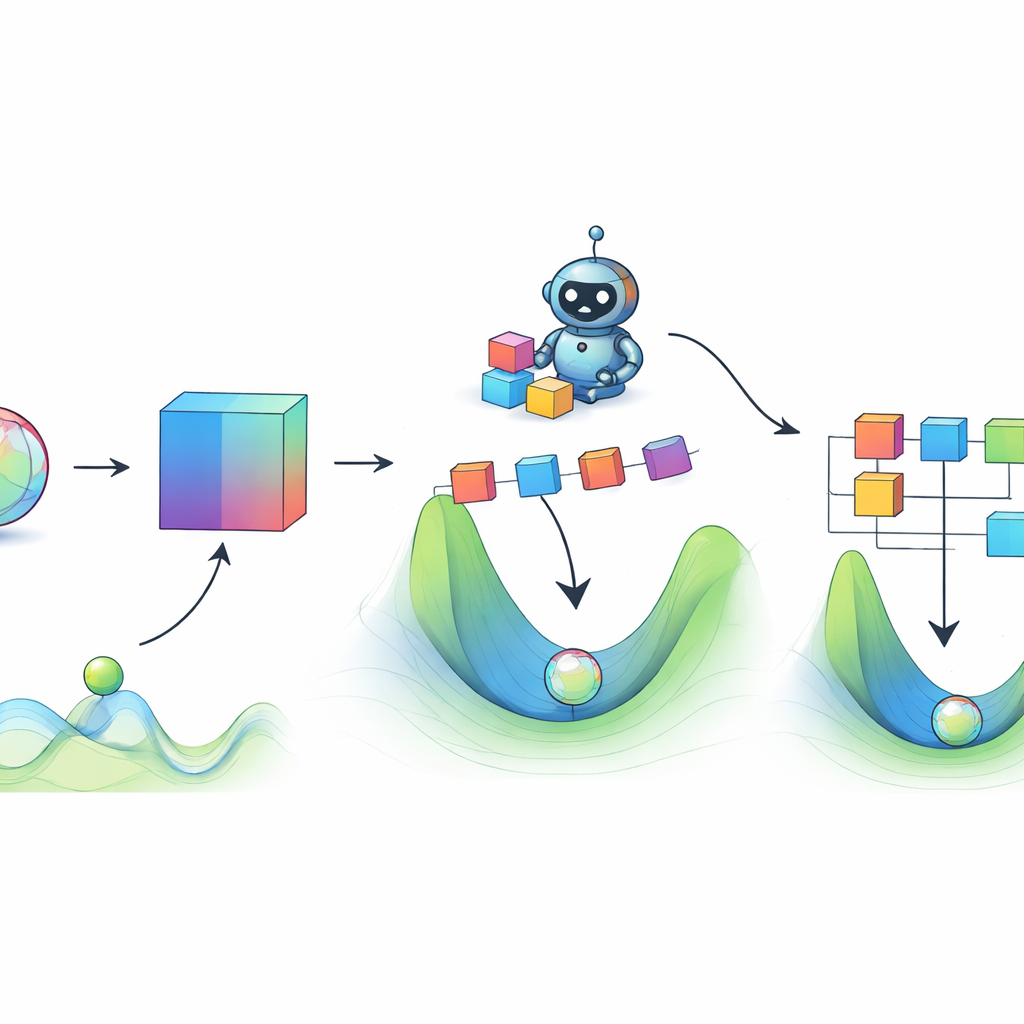
Testing on Hard Optimization Tasks
To see the method in action, the authors simulate it on two families of problems. One is the Max-Cut problem on small graphs, a standard testbed for quantum optimization. The other is the minimization of higher-order polynomial functions with multiple local minima. In both ideal simulations and more realistic ones where the gradient state is only approximately reproduced using a reinforcement-learning-based circuit synthesis tool, the nested method consistently converges to high-quality solutions. The indicator steadily decreases over iterations, showing that the algorithm moves closer to true minima rather than lingering in shallow traps or plateaus.
Beating Existing Strategies at Their Own Game
The new approach is also compared with popular adaptive methods that grow circuits gate by gate, especially ADAPT-VQE, and with standard fixed-depth training. On a molecular energy problem and on several benchmark observables, the nested scheme achieves lower final costs in settings where the other methods stall. It appears much less sensitive to both barren plateaus and unfavorable local points, though it does require extra work: each iteration involves a quantum-gradient step plus a small circuit-synthesis problem. The authors suggest using their method as a targeted tool—for example, to escape problematic regions early in training and then hand control back to cheaper classical optimization once the circuit is in a more favorable landscape.
What This Means for the Future of Quantum Learning
In everyday terms, this work gives quantum computers a more active role in learning how to program themselves. Instead of relying solely on classical guesses about how to tweak circuit knobs, the quantum device helps chart the downhill path in its own high-dimensional state space. This strategy makes it easier to avoid flat, confusing regions that have plagued earlier approaches, at least for a broad class of polynomial-style cost functions. While the method is not free—it adds computational overhead—it offers a practical way to make parameterized quantum circuits more trainable, an important step toward useful quantum optimization and quantum machine-learning applications on both today’s noisy machines and tomorrow’s fault-tolerant devices.
Citation: Li, K., Wang, Y., Gao, P. et al. Learning parameterized quantum circuits with quantum gradient. npj Quantum Inf 12, 59 (2026). https://doi.org/10.1038/s41534-025-01179-7
Keywords: parameterized quantum circuits, quantum optimization, barren plateaus, quantum gradients, variational quantum algorithms