Clear Sky Science · en
Entanglement buffering with multiple quantum memories
Why saving fragile quantum links matters
Future quantum networks will rely on a strange quantum connection called entanglement to do things like ultra-secure communication and ultra-precise sensing. But there’s a catch: entanglement is fragile and fades quickly, especially when stored in real hardware. This paper asks a practical question with big implications: if we can keep creating fresh entanglement and cleaning it up as we go, how well can we "buffer" it so that high‑quality links are ready exactly when apps need them?
A two-node quantum waiting room
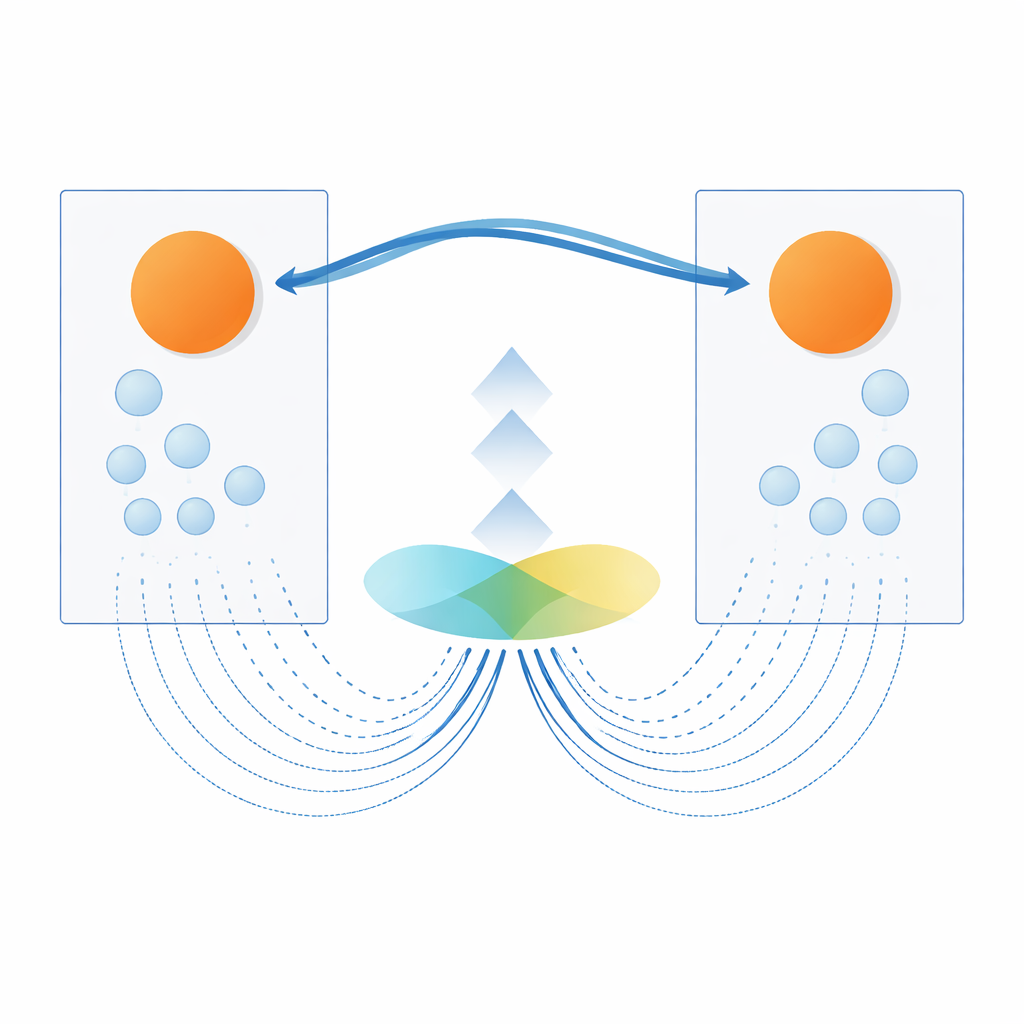
The authors study a simple but powerful building block for quantum networks: an entanglement buffer shared between two distant nodes. Each node has one "good" quantum memory that can hold an entangled link for relatively long times, and several "bad" memories that quickly lose coherence but are excellent at repeatedly generating new links. In each time step, all bad memories try in parallel to create entanglement between the two nodes. If at least one attempt works and the good memory is empty, one of these links is moved into long‑term storage. If the good memory already holds a link, the fresh ones can be used to improve it via a process called purification, or simply be discarded.
How to measure a good quantum buffer
To judge how well this buffer works, the authors focus on two user‑centric quantities. The first is availability: when an application asks for entanglement, what is the chance a stored link is actually there? The second is average consumed fidelity: when a link is used, on average how close is it to the ideal, perfectly entangled state? These two measures pull in opposite directions. Frequent purification can boost link quality but also risks losing the stored link whenever a purification attempt fails. To tackle this trade‑off, the authors derive exact analytical formulas for both availability and average fidelity that work for any purification protocol obeying basic physical constraints, and for any number of fast memories.
What happens when we purify more often
Armed with closed‑form expressions, the authors explore how the buffer behaves as they vary system parameters like the noise in the good memory, the rate of consumption requests, the success chance of generating entanglement, and the strategy for purification. A central and counterintuitive result is monotonic performance: as long as the chosen purification routines can genuinely improve a freshly generated link, purifying as often as possible always increases the average quality of the links that are eventually consumed. At the same time, this aggressive strategy always reduces availability, because each additional purification attempt opens another chance for total failure, which wipes out the stored link.
Simple strategies can beat sophisticated ones
One might guess that the best purification routines are always the most mathematically "optimal" ones that squeeze out the highest possible fidelity from a given batch of noisy links. The authors show that this is not necessarily true once the full buffer dynamics are considered. They compare simple, well‑known schemes—such as replacing the stored link with a fresh one, or using the widely used DEJMPS two‑link purification protocol—against more complex, multi‑link routines that are optimal in a narrow sense. In many realistic settings, the simple methods deliver a better balance of availability and fidelity, because complex protocols tend to succeed less often. The work also examines variants where intermediate failure flags are used to avoid discarding high‑quality links; these flags reliably improve availability but can either help or hurt average fidelity depending on how noisy the memories are.
Design rules for future quantum networks
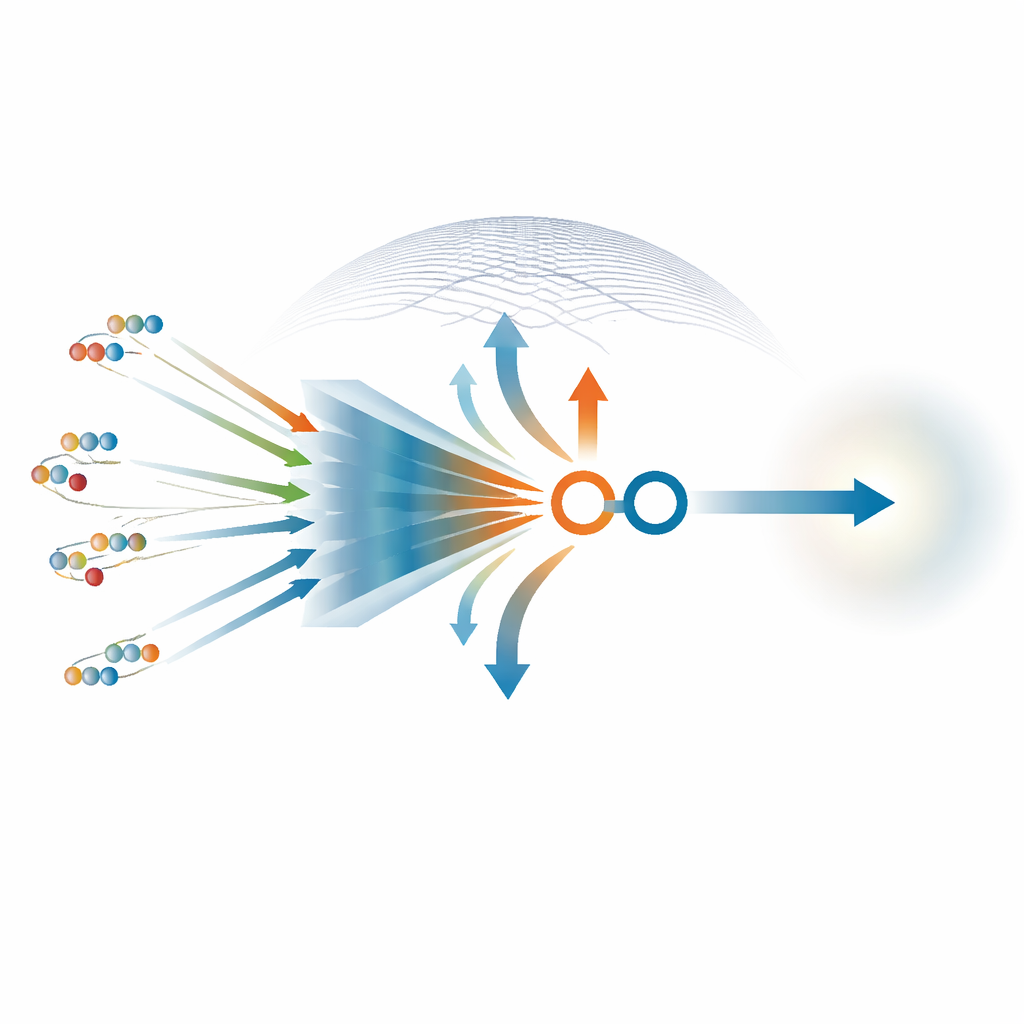
Overall, the study provides both fundamental limits and practical guidance for designing entanglement buffers in quantum repeaters and larger quantum networks. It offers tight bounds on how available and how clean stored entanglement can be, given hardware characteristics and traffic patterns. Perhaps most importantly for engineers, the results show that frequent purification is the right choice if high link quality is the top priority, even though it sacrifices how often links are available. At the same time, clever but simple purification policies can outperform highly tuned theoretical ones when real‑world factors like noise, multiplexed generation, and consumption are taken into account.
Citation: Iñesta, Á.G., Davies, B., Kar, S. et al. Entanglement buffering with multiple quantum memories. npj Quantum Inf 12, 64 (2026). https://doi.org/10.1038/s41534-025-01161-3
Keywords: quantum networks, entanglement purification, quantum memories, quantum repeaters, quantum communication