Clear Sky Science · en
TensorHyper-VQC: a tensor-train-guided hypernetwork for robust and scalable variational quantum computing
Why this new idea for quantum computers matters
Quantum computers promise breakthroughs in chemistry, materials, and optimization, but today’s machines are small and noisy. A leading strategy, called variational quantum computing, lets a classical computer and a quantum chip work together to solve hard problems. Yet as circuits get larger, training these hybrid systems often grinds to a halt and becomes extremely fragile to noise. This paper introduces TensorHyper‑VQC, a new way to control quantum circuits that keeps training stable, scales to more qubits, and naturally shrugs off much of the hardware noise that plagues current devices.
A smarter way to steer quantum circuits
Traditional variational quantum circuits directly adjust hundreds or thousands of gate angles on the quantum chip itself. As the number of qubits and circuit layers grows, the learning signal can fade away into a so‑called “barren plateau,” where gradients are essentially zero and training stalls. TensorHyper‑VQC turns this picture on its head. Instead of tuning quantum gates one by one, it trains a compact classical model, built from a tensor‑train network, to generate all the quantum gate parameters. The quantum circuit is kept fixed in shape and serves only as a forward calculator: it receives angles from the classical generator, runs once, and returns measurement results. All the heavy optimization happens in classical hardware, where gradients are easier to compute and less exposed to quantum noise. 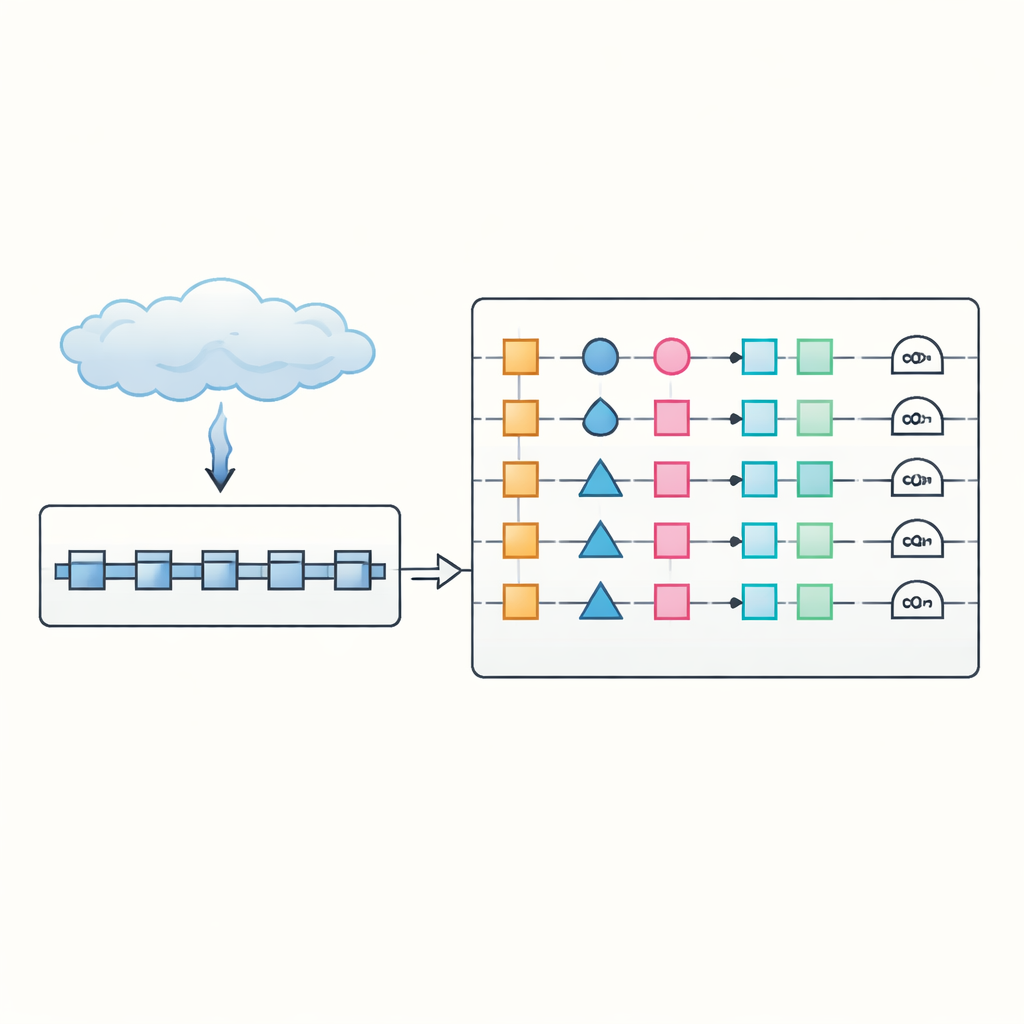
How structure tames complexity and noise
The heart of the approach is the tensor‑train (TT) network, which represents a huge list of circuit parameters using a chain of small low‑rank tensors. This structured representation acts like a clever compression scheme: it can be made more expressive by increasing its internal ranks, or more compact and noise‑tolerant by keeping them smaller. Because every gate angle is produced through this shared low‑rank structure, random fluctations from quantum measurements are naturally averaged out across many TT components. The authors use tools from Neural Tangent Kernel theory to show that this design improves the conditioning of the learning problem, speeds up convergence, and avoids the worst barren plateau effects. Their analysis also reveals a trade‑off: higher ranks boost expressivity but can hurt generalization, much like overfitting in deep learning. 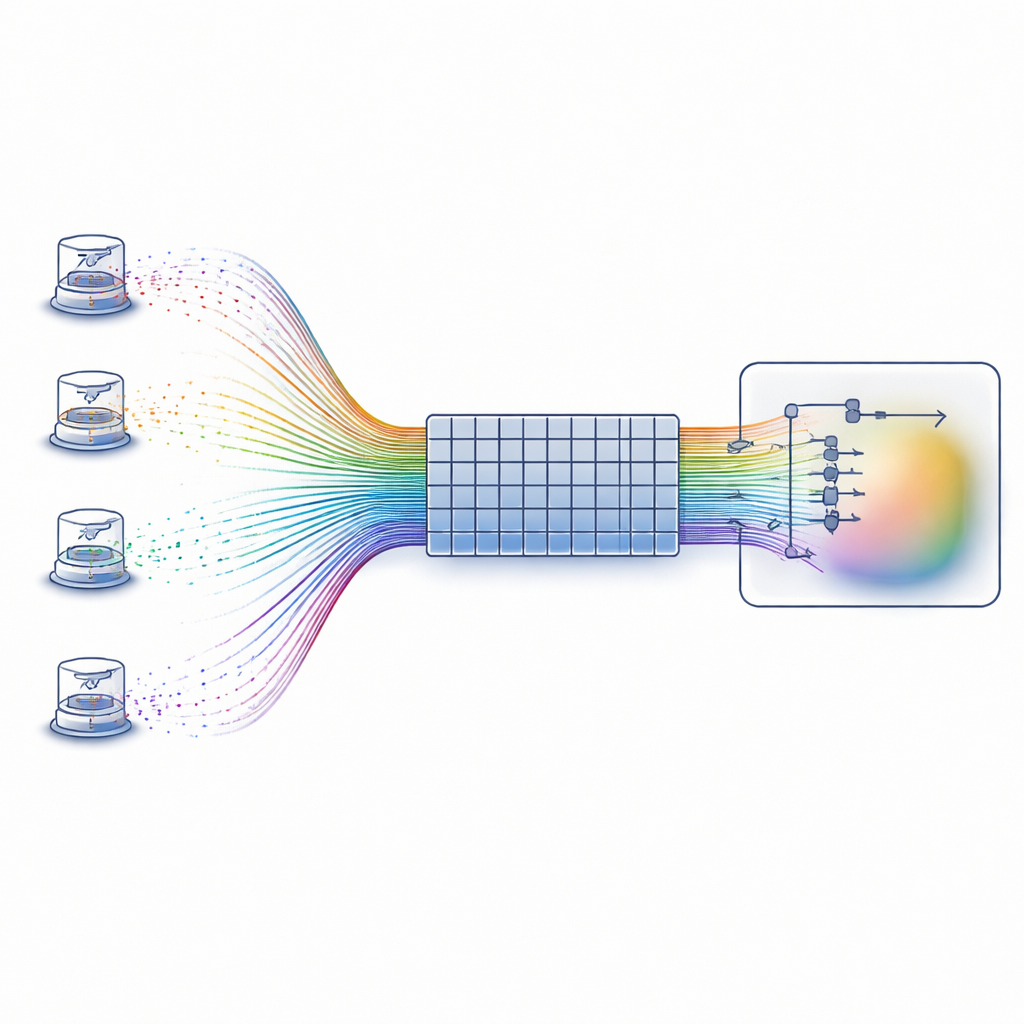
Putting the framework to real tests
The team benchmarks TensorHyper‑VQC on three quite different tasks. First, they classify images of charge‑stability diagrams from semiconductor quantum dots, which are crucial for building scalable quantum hardware. With only a few hundred trainable TT parameters, their method rapidly reaches almost perfect accuracy on clean simulations and keeps test accuracy high even when multiple types of quantum noise are injected. It not only outperforms standard variational circuits and other hypernetwork designs, but also beats strong classical vision models that use many more parameters. Remarkably, TensorHyper‑VQC maintains high accuracy on a 156‑qubit IBM Heron processor, while conventional methods with sophisticated error‑mitigation tools lag far behind.
Solving graphs and molecules on noisy devices
Next, the authors embed TensorHyper‑VQC into the Quantum Approximate Optimization Algorithm to tackle the Max‑Cut problem, a classic challenge in graph theory. On randomly generated 20‑qubit graphs, their TT‑guided approach consistently finds better cuts than standard QAOA, even when the latter is boosted with advanced noise‑reduction techniques. They then turn to quantum chemistry, estimating the ground‑state energy of a lithium hydride molecule. With just nine TT parameters, TensorHyper‑VQC achieves accuracy close to the ideal full‑configuration‑interaction value in simulations, outperforming a conventional variational eigensolver that uses nearly three times as many parameters. Under realistic noise and on actual IBM hardware, the TT‑guided model again delivers substantially smaller energy errors, highlighting its resilience in the face of decoherence and readout imperfections.
What this means for the future of quantum computing
Taken together, these results suggest a promising recipe for near‑term quantum computing: keep quantum circuits simple and fixed, and let a carefully structured classical model learn how to drive them. TensorHyper‑VQC shows that by pushing optimization into a noise‑free classical space and using low‑rank tensor structure to organize parameters, one can train deeper and larger quantum circuits more reliably, with fewer tunable numbers and less need for elaborate error‑mitigation schemes. For non‑experts, the key message is that smarter classical control can make today’s imperfect quantum chips far more useful, accelerating progress toward practical applications in areas such as device diagnostics, combinatorial optimization, and molecular design.
Citation: Qi, J., Yang, CH.H., Chen, PY. et al. TensorHyper-VQC: a tensor-train-guided hypernetwork for robust and scalable variational quantum computing. npj Quantum Inf 12, 70 (2026). https://doi.org/10.1038/s41534-025-01157-z
Keywords: variational quantum computing, quantum machine learning, tensor networks, quantum noise robustness, quantum optimization