Clear Sky Science · en
Asthma clinical decision support systems in primary care: an updated scoping review of implementation
Why smart tools for asthma care matter
Many people with asthma rely on their family doctor to spot when their breathing problems are getting worse and to adjust treatment in time. Digital tools now promise to help doctors by scanning medical records, highlighting warning signs, and suggesting better care. This review asks a simple question with big consequences for patients: are these computer helpers actually being used in everyday clinics, and do they make asthma outcomes better?

What the researchers set out to learn
The authors examined recent studies of asthma decision support tools used in primary care, where most day to day asthma management takes place. These tools ranged from simple alerts that flag high risk patients, to more advanced systems that predict future attacks, suggest treatment changes, or help create written action plans. The team searched multiple medical databases for trials from 2012 onward, including early pilot projects and full clinical trials, and then mapped each study’s goals and results onto an established model of asthma care to understand how the tools were meant to work.
Different tools, many designs
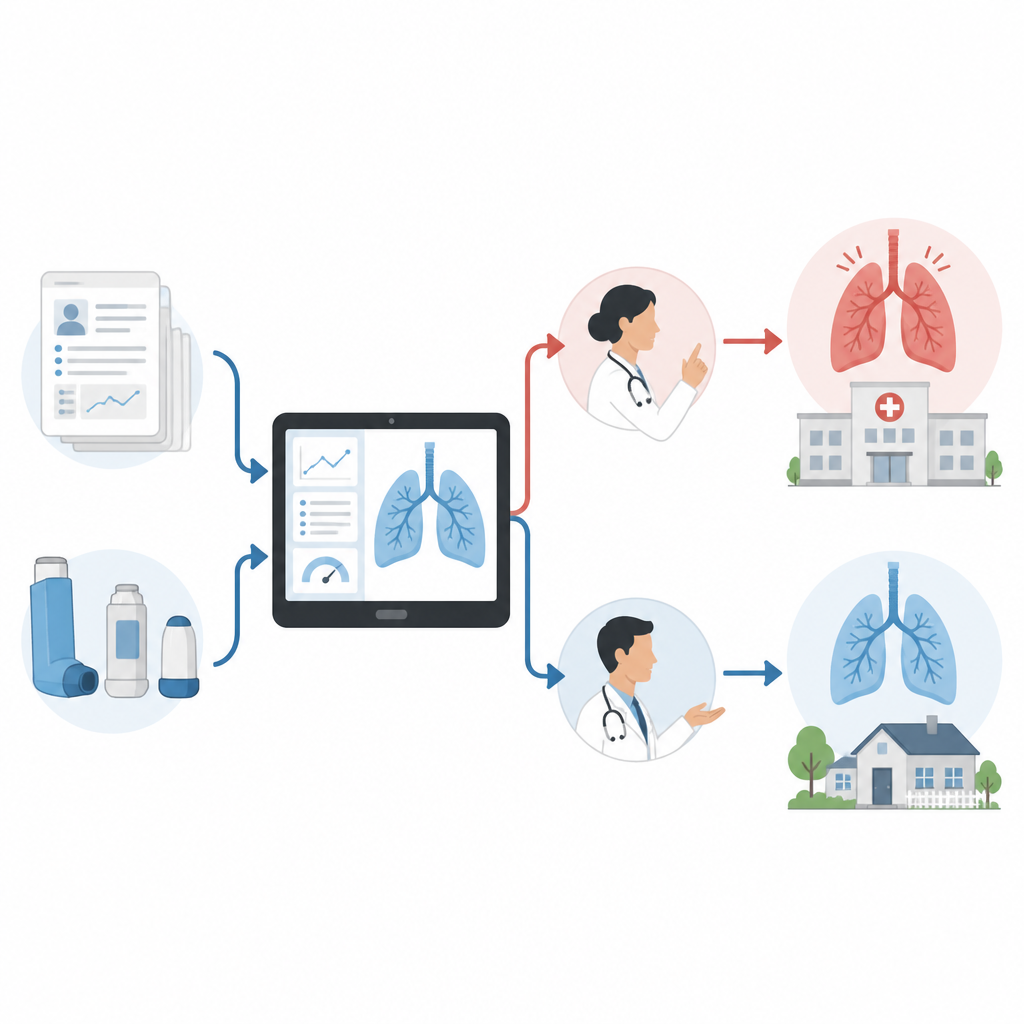
The 18 trials they found spanned six countries and used a wide mix of technologies. Some systems were built into electronic health records so that information flowed automatically from patient charts to the support tool. Others were stand alone programs or web dashboards that doctors had to open separately. The tools aimed to do several jobs: sorting patients into risk groups, prompting doctors to adjust medicines, generating personalized action plans, or giving summary reports on how well asthma was being managed in a clinic. Only a minority of projects described how doctors and patients were involved in designing the tools, or how ideas from behaviour science were used to encourage lasting changes in practice.
Where the tools helped and where they fell short
Across the trials, the clearest gains were in simple care processes. Several tools increased how often patients received written asthma action plans, had their inhaler technique checked, or were prescribed preventer inhalers in better balance with quick relief inhalers. Systems that focused on risk prediction tended to show the most consistent improvements in prescribing and follow up. Yet deeper outcomes, such as day to day asthma control, quality of life, or the number of severe attacks, rarely improved in a clear or lasting way. Even when alerts or dashboards were available, doctors often ignored them, opened them late, or stopped using them as trials went on.
Why limited use is a major barrier
Low and declining use of these tools emerged as a central theme. Many systems required doctors to leave their normal workflow to log into a separate website or open a special form during busy consultations. Others sent alerts that were easy to overlook or that fired so often they blended into background noise. Only a few studies deliberately applied behaviour change frameworks or conducted in depth process evaluations to understand why doctors did or did not follow the advice. As a result, even tools powered by good data and sound medical evidence often failed to change real world decisions or patient behaviour.
What this means for people living with asthma
For patients, the message is that computer based support alone is not enough to transform asthma care. The review shows that while digital tools can nudge doctors toward better prescribing and more frequent action planning, they rarely lead to dramatic drops in severe attacks or hospital visits. The authors argue that future tools must be built hand in hand with clinicians and patients, grounded in clear theories of how behaviour changes, and tightly woven into everyday clinic systems. Only then are decision support tools likely to be used consistently and to deliver the reliable, long term benefits that people with asthma need.
Citation: Tibble, H., Lee, B. & Skene, I. Asthma clinical decision support systems in primary care: an updated scoping review of implementation. npj Prim. Care Respir. Med. 36, 31 (2026). https://doi.org/10.1038/s41533-026-00498-2
Keywords: asthma, primary care, clinical decision support, digital health, risk prediction