Clear Sky Science · en
Machine learning-based optimization of dual subthalamic nucleus and substantia nigra targeting in deep brain stimulation
Why this matters for people with Parkinson’s
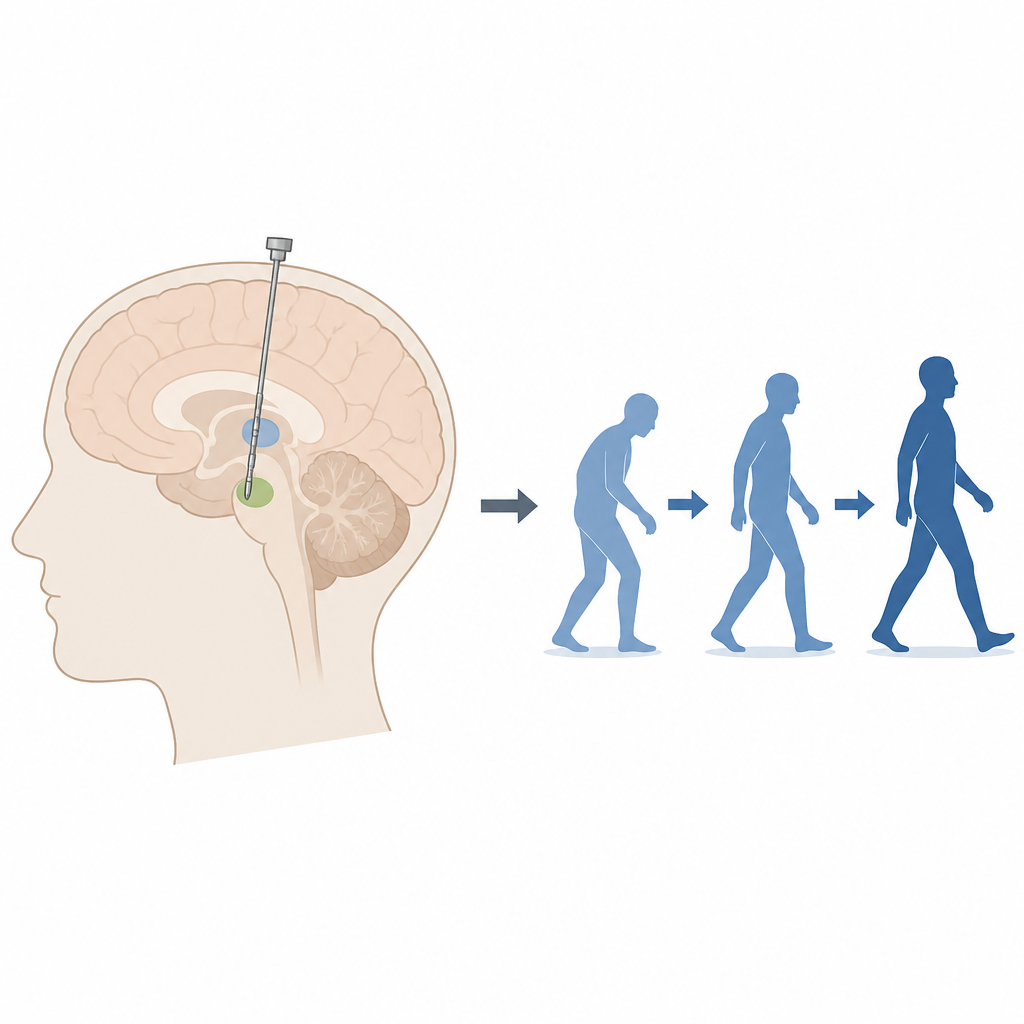
Deep brain stimulation has become an important treatment for Parkinson’s disease, especially for movement problems that no longer respond well to medication. New electrode designs can stimulate more than one spot in the brain at the same time, raising hope for better control of symptoms like freezing of gait. Yet surgeons still lack clear, data-driven rules for how to place a single electrode so it can reliably reach two tiny movement hubs deep inside the brain.
Two small targets with big roles in movement
In Parkinson’s disease, a region called the subthalamic nucleus is a common target for deep brain stimulation because it helps control movement. Just below it lies the substantia nigra, which is strongly involved in walking and balance. The substantia nigra itself has two neighboring parts with different roles. Some studies suggest that stimulating the lower part may help stubborn walking problems, but results have been inconsistent. One reason is that surgeons usually plan the operation around the subthalamic nucleus alone and hope that some electrode contacts will also land in the right part of the substantia nigra by chance.
Learning from hundreds of real surgeries
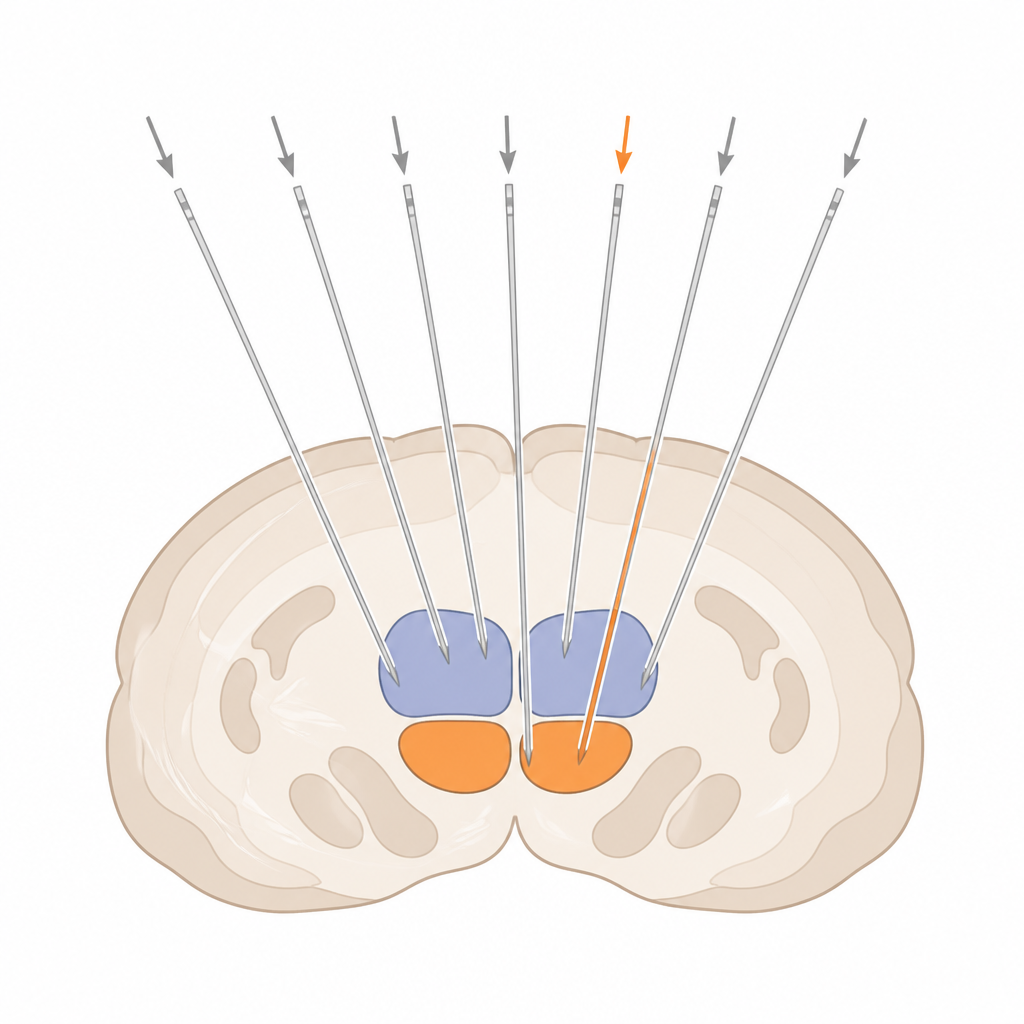
The authors analyzed imaging data from 612 electrode paths that had already been implanted in people with Parkinson’s using standard methods. They carefully reconstructed where each contact on each electrode actually sat inside the brain and whether it touched either of the two parts of the substantia nigra. They found that a single trajectory often could reach both the subthalamic nucleus and the substantia nigra, but not always the desired subregion. About six in ten trajectories reached the lower part, and more than a third reached the upper part. When the team simulated slightly longer electrodes or deeper placement, the chance of reaching at least one part of the substantia nigra rose further while still keeping the subthalamic nucleus within reach.
How machine learning turned anatomy into simple rules
To go beyond trial and error, the researchers used a machine learning method called a Gaussian Process Classifier. Instead of giving advice during surgery, this algorithm learned from the completed cases which combinations of angles and entry points were most likely to hit each part of the substantia nigra. The inputs were measurements that surgeons can already see on standard brain scans, such as the tilt of the electrode relative to key brain landmarks and where the planned path crosses certain reference lines. The model predicted with high accuracy whether a planned trajectory would pass through the lower or upper part of the substantia nigra.
From complex models to practical planning tips
After training the algorithm, the authors translated its predictions into simple rules of thumb that do not require any computer in the operating room. For surgeons aiming to stimulate the lower part of the substantia nigra while still treating the subthalamic nucleus, the rules recommend choosing a slightly more sideward target point within the subthalamic nucleus and angling the electrode a bit more steeply. For those who want to favor the upper part, a more central target and a different range of angles are suggested. Importantly, when these rules were followed in the data, the subthalamic nucleus was still well covered by other contacts along the same lead, showing that deep placement need not sacrifice the main target.
What this means for future treatment
This study does not test patient outcomes directly, but it shows that dual targeting of two crucial movement centers with a single electrode is both common and predictable. By converting thousands of data points from past surgeries into clear anatomical guidance, the work provides a path toward more consistent and precise planning of deep brain stimulation. For people with Parkinson’s disease, this could eventually translate into more reliable control of walking and balance problems, once future clinical trials confirm which specific brain regions and stimulation patterns offer the greatest benefit.
Citation: Leavitt, D., Negahbani, F. & Gharabaghi, A. Machine learning-based optimization of dual subthalamic nucleus and substantia nigra targeting in deep brain stimulation. npj Parkinsons Dis. 12, 124 (2026). https://doi.org/10.1038/s41531-026-01406-8
Keywords: Parkinson’s disease, deep brain stimulation, machine learning, subthalamic nucleus, substantia nigra