Clear Sky Science · en
Converging metabolic and functional networks for tremor expression and deep brain stimulation-mediated control
Why this matters for people with tremor
Many people with essential tremor live with constant shaking that makes simple tasks like drinking from a cup or writing their name exhausting. Deep brain stimulation is already used to calm these movements, but doctors still do not fully understand how it works in the brain. This study looks under the hood, asking whether the same brain circuit that produces tremor is also the one that deep brain stimulation quiets, and whether changes in this circuit can explain who benefits most from treatment.
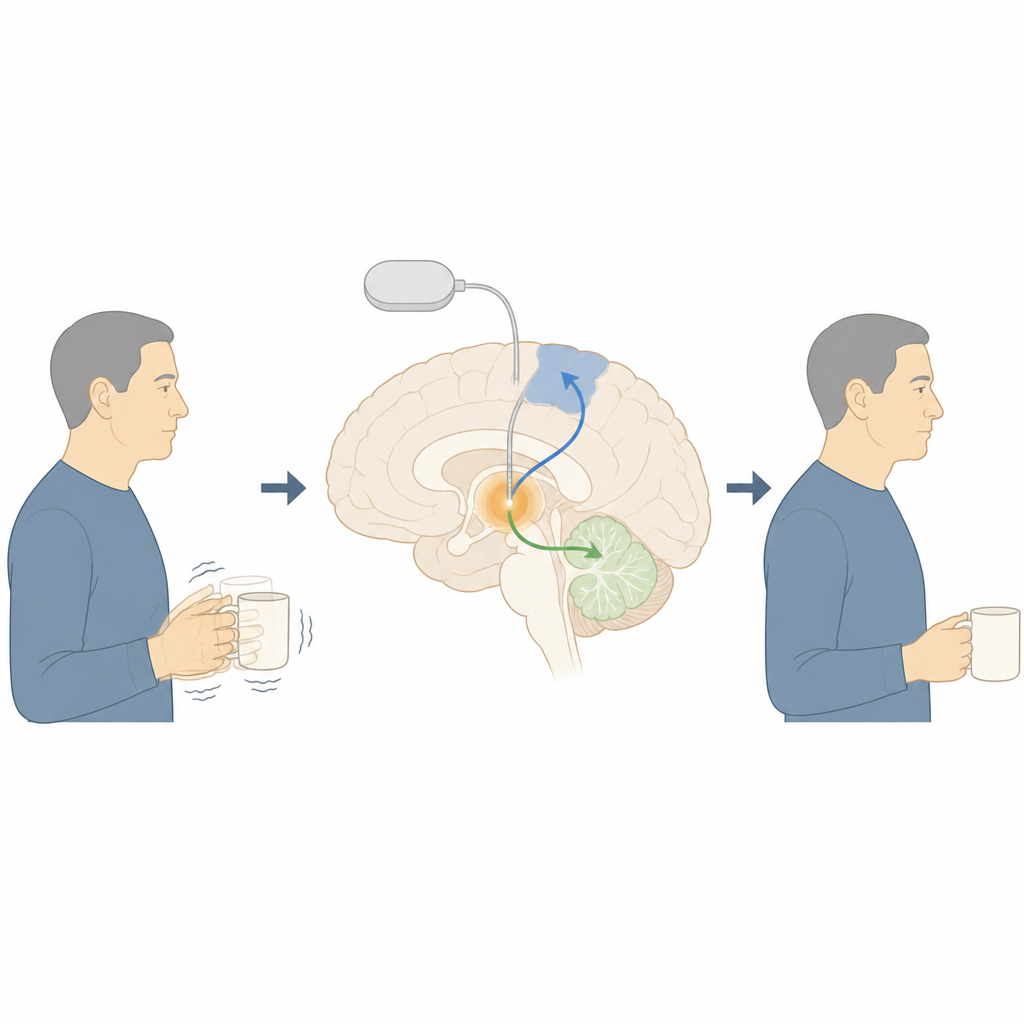
Looking at brain energy use during treatment
The researchers studied fourteen people with long standing essential tremor who had electrodes implanted deep in a relay area of the brain used for movement control. Each person was scanned twice with a type of brain imaging that tracks how much sugar different regions use, a sign of how active they are. One scan was done with stimulation turned off for three days, when tremor was strong, and another with stimulation turned on at their best clinical setting, when symptoms were much improved. By comparing these scans within the same individuals, the team could see how turning the device on changed brain activity.
Finding a movement circuit not just a single spot
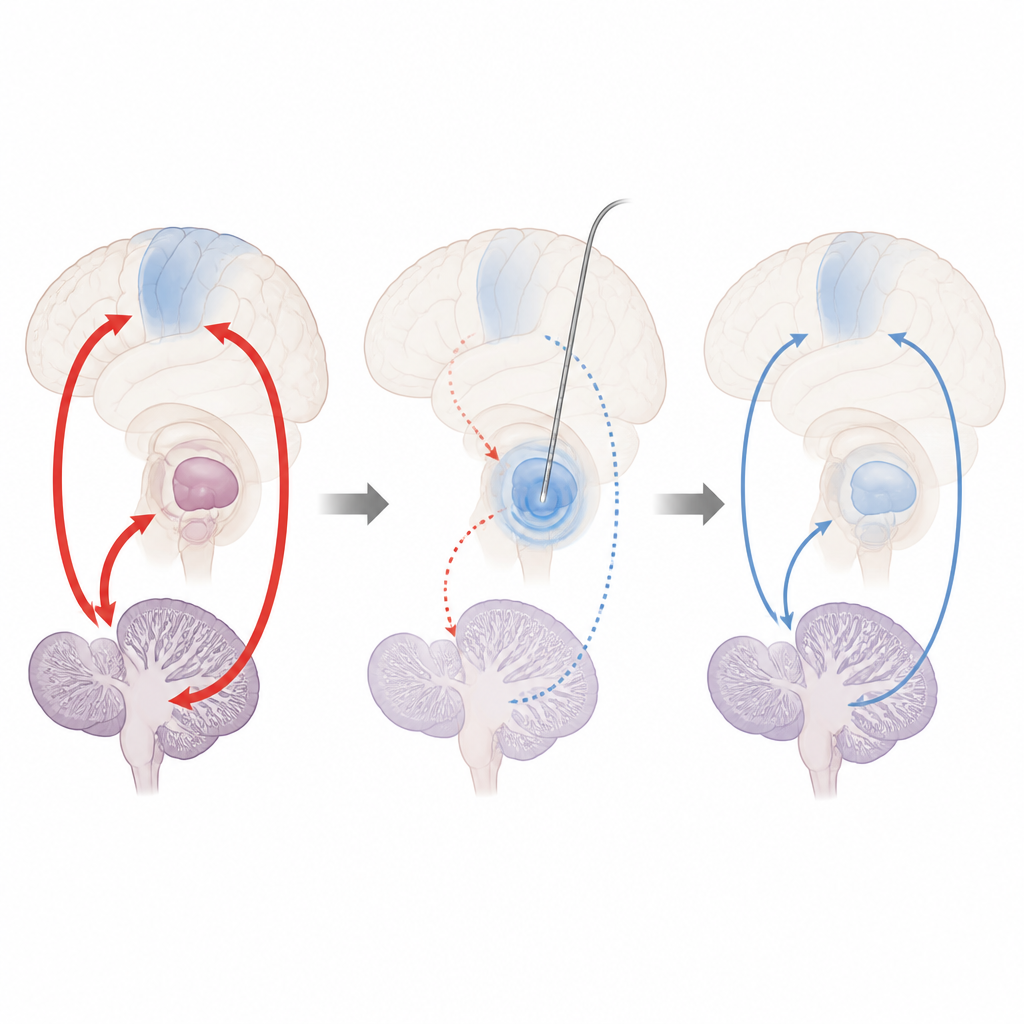
When stimulation was switched on, tremor scores dropped on average by about three quarters, confirming that the treatment was working well. In the brain, however, the largest effects were not limited to the tip of the electrode. Activity rose in a wider movement circuit that included the primary motor cortex on the surface of the brain and deep structures in the back of the head that guide coordination. At the same time, some other regions, such as visual and frontal areas, showed reduced activity. These patterns closely resembled a previously proposed “tremor treatment network” that had been mapped using other kinds of brain data.
When network changes beat local changes
A key test was whether the size of these changes could explain how much each patient improved. The amount of extra activity right around the electrode mainly reflected how strong the stimulation current was and did not reliably track symptom relief once that factor was taken into account. In contrast, the better a person’s overall pattern of brain change matched the established tremor treatment network, the more their tremor lessened, even after accounting for stimulation strength. In other words, it was the way the larger circuit responded, not just the local tissue under the electrode, that predicted success.
The same circuit drives both tremor and its relief
The team then asked which areas were more active in people who had worse tremor when the device was off. Higher tremor was linked to greater activity in the same movement and coordination regions that lit up during successful stimulation and to lower activity in some frontal and temporal areas. Statistical tests showed that this “tremor expression” pattern overlapped with the “tremor treatment” pattern more than expected by chance. Additional analyses combining brain wiring maps with the metabolic data suggested that regions more strongly connected to the stimulation site were also the ones whose activity changed most, again pointing to a network level effect.
What this means for people living with tremor
This work supports a simple but powerful idea for lay readers: deep brain stimulation helps by reshaping the very circuit that produces tremor, rather than merely shutting down a single bad spot. The electrodes act like a control knob on a shared movement pathway linking deep relay stations, the coordination center at the back of the brain, and the movement areas at the top. Understanding that symptom relief depends on how this whole network responds may guide more precise placement and tuning of future devices, and it suggests that treatments across different tremor disorders will work best when they target the same key circuit.
Citation: Weigl, B., Pistorius, R., Brumberg, J. et al. Converging metabolic and functional networks for tremor expression and deep brain stimulation-mediated control. npj Parkinsons Dis. 12, 119 (2026). https://doi.org/10.1038/s41531-026-01388-7
Keywords: essential tremor, deep brain stimulation, brain networks, FDG PET, movement disorders
See more on the researcher's website: https://sfb-retune.de/en/feature-on-clearskyscience-com/