Clear Sky Science · en
Temporal dynamics of cognitive functioning in people with Parkinson’s disease
Why this matters for people living with Parkinson’s
When people think about Parkinson’s disease, they often picture tremors and movement problems. But many people with Parkinson’s also struggle with memory, attention, and planning. Doctors usually group these thinking problems into fixed “domains,” such as memory or attention, and then diagnose mild or major thinking impairment based on those groups. This study asks a simple but important question: do these mental domains really stay fixed over the years, or do they shift and reorganize as the disease progresses?
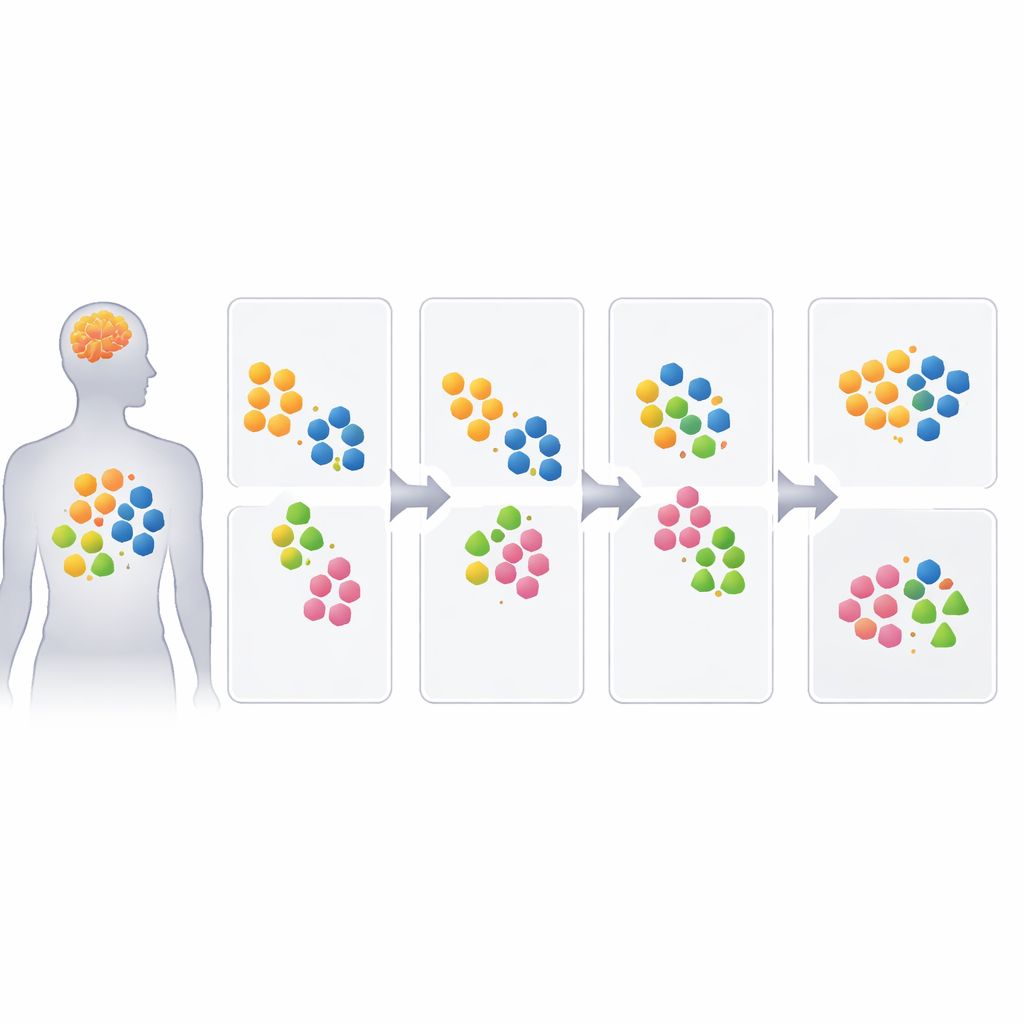
Looking at thinking as a changing system
The researchers followed 355 people with Parkinson’s disease for three years, testing a wide range of thinking skills once a year. Participants ranged from those with normal thinking to those with mild problems and full dementia. Instead of assuming in advance how tests should be grouped, the team used modern “network” methods to see which test scores tended to change together over time within each person. This allowed them to track how clusters of related abilities rise or fall together, much like watching weather patterns instead of just checking one day’s forecast.
Five clusters that don’t match the usual boxes
Over time, five main clusters of thinking abilities emerged. One centered on drawing and copying figures, another on language and word learning, a third on card-sorting tasks that demand flexible thinking, a fourth on attention and speed, and a fifth that blended visual and planning skills. Crucially, these clusters did not line up neatly with the standard textbook categories that experts use, nor with earlier one-time (“snapshot”) analyses of the same group. Only the card-sorting cluster stayed stable. This suggests that the way different tests hang together can look quite different when you watch people over years rather than at a single visit.
How one skill change can shape another
Next, the authors examined how these five clusters influenced each other from one year to the next. Some clusters showed “staying power”: people who were doing relatively well or poorly in language, attention, or visual–planning tended to keep that standing at the next assessment. Other patterns were more surprising. The flexible-thinking cluster fluctuated from year to year, suggesting a kind of rebound in performance. Even more striking, better performance on flexible-thinking tasks at one time point was linked with worse performance a year later on the drawing-and-copying cluster, hinting at a trade-off between early changes in front-of-the-brain abilities and later changes in more visual, spatial skills.

Rethinking how we define and track decline
These shifting patterns challenge the idea that cognitive domains in Parkinson’s are stable containers that can be defined once and for all. Instead, the results fit with theories that propose at least two partly separate paths of decline in Parkinson’s: one affecting attention and planning early on, and another affecting memory, language, and visual skills later. The new dynamic clusters also did a slightly better job than traditional domains at predicting scores on a common global thinking test, hinting that they may be more useful for forecasting future decline and tailoring cognitive screening tools.
What this means for diagnosis and treatment
For people with Parkinson’s and their clinicians, the key message is that thinking changes are not just about how someone performs on a test today, but about how different abilities move together over time. Relying solely on fixed domain labels may miss important patterns of change and even blur the distinction between different disease mechanisms. By treating cognition as a shifting network rather than a set of rigid boxes, future guidelines may be able to identify risk earlier, link test results more precisely to brain changes and genes, and design more individualized cognitive training. In short, this work lays the groundwork for more dynamic, and ultimately more accurate, ways to understand and support thinking in Parkinson’s disease.
Citation: Scharfenberg, D., Kalbe, E., Ophey, A. et al. Temporal dynamics of cognitive functioning in people with Parkinson’s disease. npj Parkinsons Dis. 12, 86 (2026). https://doi.org/10.1038/s41531-026-01338-3
Keywords: Parkinson’s disease, cognitive decline, longitudinal study, neuropsychology, network analysis