Clear Sky Science · en
Autophagy dysfunction in iPSCs-derived neurons and midbrain organoids carrying a SNCA triplication
Why brain clean up matters in Parkinson’s
Parkinson’s disease is best known for its tremors and movement problems, but deep inside affected brain cells another drama is unfolding: a failure of the cell’s own recycling system. This study uses cutting edge lab grown human neurons and tiny midbrain like organoids to watch that clean up process in real time, revealing when it goes wrong and how that breakdown lines up with the buildup of a key protein linked to Parkinson’s.
Building mini human models of Parkinson’s
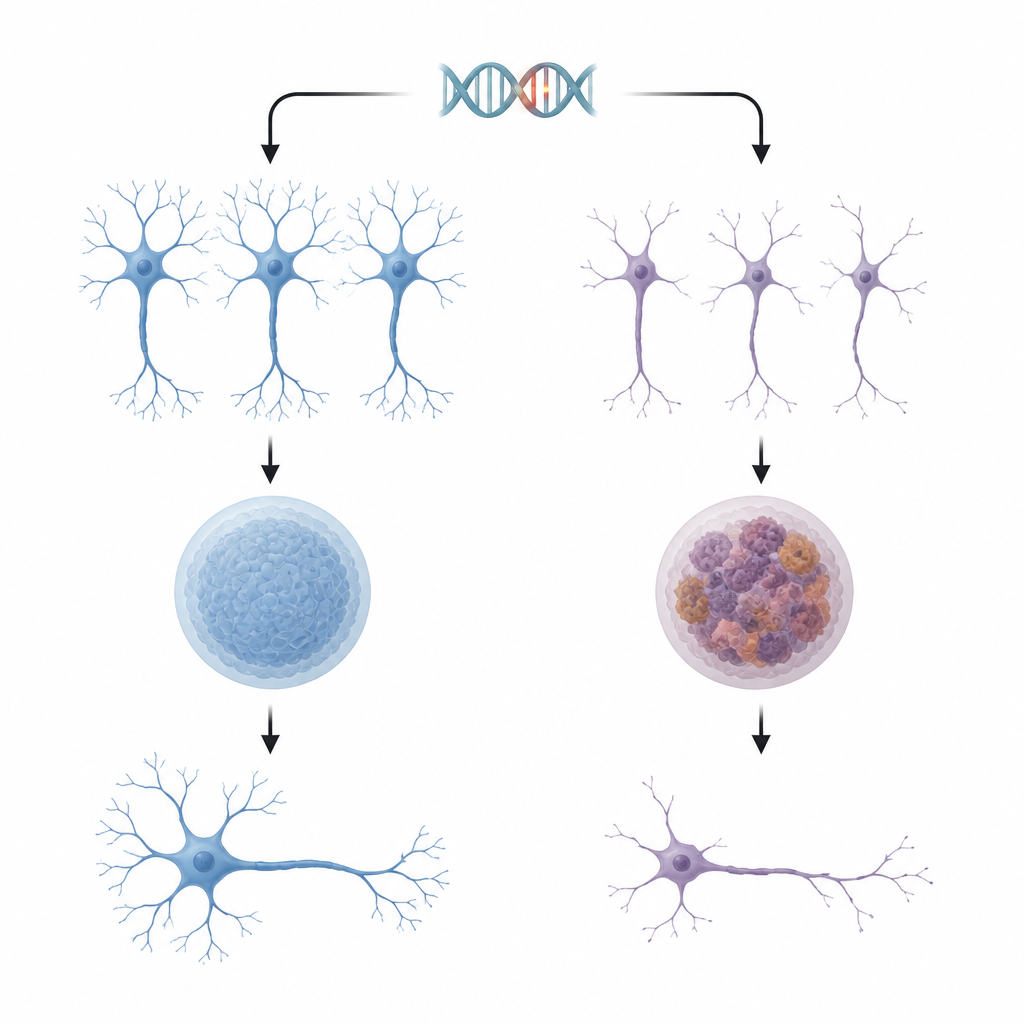
The researchers started with skin or blood cells from people carrying a rare genetic change that gives them three copies of the gene for a protein called alpha synuclein. Extra copies of this gene drive early and severe Parkinson’s. They reprogrammed these cells into induced pluripotent stem cells and then guided them to become two types of brain models: flat dishes of neurons and three dimensional midbrain organoids that more closely resemble a tiny piece of human brain tissue. These models contain many dopamine producing nerve cells, the same type that is lost in Parkinson’s.
Watching the cell’s recycling centers in action
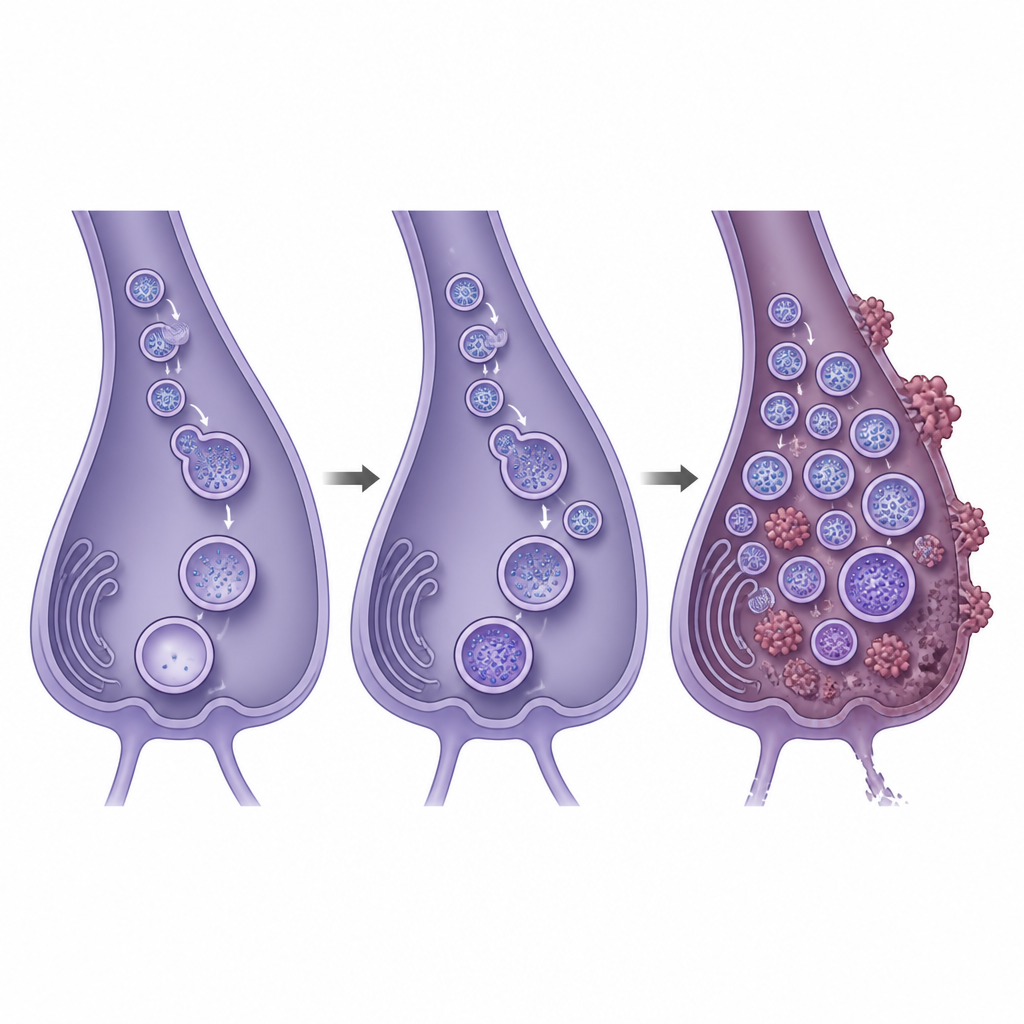
To track how cells dispose of waste, the team used a fluorescent reporter called LC3 Rosella that glows differently depending on acidity. As recycling vesicles fuse with acidic lysosomes to form autolysosomes, the color pattern changes, allowing scientists to measure their number and size in living cells over days. In neurons from Parkinson’s patients, small efficient autolysosomes were already reduced at the very start of differentiation, and over the next 11 days both the total area and density of these structures declined. Larger, less efficient vesicles piled up before the entire system slowed, pointing to an early and progressive failure of cellular clean up.
Mini midbrains reveal a slow burn
In the three dimensional midbrain organoids, the story unfolded over a longer time scale. At 50 days, Parkinson’s organoids already showed a smaller area taken up by autolysosomes, and by 70 days every autophagy measure was reduced, including the largest vesicle size and the number of vesicles of all sizes. Additional tests confirmed that key recycling proteins were not turning over properly and that lysosomes themselves were less capable. At the same time, total alpha synuclein and its phosphorylated, aggregation prone form piled up, especially in dopamine producing neurons. Stains that highlight misfolded protein clumps showed that these alpha synuclein rich aggregates were more common and more resistant to degradation in Parkinson’s organoids.
From clogged recycling to fading nerve signals
The team then asked what these microscopic changes meant for the health of the organoids’ nerve cells. Levels of a general neuron marker stayed stable, but a marker specific to dopamine producing neurons declined by 70 days in Parkinson’s organoids, and their delicate nerve fibers became fragmented. Using tiny electrode grids, the researchers recorded the electrical activity of the organoids and saw that firing rates and burst patterns were already reduced between 50 and 70 days. This loss of network activity appeared before the full drop in dopamine neuron markers, suggesting that functional decline and autophagy problems come early while cells are still present.
What this means for people with Parkinson’s
For a lay reader, the key message is that in these human based models of genetic Parkinson’s, the cell’s recycling machinery falters early, long before dopamine neurons fully die. As waste handling slows, alpha synuclein accumulates, forms sticky aggregates, and is closely followed by weakened electrical signaling and loss of dopamine related features. These findings support the idea that boosting autophagy and lysosome function, especially early in the disease process, could help keep brain cells healthier for longer and may be a promising direction for future treatments.
Citation: Serra-Almeida, C., Jarazo, J., Gomez-Giro, G. et al. Autophagy dysfunction in iPSCs-derived neurons and midbrain organoids carrying a SNCA triplication. npj Parkinsons Dis. 12, 123 (2026). https://doi.org/10.1038/s41531-026-01330-x
Keywords: Parkinson’s disease, autophagy, alpha synuclein, midbrain organoids, dopaminergic neurons