Clear Sky Science · en
From laminar to turbulent: how methanogen and srb mic pathways shape their response to flow dynamics
Why flowing water can quietly eat through metal
Buried pipelines, offshore wind farms, and industrial cooling loops all rely on metal structures that sit in moving water for years. Hidden on those metal surfaces, microscopic communities of microbes build slimy films that can dramatically speed up rusting, a problem known as microbiologically influenced corrosion. This study asks a simple but crucial question: how does the speed and style of water flow—from smooth and gentle to fast and turbulent—change the way these microbes damage steel?
Tiny life forms that bite into steel
The researchers focused on two common troublemakers found on corroded steel: a sulfate-reducing bacterium called Desulfovibrio ferrophilus IS5 and a methane-producing microbe, Methanobacterium aff. IM1. Both can harvest energy from iron in low-oxygen seawater, but they do it in different ways. One produces sulfide that reacts with iron, while the other relies on special enzymes tied closely to the metal surface. Because these organisms are frequently detected in pipelines and marine infrastructure, understanding how they behave under realistic flow conditions is essential for predicting when and where dangerous pitting will occur.
Recreating calm and chaotic flows
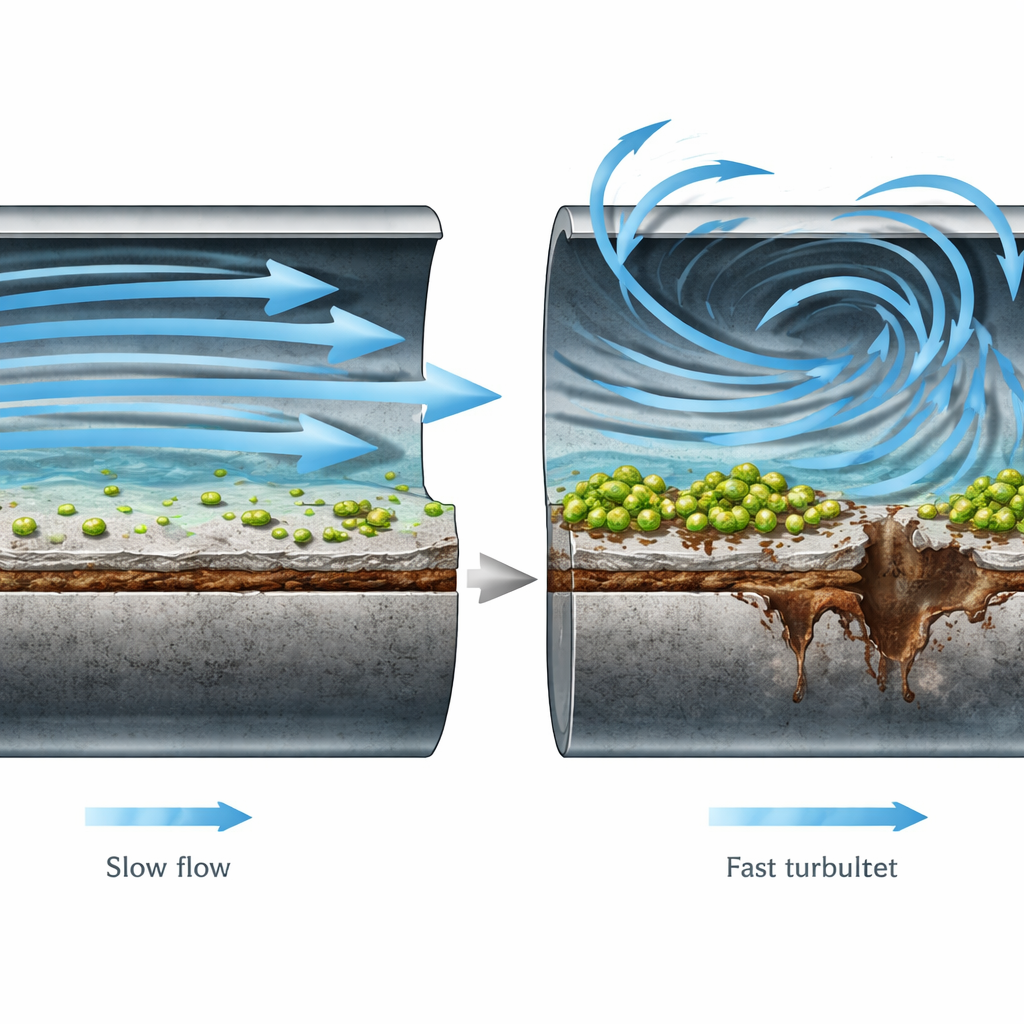
To mimic real systems, the team exposed carbon steel samples to two controlled flow setups under oxygen-free, artificial seawater. A multiport flow column produced very slow, strictly smooth (laminar) flow, similar to what might occur in dead legs or stagnant corners of a pipe. A separate semicircular flow cell generated fully turbulent flow, closer to conditions in circulating seawater lines or moderate pipeline flow. Steel coupons in both setups were either left sterile or inoculated with one of the two microbes and then exposed for 14 days. Afterward, the scientists weighed the coupons to measure overall material loss and used several imaging methods to inspect surface damage, pit depth, and the thickness and structure of the corrosion and biofilm layers.
How flow reshapes corrosion damage
Across all conditions, the presence of microbes consistently drove more severe corrosion than sterile controls, but the details depended strongly on flow regime and microbe type. Under laminar flow, Methanobacterium aff. IM1 produced thicker corrosion layers than sterile samples and clear signs of pitting, even when average corrosion rates were not dramatically higher. Under turbulent flow, both microbes became substantially more aggressive: corrosion rates rose sharply compared to static and laminar conditions. The methanogen was especially damaging, causing high, nearly uniform attack across most coupons and producing the deepest and widest pits, whereas Desulfovibrio ferrophilus IS5 formed thicker, more irregular corrosion–biofilm layers.
When thickness misleads and roughness tells the story
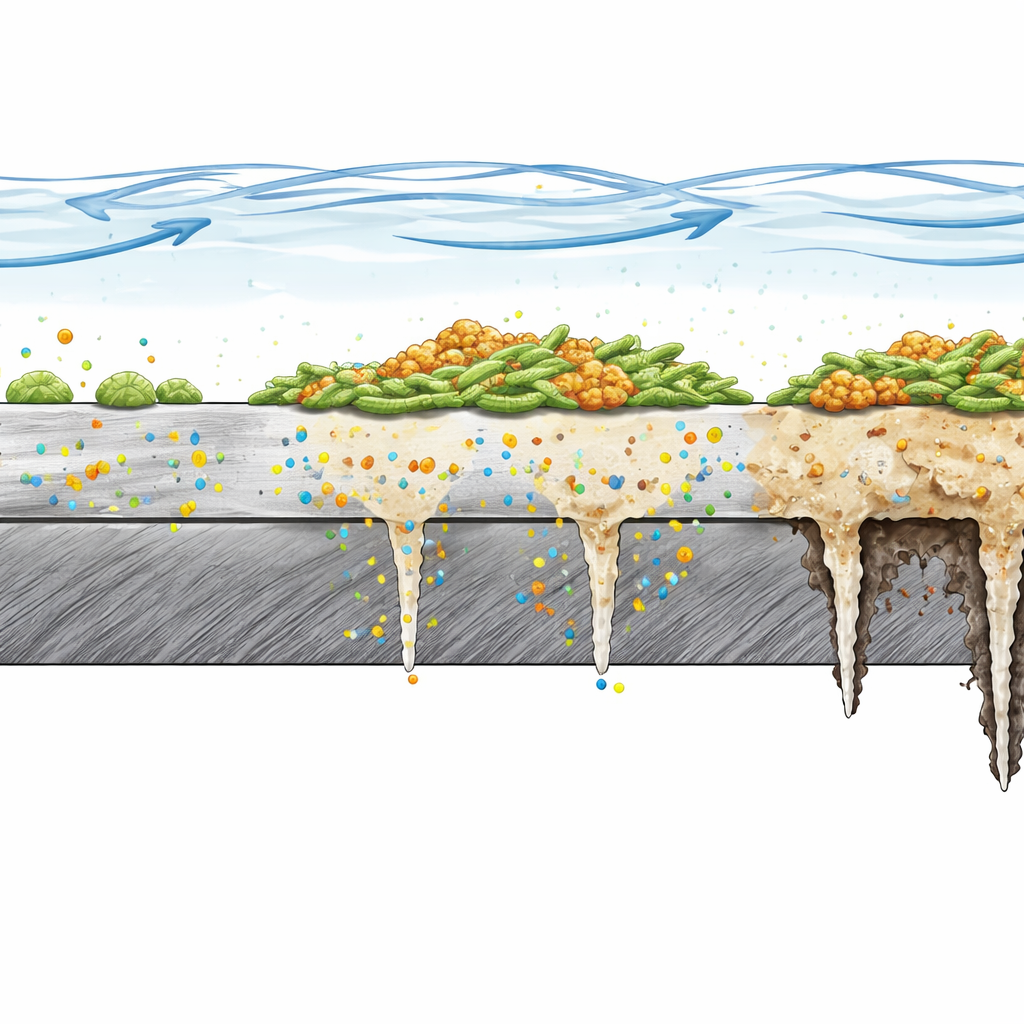
One of the study’s striking findings is that a thicker surface layer does not automatically mean more corrosion. Using optical coherence tomography, the team found that Desulfovibrio ferrophilus IS5 built up a much thicker and more heterogeneous corrosion–biofilm layer under turbulent flow than either sterile controls or the methanogen. Yet the methanogen caused higher overall metal loss and deeper pits, despite a remaining layer similar in thickness to sterile samples. High shear likely stripped away parts of its weaker corrosion layer, so the surviving thickness underestimated the total damage done. Surface mapping confirmed that microbially exposed coupons—especially those colonized by Methanobacterium aff. IM1—were far rougher and more pitted than sterile ones, emphasizing that localized attack and surface unevenness, rather than bulk film thickness, better reflect true risk.
Why flow is a hidden control knob
Putting these pieces together, the researchers show that the style and intensity of flow act as a powerful “control knob” for microbially driven corrosion. Faster, turbulent conditions did not wash problems away; instead, they often intensified them by improving nutrient delivery, removing protective films, and reshaping biofilms into structures that promote sharp chemical gradients at the metal surface. Different microbes responded in distinct ways, with the methanogen becoming particularly destructive under turbulence. For engineers and asset managers, the message is clear: assessing corrosion risk and designing protection strategies for pipelines and marine structures must account not only for which microbes are present, but also for how water moves past the metal, from quiet corners to roaring flow.
Citation: Deland, E., Taghavi Kalajahi, S., Carvalho, F.M. et al. From laminar to turbulent: how methanogen and srb mic pathways shape their response to flow dynamics. npj Mater Degrad 10, 56 (2026). https://doi.org/10.1038/s41529-026-00795-8
Keywords: microbiologically influenced corrosion, biofilms, flow dynamics, carbon steel, pipelines