Clear Sky Science · en
Novel corrosion protective coating formulations suggested by machine learning of historic test data
Why smarter paint matters
Steel bridges, ships, cars and buildings all depend on paint to keep rust at bay. Yet designing a protective coating is still often a craft learned by trial and error. This study shows how a form of artificial intelligence can sift through past test results to suggest new anticorrosion paints that work as well as, or better than, today’s products, while exploring ingredient combinations that human experts would probably never try.
The challenge of endless recipes
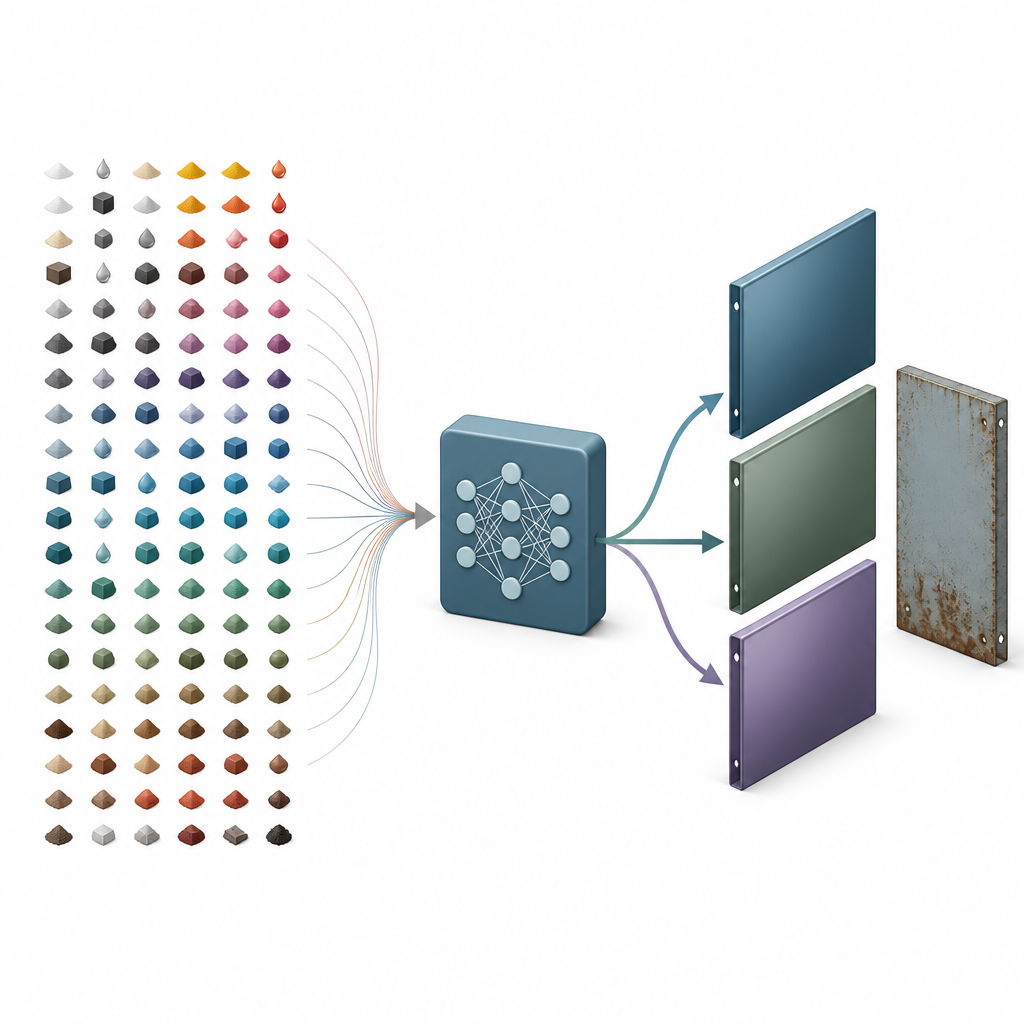
Modern protective paints are complex mixtures of resins, pigments, corrosion inhibitors, colorants and other additives. Each can be used in different amounts and combinations, creating an astronomical number of possible recipes. Testing even a tiny fraction in the lab is slow and costly, so companies tend to explore familiar territory near known good formulations. That makes it hard to discover unusual mixtures that might perform better or use ingredients more efficiently.
Turning old test panels into a map
The authors gathered historic results from 492 salt spray corrosion tests on steel panels coated with waterborne paints that used 148 different ingredients. Each coating had been rated on standard visual scales for rusting and blister formation. Using these data, the team trained a machine learning model, specifically a random forest, to predict how a given recipe would score. They then treated the huge space of possible recipes as a landscape, where each point is a formulation and its height represents corrosion performance. A second algorithm, called differential evolution, was used to roam this landscape, searching for high points that correspond to promising new recipes.
How well the digital guide performed
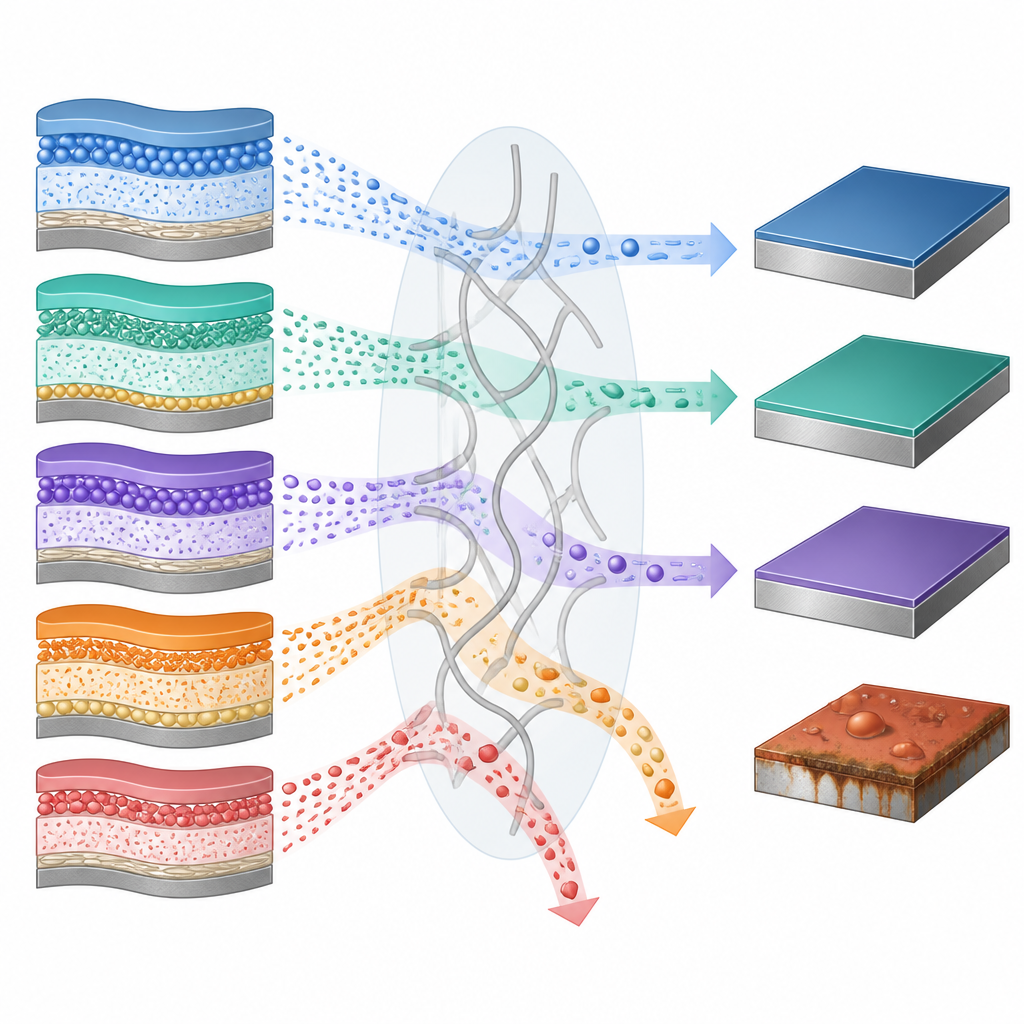
The model was able to classify coatings as good or poor with high accuracy for blistering inside the paint film, and with better-than-random success for rusting and blistering near a deliberate scratch. When the researchers examined which factors mattered most, they found that test duration, type of metal, number of paint layers and resin choice dominated performance, in line with practical experience. Some results were more surprising: for example, certain colorants and neutralising agents appeared more influential than corrosion inhibitors used in low amounts, hinting at complex interactions among ingredients.
Testing two surprising new paints
To see whether their virtual exploration would hold up in the real world, the team selected two machine suggested recipes and made small batches of paint. These were compared with a standard reference coating in a demanding cyclic salt spray test lasting more than 700 hours. One suggested paint, which used an unusual blend of two resins that had each performed poorly on their own, matched the reference in resisting rust overall and did better around the scratch. The second, based on a resin that had previously failed conventional screening, performed somewhat worse but still showed improved behavior compared with its earlier reputation.
What this means for future coatings
This work is a proof of principle that machine learning can guide the search for better protective paints, even when only modest historical data are available and when the model knows nothing about physical properties such as viscosity or hardness. Instead of replacing expert formulators, the approach acts as a smart assistant that proposes non obvious combinations worth testing. As more data and ingredient details are added, similar tools could shorten development times, widen the range of viable recipes and help uncover new, sometimes counterintuitive, ways to keep metal structures from rusting.
Citation: Samanta, S., Luigjes, B., Lyon, S. et al. Novel corrosion protective coating formulations suggested by machine learning of historic test data. npj Mater Degrad 10, 63 (2026). https://doi.org/10.1038/s41529-026-00771-2
Keywords: corrosion coatings, machine learning, protective paints, steel corrosion, materials design