Clear Sky Science · en
Probing degradation of Cobalt-free LiNi0.5Mn1.5O4 ceramic cathode in lithium-ion batteries
Why this new battery study matters
Lithium-ion batteries power our phones, laptops, and electric cars, but today’s designs rely heavily on cobalt, a costly metal linked to environmental and ethical concerns. This study explores a promising cobalt-free alternative that could pack more energy into a smaller, safer, longer-lasting battery—if we can understand and fix how it wears out over time.
A new kind of tightly packed battery heart
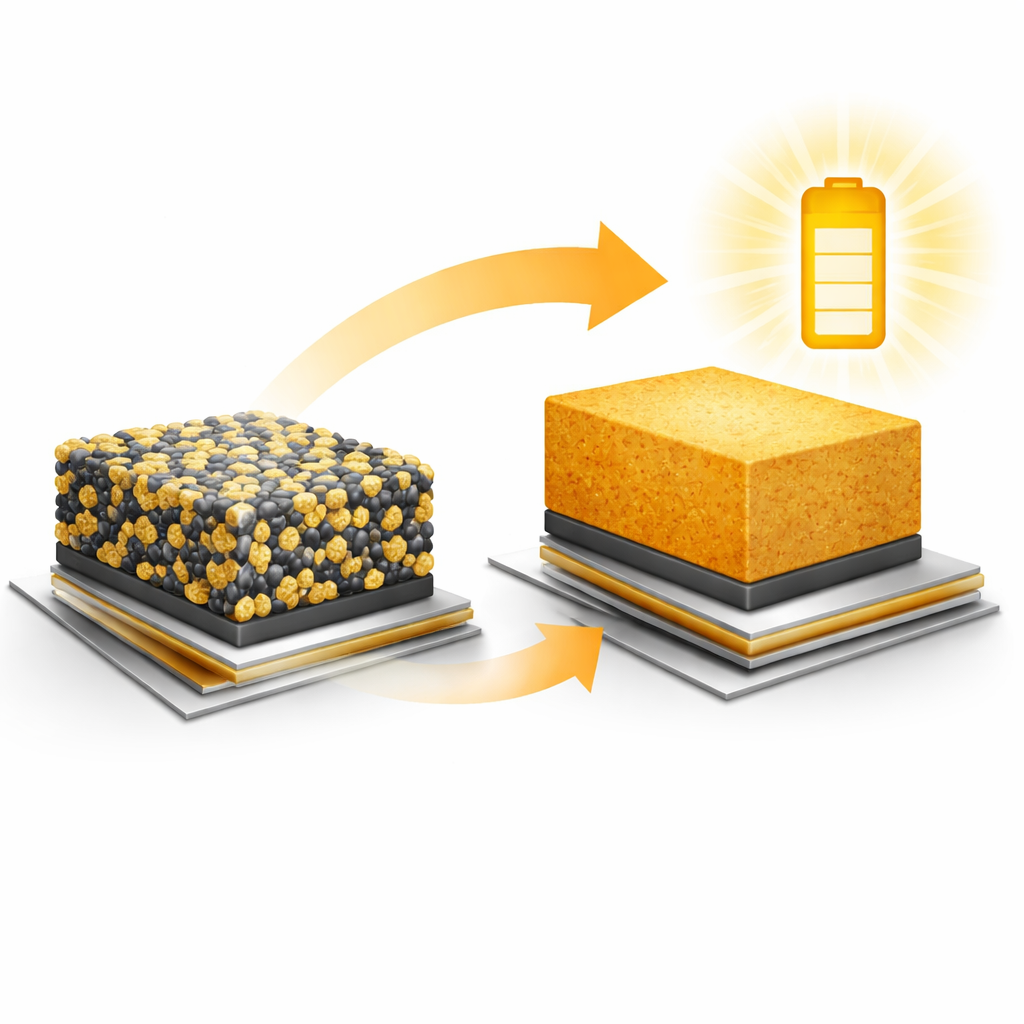
Most commercial batteries use cathodes made from a loose mixture of powders, binders, and other inactive ingredients. These extra components take up space and reduce how much energy the battery can store. The researchers instead use a dense “ceramic” cathode made almost entirely of an active material called LiNi0.5Mn1.5O4 (LNMO), which works at a very high voltage. By removing binders and conductive additives, they create an “all-electrochemically active” electrode that can achieve very high loading and areal energy—about 25 milliwatt-hours per square centimeter in this work—while keeping the structure mechanically robust.
Tuning heat and gas to shape the material
To build these ceramic cathodes, powdered LNMO is pressed and then fired at high temperatures under either normal air or pure oxygen. The team shows that both the firing temperature and the gas atmosphere strongly influence the microscopic structure. Higher temperatures make the crystals grow and the ceramic denser, which helps lithium ions move more easily. But too much heat in air also causes oxygen and lithium to escape, pushing manganese into a more reduced state that distorts the crystal lattice and creates defects. When the material is fired in oxygen instead, these harmful changes are largely suppressed: there are fewer oxygen vacancies, less of the problematic manganese state, and a more stable crystal framework.
Balancing conductivity and hidden damage
The authors carefully measure how well lithium ions travel through the ceramic by using impedance spectroscopy, which tracks how the material responds to tiny electrical signals at different temperatures. They find a sweet spot where higher temperature improves density and ion pathways inside the grains and across grain boundaries, boosting conductivity. However, in air-sintered samples this benefit reverses at very high temperatures as chemical damage at grain boundaries grows. Oxygen-sintered samples hold onto their good performance up to a higher firing temperature, confirming that the chemical environment during processing is just as important as how tightly the ceramic is packed.
When the metal contact becomes a weak link
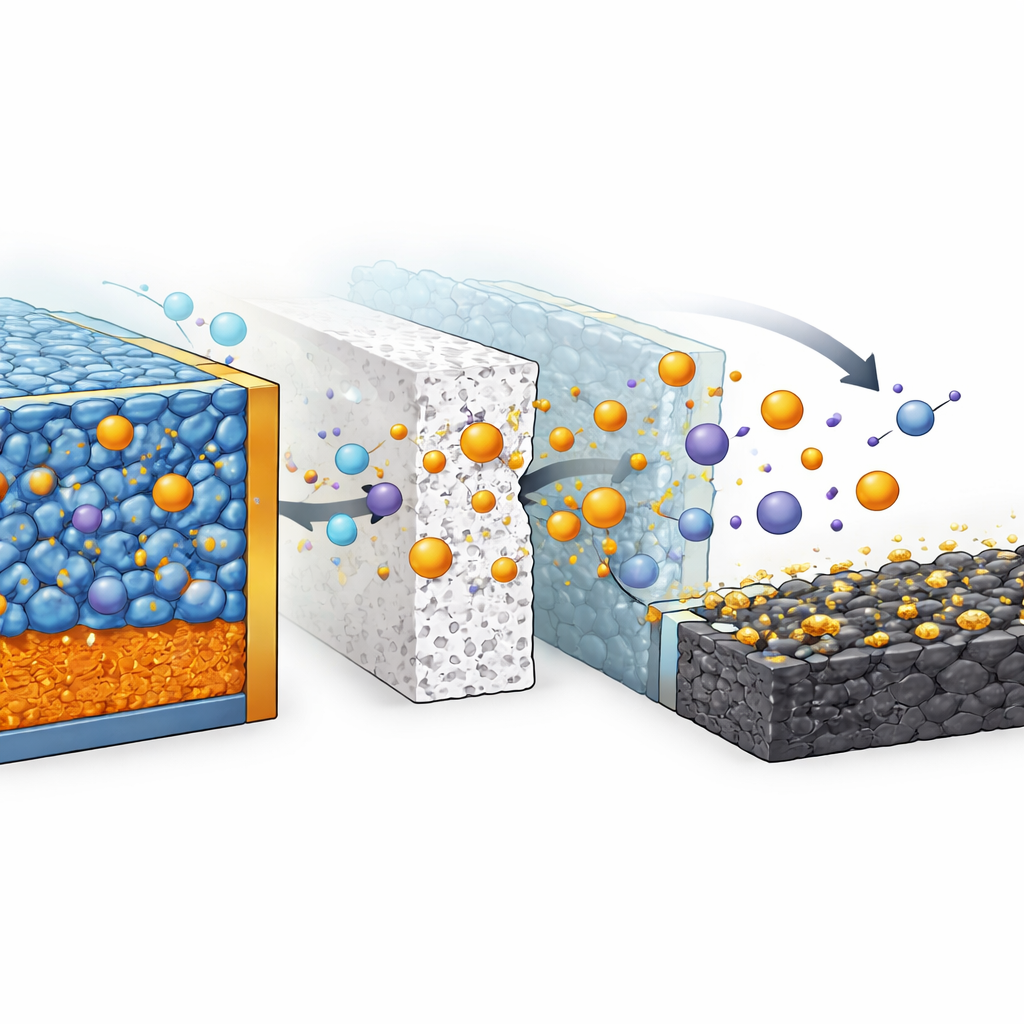
Surprisingly, when these ceramic cathodes are assembled into coin cells with liquid electrolyte, the batteries lose capacity much faster than expected, and the charging curve stretches in an unusual way. Post-mortem imaging reveals why: the thin gold layer used as the current collector, chosen because it is normally quite stable, is actually dissolving at the ultra-high operating voltage of LNMO (around 4.7 volts versus lithium). Gold atoms detach from the collector, move through the ceramic pores and separator, and eventually redeposit on the lithium anode. This migration disrupts the contact between cathode and collector, thickens the interfacial films, increases resistance, and contributes more to performance loss than the modest dissolution of the active LNMO itself.
Slowing the breakdown of the ceramic itself
The team also tracks how the ceramic cathode structure changes after cycling. In air-sintered samples, the crystal lattice expands noticeably, and advanced electron microscopy shows mixed manganese charge states and many oxygen defects near the surface. These regions encourage manganese to dissolve into the electrolyte, trigger further oxygen release, and set off a chain of reactions that damage both the cathode and the electrolyte over time. Oxygen-sintered ceramics show much smaller lattice changes, fewer defects, and less manganese loss, meaning their internal network remains more intact even under demanding high-voltage operation.
What this means for future batteries
For a non-specialist, the key message is that packing more energy into cobalt-free batteries is not just about inventing a new material; it is about carefully controlling how that material is cooked and what metals touch it. This study shows that LNMO ceramic cathodes can deliver high energy density, but only if they are fired in oxygen to tame damaging defects and paired with a collector metal that can survive their high voltage. By exposing the hidden roles of processing atmosphere, microscopic structure, and current collector stability, the work offers a roadmap for designing tougher, greener batteries that last longer in real use.
Citation: Li, C., Ma, J., Jiang, C. et al. Probing degradation of Cobalt-free LiNi0.5Mn1.5O4 ceramic cathode in lithium-ion batteries. npj Mater Degrad 10, 55 (2026). https://doi.org/10.1038/s41529-026-00768-x
Keywords: lithium-ion batteries, cobalt-free cathodes, ceramic electrodes, high-voltage spinel, battery degradation