Clear Sky Science · en
Grain boundary effects on radiation damage and tritium diffusion in Li–Al–O ceramics from molecular dynamics and experiments
Why tiny borders inside ceramics matter
Lithium ceramics help produce tritium, a key material for national defense and future fusion energy. Inside these materials, countless tiny borders called grain boundaries can quietly decide whether the ceramic shrugs off radiation or leaks its tritium. This study combines computer simulations and experiments to show how those hidden borders both protect the material from damage and, at the same time, can open express lanes for tritium to move.
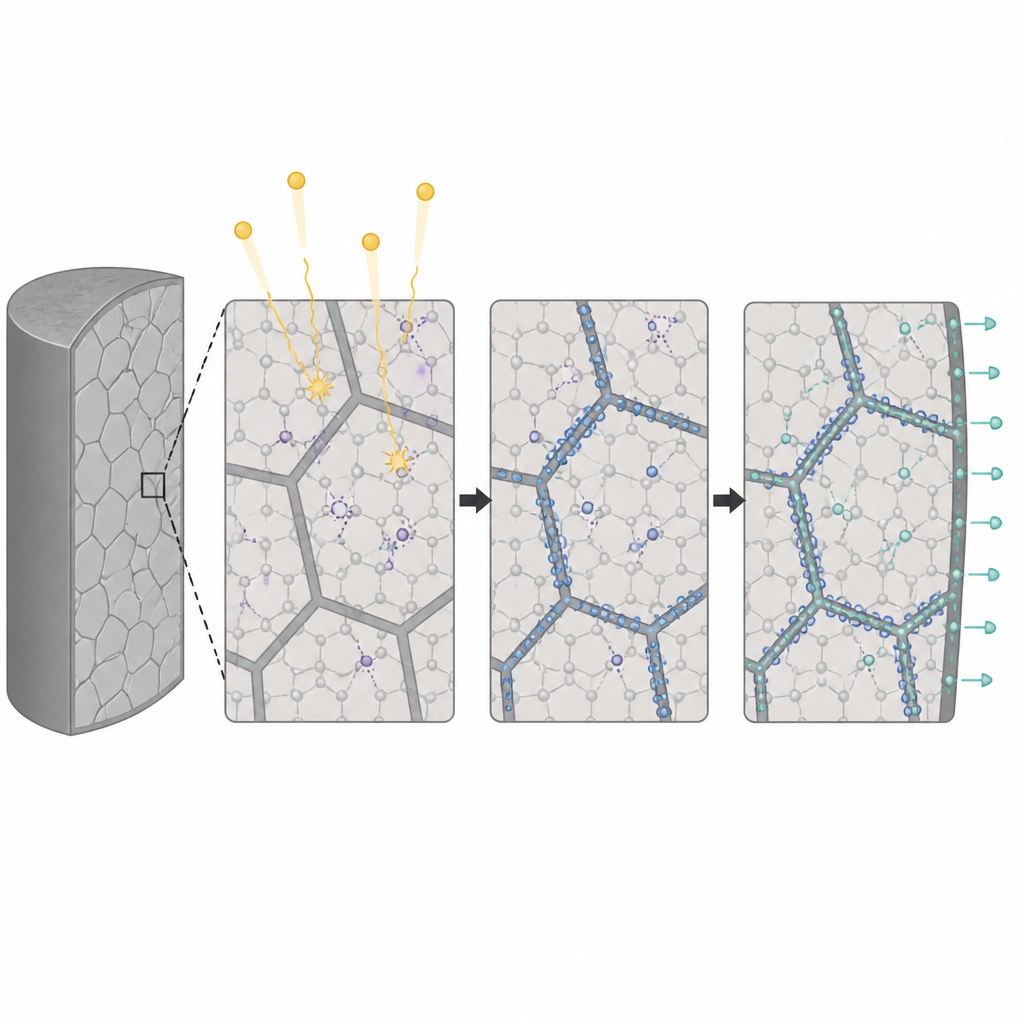
From nuclear pellets to atomic highways
The work focuses on two closely related ceramics, both based on lithium, aluminum, and oxygen. One, called gamma lithium aluminate, is already used in tritium-producing fuel rods. Under radiation, it can transform into a second phase with a more tightly packed crystal structure. In service, these pellets sit in a harsh neutron environment and must hold onto the tritium they generate until it is intentionally extracted. That makes two questions crucial: how badly does radiation damage the ceramic, and how easily can tritium move through it?
How grain boundaries tame radiation damage
The researchers used high-powered microscopes to examine irradiated pellets and saw that cavities tend to cluster along grain boundaries, with nearby regions stripped of defects. To understand this behavior at the atomic level, they ran molecular dynamics simulations that track the motion of hundreds of thousands of atoms after energetic particles knock atoms out of place. In single crystals, without internal borders, lithium atoms are easily displaced and many defects survive. When grain boundaries are present, however, they act like sinks that pull mobile extra atoms toward them, especially the lighter lithium atoms. This “clean up” weakens the amount of long-lived damage inside the grains, cutting certain defect counts by as much as a factor of seven.
Fast paths for tritium along hidden borders
Those same grain boundaries, though, behave very differently for tritium. The team followed tritium ions during repeated radiation pulses at elevated temperature. Instead of wandering evenly through the material, many tritium atoms made sudden, long jumps along the grain boundaries, while tritium inside the grains barely moved. When they calculated effective diffusion rates, tritium moved two to ten times faster along grain boundaries than in the bulk. The effect was especially strong in gamma lithium aluminate, whose more open boundaries offer extra free space for atoms to hop through. The denser secondary phase showed lower tritium mobility, suggesting that its tighter boundaries are less welcoming to tritium.
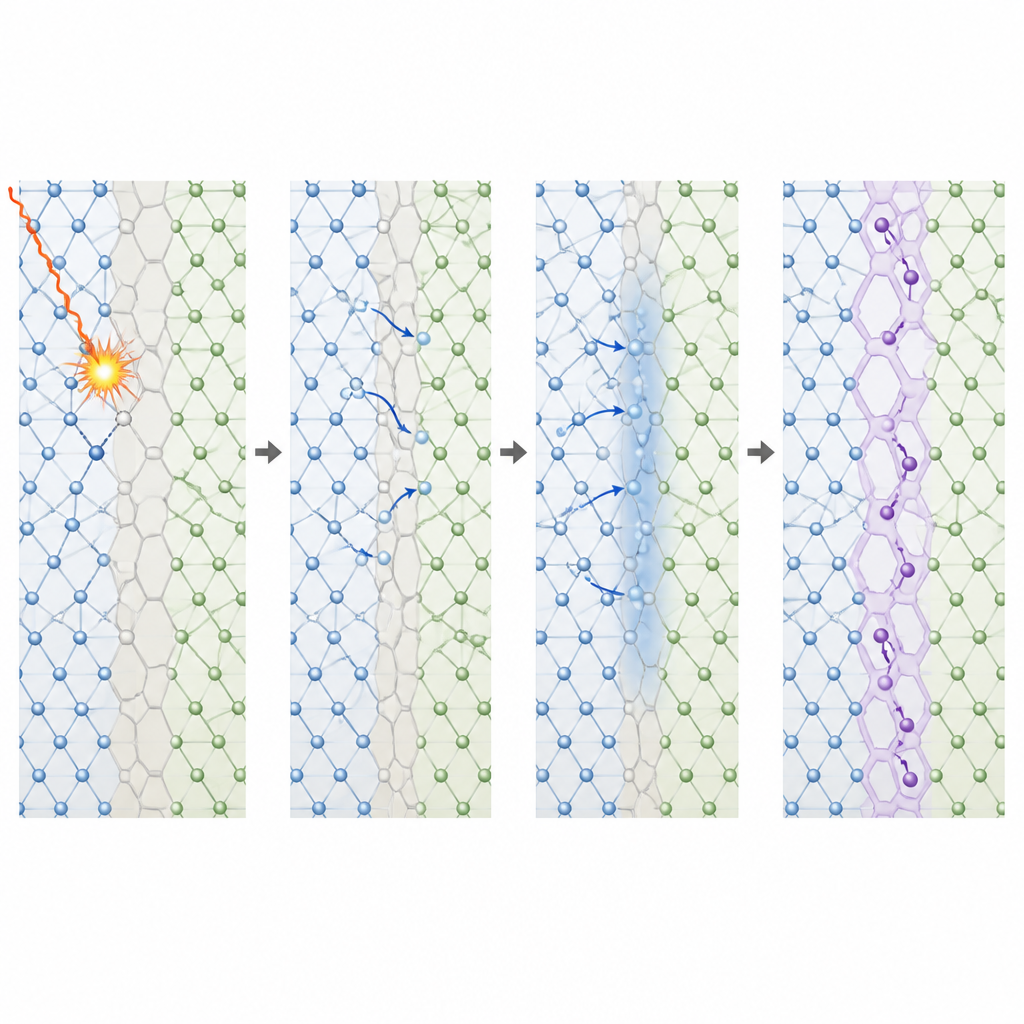
Different behaviors in two sister ceramics
The simulations also revealed that the secondary phase resists radiation in a different way. Its atoms are harder to displace in the first place, so overall damage levels stay lower, and the grain boundaries do not draw in as many point defects. Experiments where surrogate gases were implanted into real pellets back up this picture: the original gamma phase tends to lose lithium near its surface and develop amorphous layers, while the secondary phase largely holds onto its lithium and keeps its crystal order. Together, these differences point to a trade off between how easily the material is damaged and how easily tritium can escape.
Designing ceramics for safe tritium control
For engineers, the message is that grain boundaries are double edged tools. They help heal radiation damage by soaking up extra atoms but also open up fast tritium pathways that could let the gas leak out of fuel pellets too quickly. By carefully tuning how many grain boundaries exist, what kinds they are, and how much of the secondary phase is present, it should be possible to design lithium ceramics that both survive intense radiation and keep tritium where it is wanted until it is deliberately recovered.
Citation: Roy, A., Jiang, W., Casella, A.M. et al. Grain boundary effects on radiation damage and tritium diffusion in Li–Al–O ceramics from molecular dynamics and experiments. npj Mater Degrad 10, 57 (2026). https://doi.org/10.1038/s41529-026-00766-z
Keywords: lithium aluminate, grain boundaries, radiation damage, tritium diffusion, ceramic breeder materials