Clear Sky Science · en
Grain ultra-refinement–induced multilayer co-enrichment of Cr and Si in the rust layer enhances corrosion resistance of weathering steel
Why rust can sometimes protect steel
Steel bridges, buildings, and ships are constantly attacked by air, moisture, and salt, which slowly eat away at the metal. A special family of alloys called weathering steels is designed so that the rust they form turns into a protective skin instead of a destructive crust. This study explores how making the steel’s internal crystal grains extremely small, and adding modest amounts of chromium and silicon, can turn that rust layer into an even better shield against corrosion in salty environments like coastal regions.
From everyday steel to self‑protecting metal
Ordinary low‑alloy steel is strong and cheap, so it is widely used in bridges, buildings, pipelines, and ships. However, when exposed to the atmosphere, especially where salt is present, it corrodes and gradually loses strength. Weathering steels tackle this problem by adding small amounts of elements such as chromium, nickel, copper, phosphorus, and silicon. These ingredients encourage the formation of a dense, tightly attached rust layer that slows down further attack. Yet, not all rust layers are equally protective, and the role of each alloying element—particularly chromium and silicon—has been debated, with some studies reporting benefits and others seeing drawbacks.
Making the grains tiny to tune rust
The authors compared two versions of the same weathering steel: one with relatively large grains about 25 micrometers across, similar to conventional steel, and another that had been processed to have ultrafine grains only about 0.5 micrometers wide. Both steels contained chromium and silicon and were tested in a lab setup that repeatedly wetted and dried the samples in a salty solution, imitating marine splash or spray. By tracking weight loss, electrical behavior, and detailed rust structure and chemistry, the team followed how the rust layers formed and evolved over hundreds of hours.
How a multilayer rust shield forms
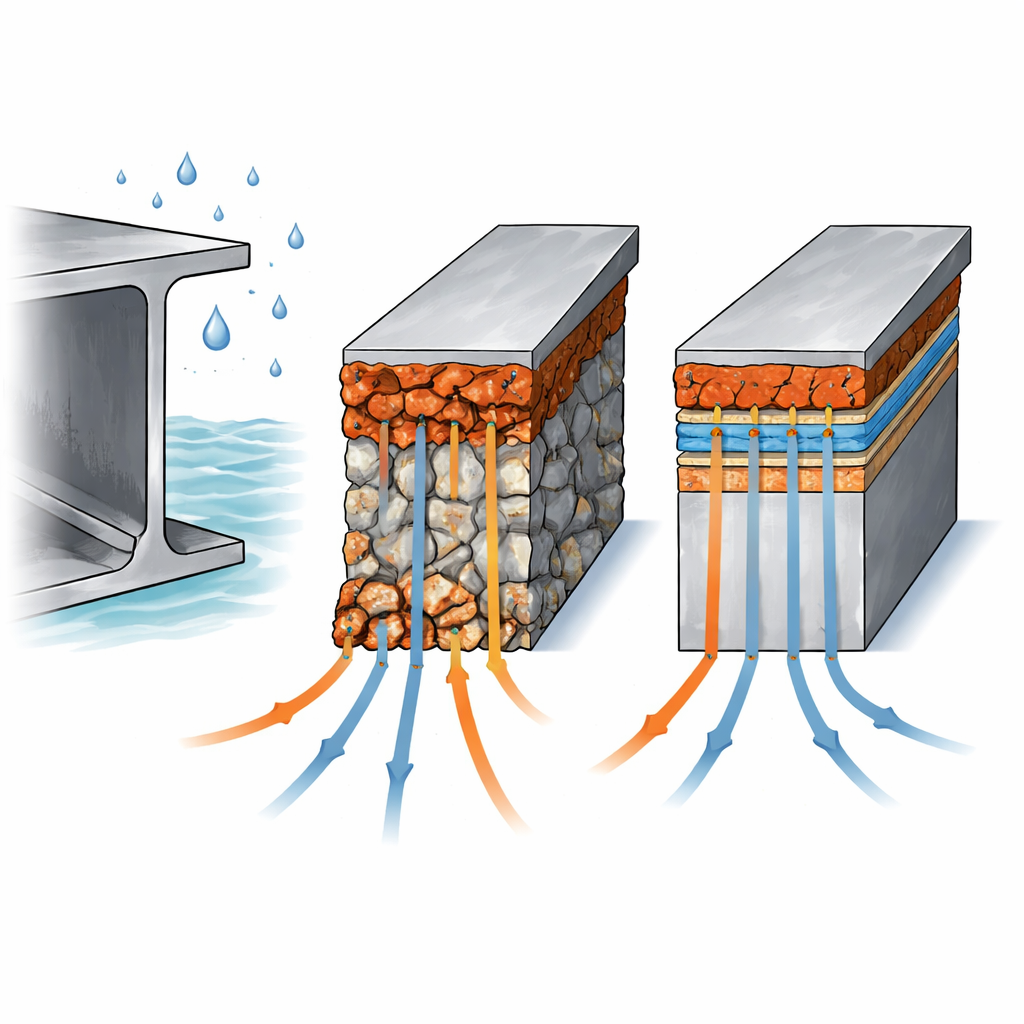
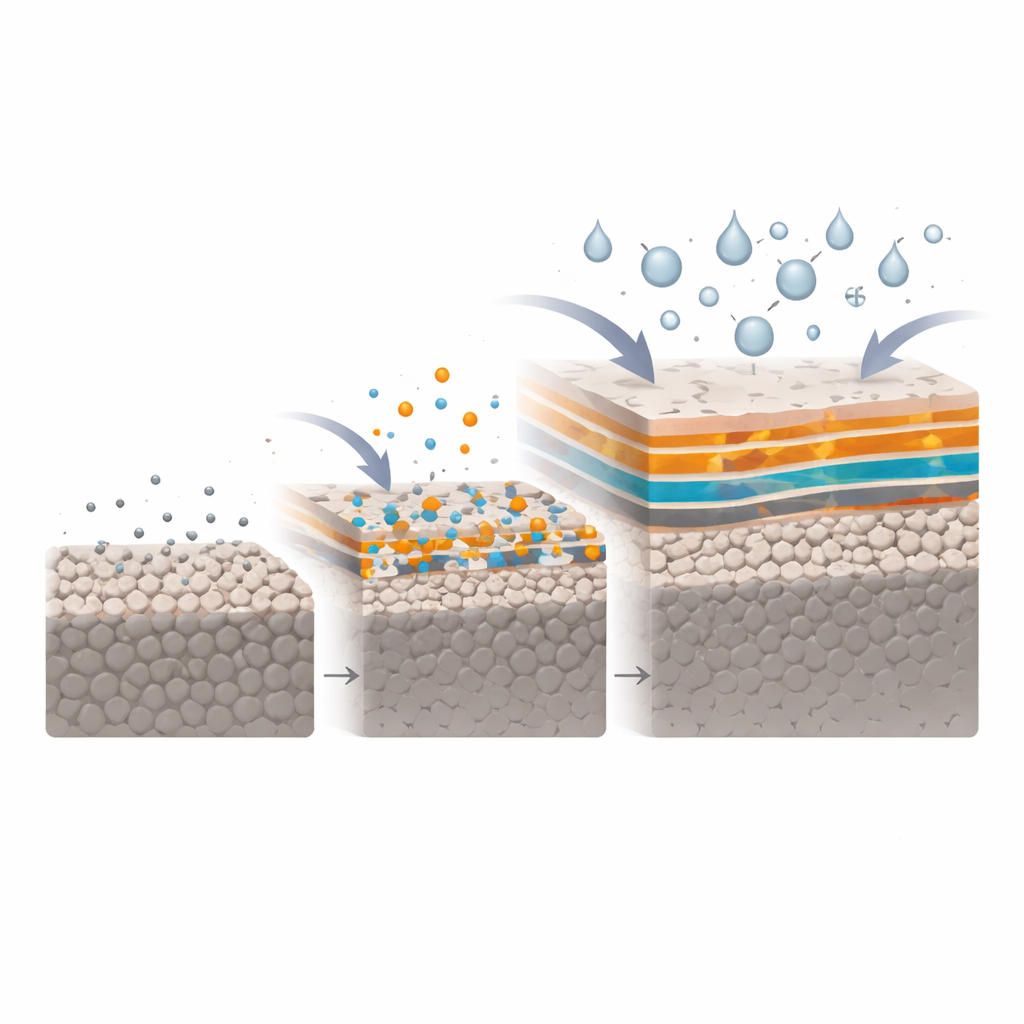
Early in exposure, the ultrafine‑grained steel actually corroded slightly faster than the coarse‑grained version. Its many grain boundaries made the surface more reactive, so iron dissolved more readily and initial rust built up quickly. Over time, however, a very different picture emerged. In the fine‑grained steel, chromium and silicon were pulled toward the surface as iron selectively dissolved. Within the rust, these elements gathered in the same regions and formed multiple stacked layers of mixed chromium–silicon oxides. At the same time, the unstable initial rust phases gradually transformed into a more stable, fine‑grained iron oxyhydroxide known as alpha‑FeOOH, which tends to pack into a dense, continuous inner layer. Together, the multilayer chromium–silicon zones and the compact alpha‑FeOOH created an armor‑like rust structure with few cracks and pores.
Keeping salt and oxygen out
In contrast, the steel with large grains developed a thicker but more porous rust layer, with cracks and channels that allowed aggressive chloride ions and oxygen to penetrate deep toward the metal. Chromium and silicon were only weakly enriched, and the protective alpha‑FeOOH phase grew more slowly and in smaller amounts. Measurements of how easily electrical charge and dissolved oxygen moved through the rust confirmed that the ultrafine‑grained steel ended up with a much more resistive, diffusion‑blocking layer. Three‑dimensional surface maps after rust removal showed that the coarse‑grained steel suffered deeper, sharper pits, while the ultrafine‑grained steel remained much smoother, with far less localized damage.
What this means for long‑lasting steel structures
By the end of the test, the initially more active ultrafine‑grained weathering steel outperformed its coarse‑grained counterpart, corroding more slowly and avoiding severe pitting. The study shows that when chromium and silicon are present, shrinking the steel’s grains can trigger a beneficial chain reaction: faster early dissolution of iron concentrates these elements in the rust, they build up as multiple chromium–silicon oxide layers, and they help convert the rust into a dense, stable form that effectively blocks salt and oxygen. For engineers, this suggests that controlling both composition and grain size can produce weathering steels whose rust truly behaves like a durable, self‑healing coat of armor, extending the service life of critical infrastructure in harsh, salty environments.
Citation: Wang, P., Geng, Y., Li, H. et al. Grain ultra-refinement–induced multilayer co-enrichment of Cr and Si in the rust layer enhances corrosion resistance of weathering steel. npj Mater Degrad 10, 51 (2026). https://doi.org/10.1038/s41529-026-00765-0
Keywords: weathering steel, corrosion resistance, grain refinement, chromium and silicon, protective rust layer