Clear Sky Science · en
Time-series profiling of structure–property relationships in biodegradable polymers via NMR-driven data science
Why smarter biodegradable plastics matter
As worries about plastic waste in oceans grow, biodegradable plastics are often promoted as an easy fix. But not all “green” plastics break down in the same way or on a useful schedule, especially in real coastal waters filled with salt, mud, and microbes. This study explores how different biodegradable plastics actually fall apart over time in estuary water, and shows how advanced measurements and data science can be combined to design materials that stay strong when we need them, yet reliably disappear afterward.
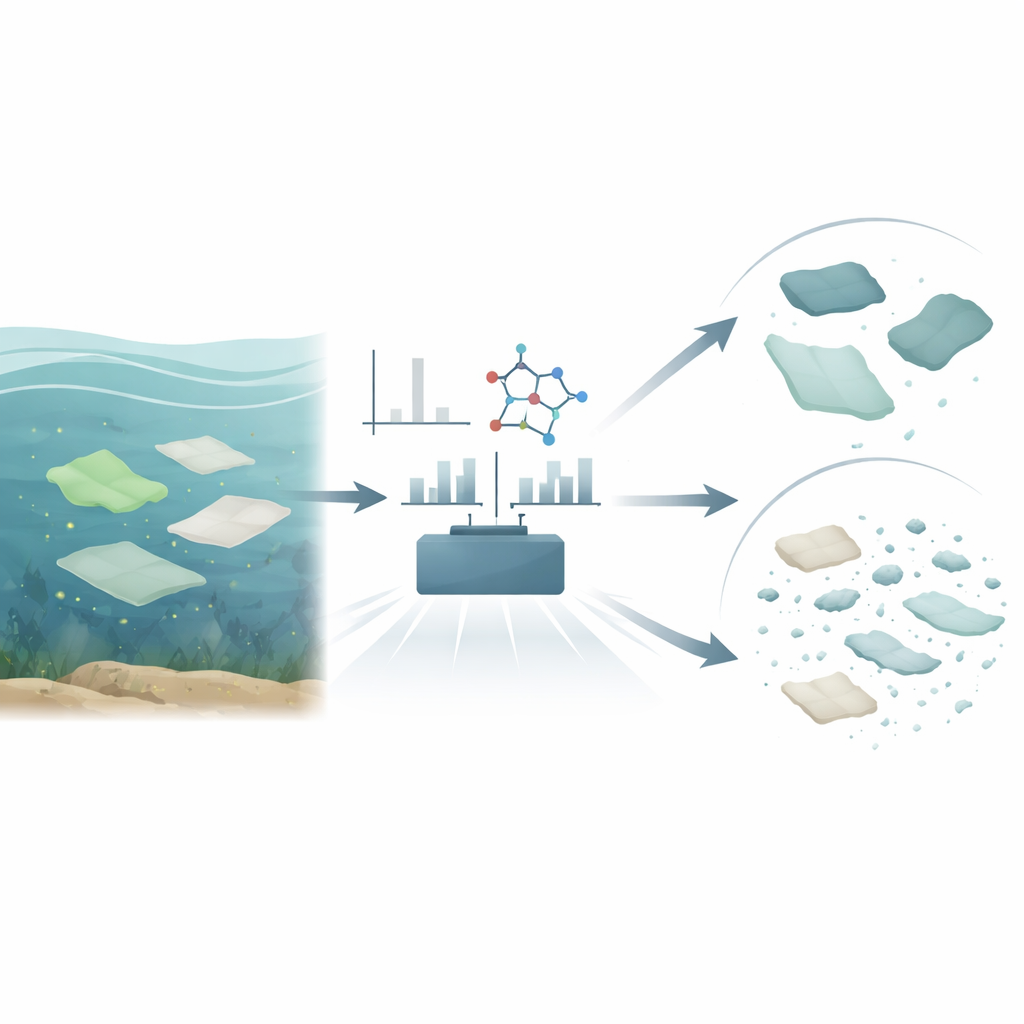
Watching plastics change day by day
The researchers focused on seven widely used biodegradable polyesters, including materials used in packaging, agricultural films, and bioplastics made by microbes. These plastics were shaped into thin sheets and placed in brackish water collected from a Japanese estuary. Over 30 days, the team tracked how much mass each sample lost, revealing very different behaviors even under identical conditions. Some materials, such as PHBH and P(3HB), quickly shed mass after a short waiting period, while others like PBS and PBAT started degrading later and more slowly. Polycaprolactone began to break down earlier and more steadily. These contrasts confirmed that “biodegradable” is not a one-size-fits-all label: the rate and pattern of breakdown strongly depend on the internal make-up of each plastic.
Looking inside plastics with magnetic lenses
Mass loss alone cannot show what is happening at the molecular level inside a plastic sheet. To open this black box, the team used powerful forms of nuclear magnetic resonance (NMR), a technique that treats atoms a bit like tiny spinning magnets. One type of NMR, called time-domain NMR, senses how easily polymer chain segments can move, distinguishing rigid regions from more flexible ones. Another, solution-state NMR, examines the detailed chemical surroundings of atoms once the polymer is dissolved. Together with standard tests of strength and stretchiness, plus thermal measurements that capture crystal content and softening temperatures, these tools created a rich portrait of each material’s inner structure and motion before and during degradation.
Teaching computers to read the signals
The central idea of the work is to consider plastic degradation as a time-based story rather than a single before-and-after snapshot. The authors built machine learning models, including a convolutional neural network and a Random-Forest model, that learned from many kinds of input at several time points: NMR signals, mechanical properties such as Young’s modulus, strain at break, and maximum stress, and thermal traits like melting and glass transition temperatures. The models predicted how much mass each sample would lose as degradation progressed and did so with strong accuracy. To avoid treating the algorithms as opaque black boxes, the team used explainable AI tools to estimate how much each feature contributed to predictions at different stages, effectively asking the model what it was “paying attention” to over time.
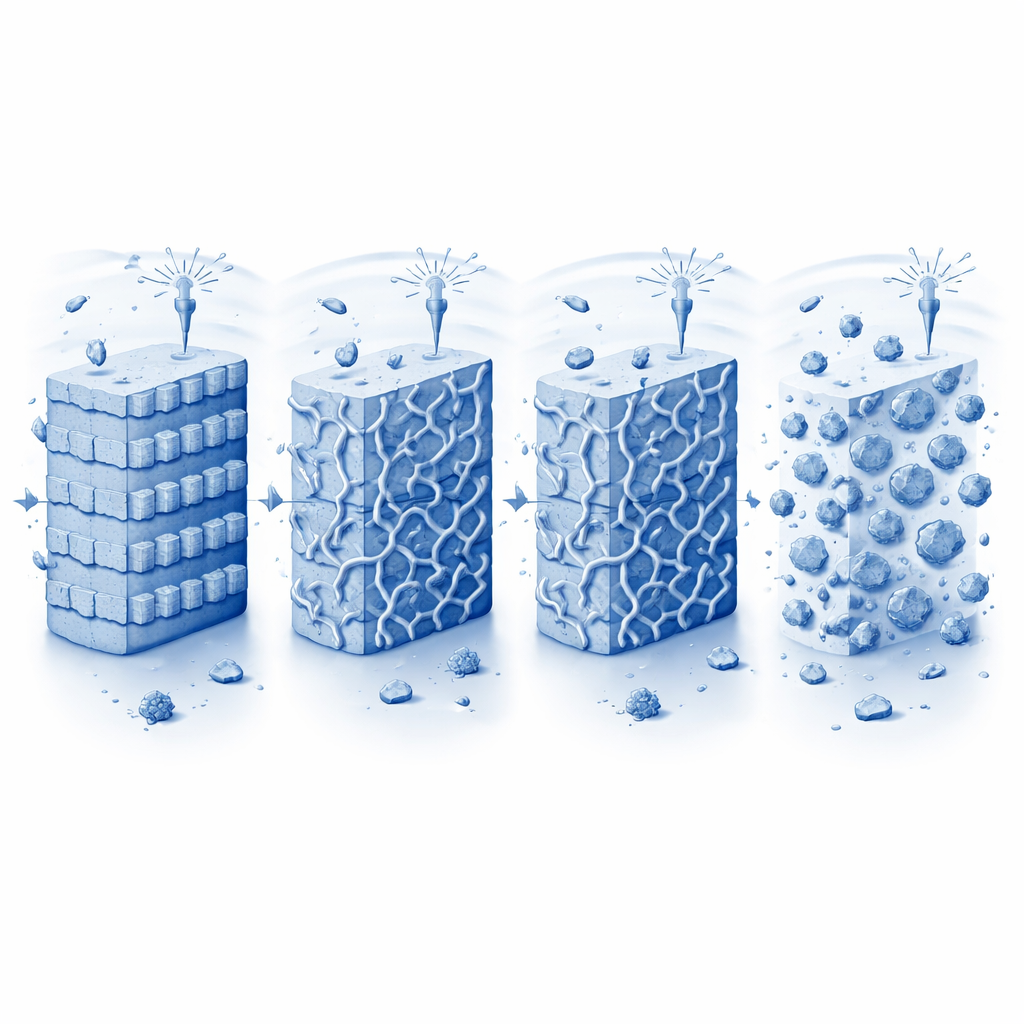
How control shifts as plastics age
The time-based analysis revealed a subtle but important pattern. Early in exposure, predictions were driven mainly by bulk mechanical traits: how far a sample could stretch before breaking and how much stress it could bear. These features captured the initial integrity of each plastic sheet. As days passed and the materials’ insides reorganized, measures linked to internal motion and local chemistry grew in importance. Thermal indicators of crystal structure and NMR-derived signatures of chain mobility and chemical environment became stronger guides to how fast mass was being lost. A separate statistical analysis showed that many of these features are interdependent clusters rather than isolated knobs, so the apparent “shift” reflects changing emphasis within a web of related structural signals rather than a simple handoff from one controlling factor to another.
Designing plastics for a full life cycle
For non-specialists, the key takeaway is that designing better biodegradable plastics is not just about choosing the right chemical recipe, but about managing how a material’s structure relaxes and opens up over time. This study demonstrates that by combining precise physical measurements with data-driven models, it is possible to map when different aspects of a plastic—its toughness, its crystallinity, its internal mobility—matter most for its behavior in real water. In practice, this means engineers can aim for plastics that stay mechanically reliable during their service life yet are primed to gradually loosen their internal constraints and become accessible to water and microbes afterward. Rather than offering a single magic formula, the work provides a time-aware roadmap for tuning materials so that strength and degradability are balanced stage by stage along their life cycle.
Citation: Ni, X., Amamoto, Y. & Kikuchi, J. Time-series profiling of structure–property relationships in biodegradable polymers via NMR-driven data science. npj Mater Degrad 10, 53 (2026). https://doi.org/10.1038/s41529-026-00764-1
Keywords: biodegradable polymers, marine plastic degradation, nuclear magnetic resonance, machine learning in materials, structure–property relationships