Clear Sky Science · en
Effect of CO2 curing on the performance of the passivation film of steel bars in cement-based materials
Why greener concrete protection matters
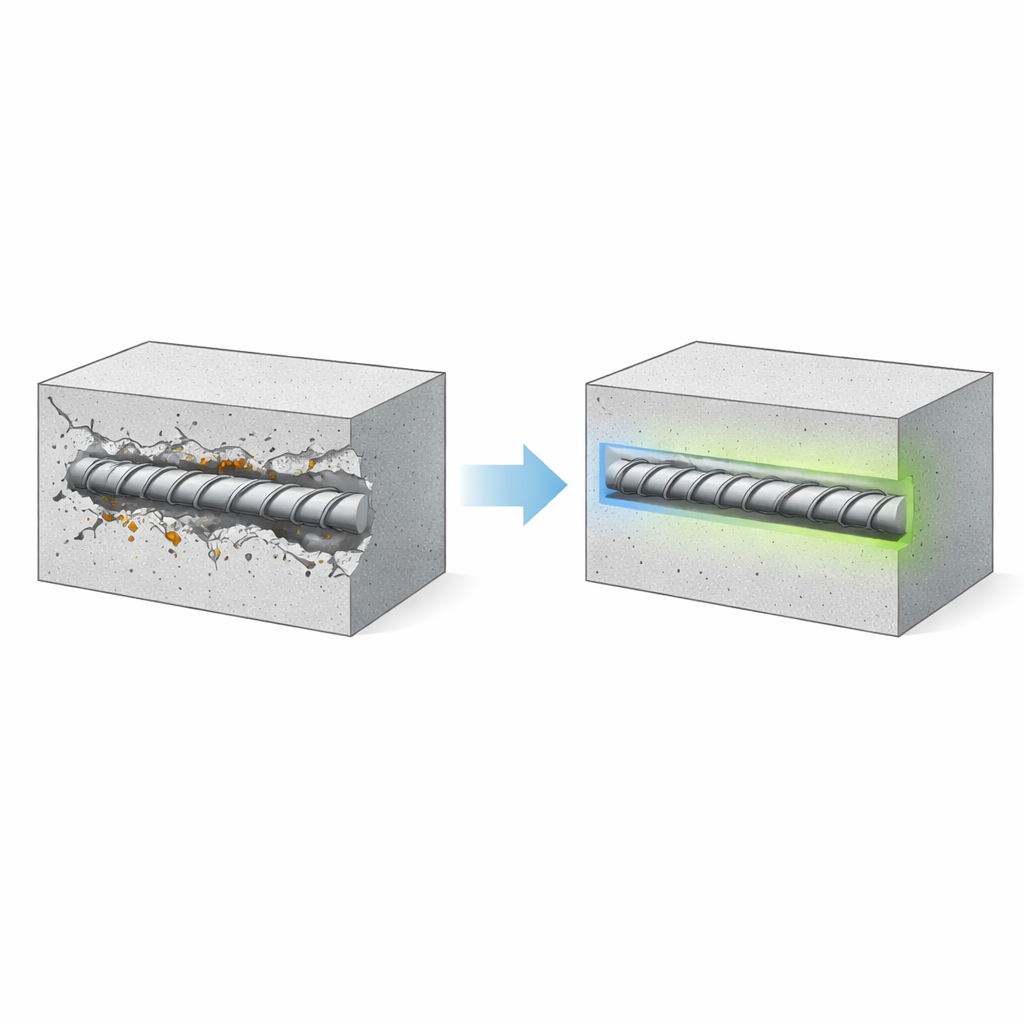
Modern cities rely on reinforced concrete, where steel bars hidden inside carry much of the load. Over time, those bars can rust, threatening bridges, buildings, and sea walls. At the same time, the cement industry is a major source of carbon dioxide (CO2). This study explores a technology called CO2 curing that could help on both fronts at once: it locks CO2 into fresh concrete and, as this work shows, can actually make the steel inside better protected against corrosion.
Breathing in CO2 to make stronger concrete
Instead of letting new concrete harden only in moist air or steam, CO2 curing exposes it to a high concentration of carbon dioxide during its early life. The gas reacts with the cement paste to form solid carbonate minerals that pack into the pores near the surface. This reaction both stores CO2 in the material and creates a denser outer shell. Because most concrete structures are reinforced with steel bars, the authors focused on what this altered environment does to the thin protective layer—called the passivation film—that naturally forms on steel in highly alkaline concrete and keeps it from rusting.
Watching steel go passive and then lose protection
The team cast small mortar cylinders containing steel bars and cured half of them with CO2 and half with standard moist conditions. They then tracked how the steel transitioned from an active, unprotected state to a passive, protected one using several electrochemical techniques that sense tiny currents at the steel surface. These measurements showed that in normal mortar the steel took about three weeks to reach a stable passive state, whereas in CO2-cured mortar it did so in roughly half the time. The authors link this speed‑up to a temporarily higher oxygen concentration around the steel caused by CO2 reacting and densifying the outer mortar layer, which pushes dissolved oxygen inward and drives faster formation of the protective film.
A thinner but tougher protective skin
At first glance, the passivation film in CO2‑cured specimens might seem worse: it is slightly thinner—about 4.06 nanometers versus 4.73 nanometers in standard curing. But the same tests showed that it resists charge transfer more strongly, meaning it is harder for corrosive reactions to proceed. Microscopy of the steel surface revealed why. In CO2‑cured mortar, the film is more uniform and finely ordered, forming a continuous vertical grain pattern that blocks pathways for chloride ions and oxygen. Chemical analysis using X‑ray photoelectron spectroscopy further showed that this film has a higher proportion of iron in a lower oxidation state (Fe2+) relative to Fe3+. That balance appears to pack the film more tightly and give it a greater ability to self‑repair small defects, reconciling the surprising combination of thinner thickness and better protection.
Holding off salt damage for much longer
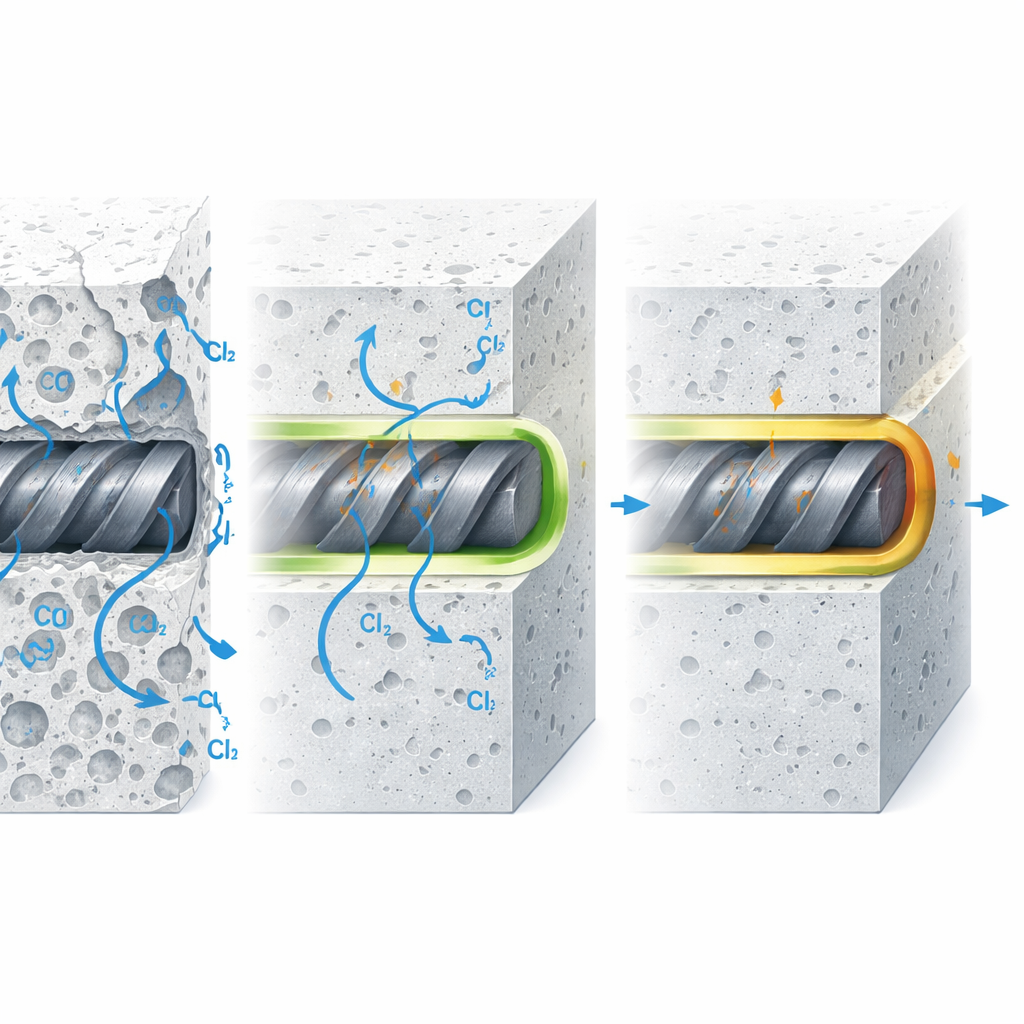
Real structures are often exposed to salts from sea water or de‑icing agents, which can gradually break down the passivation film. To mimic this, the researchers cycled their specimens through repeated soaking in salt solution and drying. Steel in standard‑cured mortar lost its protective state after 18 such cycles, with corrosion currents jumping sharply. In contrast, steel in CO2‑cured mortar stayed passive until about 30 cycles, meaning the onset of serious corrosion was delayed by roughly two‑thirds. This improvement comes from a double benefit: the carbonated outer mortar layer slows down the arrival of chloride ions, and the refined passivation film itself is more stable and less defect‑prone under attack.
What this means for future structures
Taken together, the findings suggest that CO2 curing does more than just trap greenhouse gas in concrete; it also reshapes the microscopic shield protecting the steel within. By speeding up the formation of a denser, chemically more resilient passivation film, and by combining this with a tighter surface pore structure, CO2‑cured concrete can better resist salt‑induced corrosion over time. For engineers, this means that swapping traditional steam curing of precast elements for CO2 curing could extend the service life of bridges, marine structures, and other critical infrastructure while contributing to CO2 utilization—offering a rare win‑win for durability and climate impact.
Citation: Guo, B., Shi, L., Chu, J. et al. Effect of CO2 curing on the performance of the passivation film of steel bars in cement-based materials. npj Mater Degrad 10, 50 (2026). https://doi.org/10.1038/s41529-026-00762-3
Keywords: CO2 curing, reinforced concrete, steel corrosion, passivation film, chloride attack