Clear Sky Science · en
Advanced sensor systems and machine learning for pipeline integrity management: a review of corrosion monitoring and prediction strategies
Why Keeping Pipelines Healthy Matters
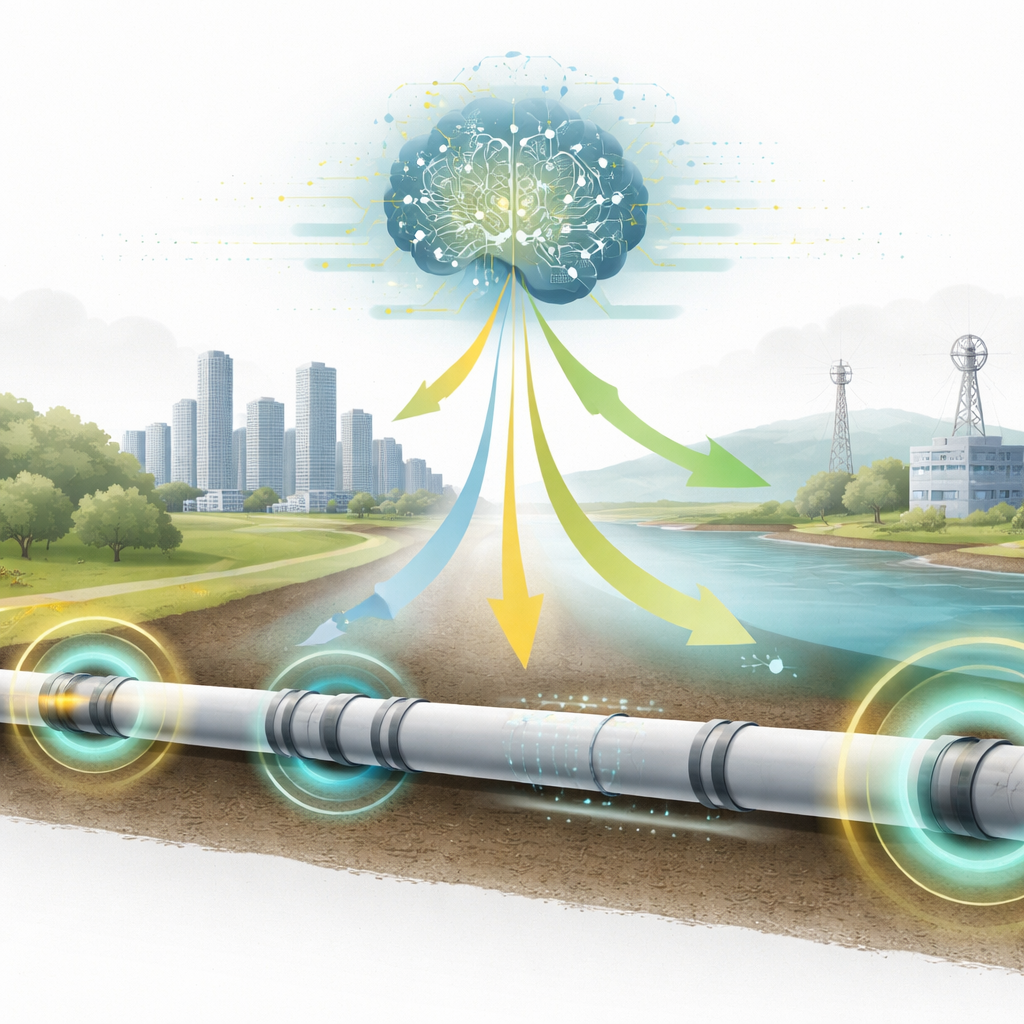
Oil and gas pipelines quietly crisscross continents, carrying the fuels that power homes, transport and industry. When these steel arteries fail, the results can be deadly fires, toxic spills and billion‑dollar cleanups. This article reviews how modern sensors and artificial intelligence are being combined to spot dangerous corrosion earlier, make sense of huge streams of inspection data, and move the industry from occasional checkups to continuous, predictive care of these critical lifelines.
The Hidden Enemy Eating Away at Steel
At the heart of the problem is corrosion: a slow electrochemical process where steel reacts with water, gases and soil, gradually thinning the pipe wall or punching tiny pits through it. Inside the pipe, water mixed with carbon dioxide can form a weak acid that steadily dissolves the metal, while hydrogen sulfide can both corrode and make the steel brittle. Outside, moist soil, salt, stray electrical currents and even colonies of microbes can attack the pipe, sometimes creating deep, narrow pits or crack‑like damage that is hard to see but severely weakens the structure. Because pipelines can stretch for hundreds or thousands of meters through changing environments, these defects appear unevenly and unpredictably, turning inspection into a major technical challenge.
When Corrosion Turns into Catastrophe
Corrosion is dangerous not just because metal is lost, but because it concentrates stress in small areas. Deep pits or growing cracks act like microscopic notches; under high internal pressure, these spots carry far more load than the surrounding steel. Engineers describe safety in terms of “burst pressure” the pressure at which a pipe is expected to rupture. Simple engineering formulas and detailed computer simulations can estimate this for a given flaw, but they depend on knowing the defect’s exact size and shape, and how fast it is growing. That in turn requires comparing multiple inspection runs over years and correctly matching the “same” flaw as it changes, even when one large pit splits into several, or several merge into a larger scar. This seemingly simple data‑matching step is error‑prone and has been a key weak link in traditional pipeline integrity management.
New Eyes Inside and Outside the Pipe
To find corrosion before it causes a break, operators now use an array of advanced, non‑destructive testing tools. Smart inspection robots travel inside the pipe, using magnetic fields to sense where metal is missing and high‑frequency sound waves to directly measure wall thickness or detect cracks. Other systems are attached to the outside: rings of ultrasonic sensors that can send waves tens of meters along the pipe, ultra‑sensitive microphones that listen for the tiny “pings” of a crack growing or a leak starting, and fiber‑optic cables that effectively turn the whole pipeline into a continuous thermometer and strain gauge. These technologies can cover long distances and detect many kinds of flaws, but each brings its own data problem: some produce extremely complex, noisy signals; others generate vast quantities of measurements, millions of points per second along even a modest stretch of pipe.
Turning Raw Signals into Reliable Warnings
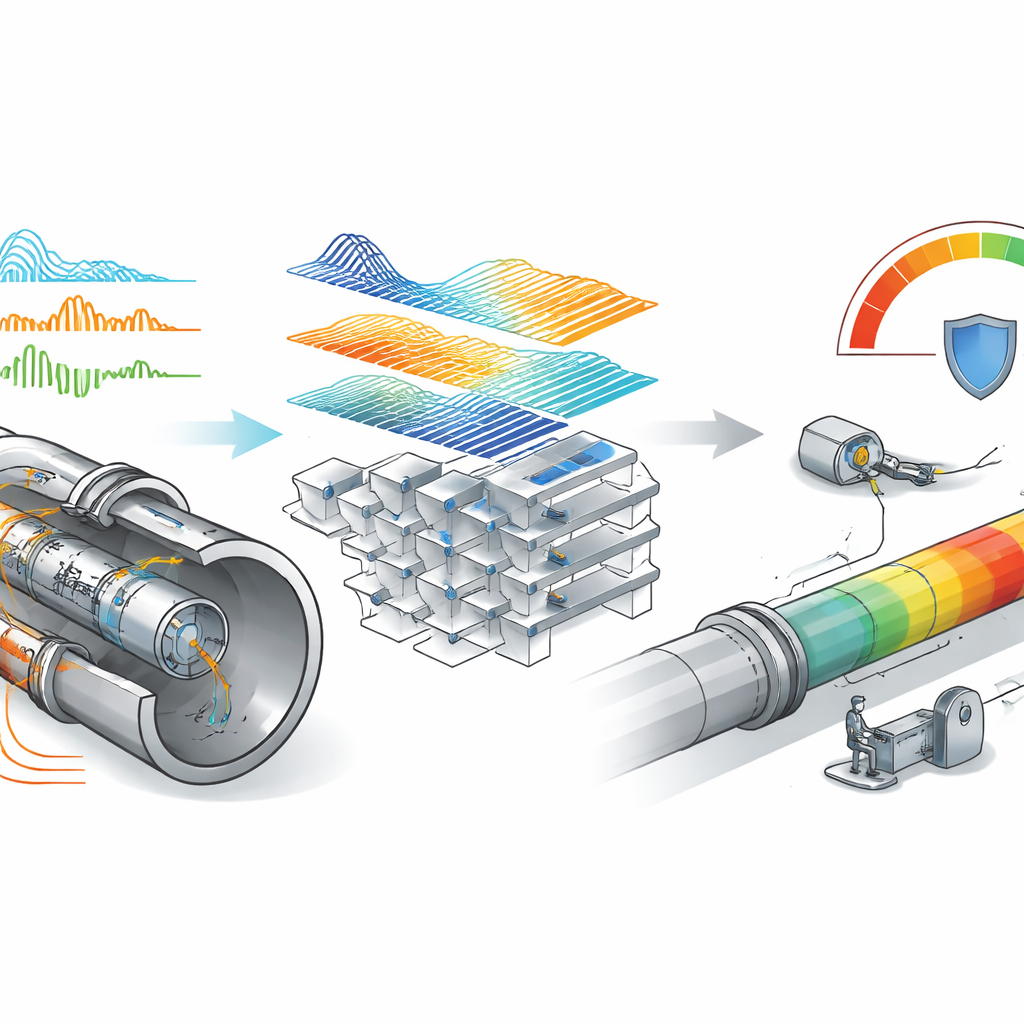
The review argues that the major bottleneck is no longer measuring the pipe, but interpreting what all these sensors see. This is where machine learning comes in. For relatively simple inspection tables that list defect length, width and depth, decision‑tree models can automatically sort flaws into standard categories with near‑perfect accuracy. For messier signals such as ultrasonic echoes or the hissing sounds of a tiny leak, more sophisticated algorithms can first clean the data and then recognize the distinctive patterns of real damage against background noise. In the most challenging case, magnetic readings are treated like images so that deep learning models can infer the true three‑dimensional shape of a corrosion pit from its magnetic fingerprint, even distinguishing between damage caused by microbes and that caused by mechanical scraping.
From Today’s Snapshot to Tomorrow’s Digital Twin
Beyond simply identifying defects, researchers are linking physics‑based simulations and neural networks to forecast how and when a given flaw might fail. Detailed computer models of pipelines under pressure are used to generate virtual examples of many corrosion shapes, and neural networks learn from these to predict burst pressure almost instantly from new sensor data. Other models act as translators between different sensor types, turning a magnetic map into a virtual thickness image so results can be directly compared. Woven together, these tools form the basis of a “digital twin” a live, virtual copy of a pipeline that continuously ingests inspection reports and real‑time sensor feeds, updates the estimated risk along every segment, and highlights where maintenance will be needed long before a leak occurs.
What This Means for Safety and the Future
The article concludes that no single sensor can guarantee safe pipelines. Instead, the real breakthrough comes from combining multiple sensing methods with machine learning engines that can handle both the complexity and the volume of data. Done well, this shift allows operators to move from fixed‑interval, reactive repairs to ongoing, predictive maintenance that extends the life of aging assets, reduces unnecessary excavations, and cuts the risk of sudden failures. Future work will focus on improving sensor hardware for difficult environments, training models on noisier real‑world data, and making these algorithms more transparent and physics‑aware so that engineers can trust their recommendations in safety‑critical decisions.
Citation: Olawole, O.O., Gbadeyan, O.J., Deigh, C. et al. Advanced sensor systems and machine learning for pipeline integrity management: a review of corrosion monitoring and prediction strategies. npj Mater Degrad 10, 48 (2026). https://doi.org/10.1038/s41529-026-00761-4
Keywords: pipeline corrosion, machine learning, structural health monitoring, non-destructive testing, digital twin