Clear Sky Science · en
Atomistic understanding of the impact of radiation on the aqueous leaching of sodium borosilicate glass matrix
Why Nuclear Waste Glass Matters
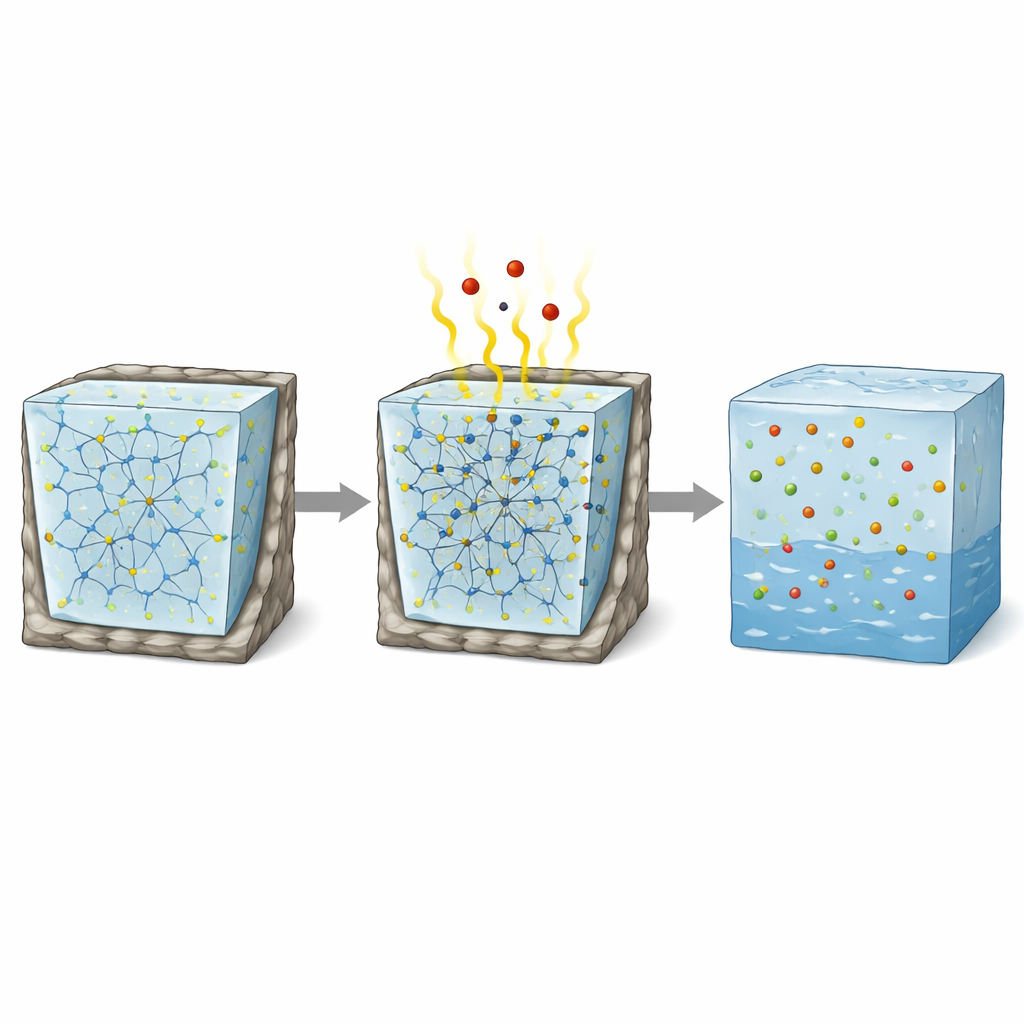
When we talk about nuclear power, one of the biggest questions is what to do with the most radioactive leftovers. Around the world, a special type of glass, called sodium borosilicate glass, is used to lock these atoms in place for thousands of years. This study peels back the curtain at the atomic scale to ask a crucial question: as this glass is slowly battered by radiation deep underground, does it stay strong and resistant to water, or does it gradually weaken and let radioactive elements escape?
Locking Radioactivity Inside Glass
Today’s high‑level nuclear waste is usually mixed into molten sodium borosilicate glass and cooled into large, solid blocks. This glass is popular because it can accept many different chemical ingredients while remaining stable and slow to dissolve in water. But inside each block, some atoms continue to decay, hurling out energetic fragments that slam into the surrounding material. Over centuries and beyond, these tiny “ballistic cascades” can jostle atoms out of place, subtly reshaping the glass. At the same time, groundwater may eventually reach the waste package in a deep geological repository, making it vital to understand how radiation damage and water corrosion interact.
Simulating a Million Years in a Computer
Because real‑time experiments over geological ages are impossible, the authors used large‑scale molecular dynamics simulations to mimic what happens to this glass when it is repeatedly hit by energetic recoil atoms, like those produced when plutonium decays to uranium. They built a detailed virtual glass containing nearly 40,000 atoms, then fired many high‑energy projectiles through it to imitate centuries of radiation. The team analyzed how the short‑range connections between silicon, boron, oxygen, and sodium changed, and how the medium‑range network of rings and cages in the glass evolved. They also calculated how these structural changes affected properties that engineers care about: density, stiffness, resistance to heat, vibrational behavior, and how easily sodium ions leach out into water.
How Radiation Rearranges the Glass Network
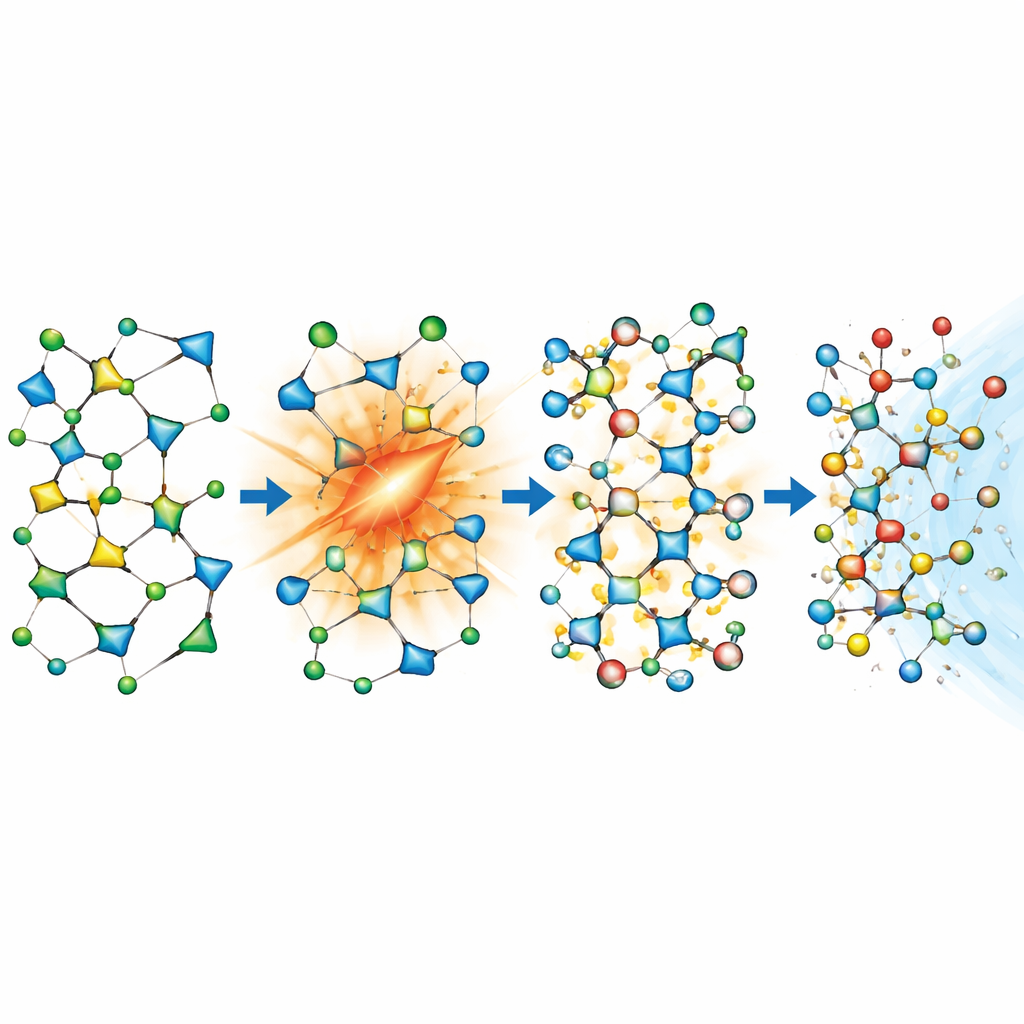
The simulations show that radiation does not simply punch holes in the glass; it subtly rewires its internal network. Locally, regions along the projectile paths are briefly heated and then rapidly “quenched,” a bit like flash‑cooling a melt. This process converts some four‑connected boron units into three‑connected ones and creates more non‑bridging oxygens—oxygen atoms that terminate the network rather than link two building blocks. At the same time, sodium ions, which initially help balance charge, increasingly behave as network modifiers that sit near these broken links. The glass becomes slightly denser overall, forms more small atomic rings, and shows higher configurational disorder, even though its average density increases only about 2 percent.
From Structure Changes to Strength and Corrosion
These microscopic adjustments translate into noticeable shifts in bulk behavior. The glass transition temperature—the point where the glass softens on heating—drops by roughly 6 percent, reflecting a more flexible, less tightly connected network. Mechanical tests in the simulation reveal that the irradiated glass is less stiff and less strong, with the Young’s modulus and ultimate tensile strength falling by about 9 and 18 percent, respectively, and a slightly more plastic‑like failure. When the authors placed the glass in contact with water, they found that sodium ions moved more readily toward the interface and into the solution. The leaching rate of sodium increased by nearly 18 percent, consistent with a network that has more broken links and sodium‑rich clusters that are easier for water to attack. Although the absolute rates are lower than measured in experiments—because real chemical reactions like bond hydrolysis were not included—the trend of faster corrosion after irradiation matches laboratory observations.
Role of Dose Rate and Long‑Term Stability
Importantly, the researchers explored how the energy of each recoil event—the “dose rate”—affects the damage. At low recoil energies, the local structure after each collision recovers fairly well, and the glass network below about 10 keV recoils looks very similar to the undamaged material. At higher energies, damage accumulates: more small rings appear, bond angles tighten, and non‑bridging oxygens proliferate, leaving a more depolymerized and disordered network. Yet in all cases, the changes in density, boron speciation, and non‑bridging oxygen content tend to saturate with dose, meaning that beyond a certain point additional radiation produces diminishing extra damage. This behavior supports the idea that, under the much slower dose rates expected in real waste repositories, much of the damage can anneal as it forms.
What This Means for Storing Nuclear Waste
For a general reader, the key message is both cautionary and reassuring. Radiation does make nuclear waste glass somewhat less rigid and somewhat more prone to releasing sodium when in contact with water, by subtly loosening and rearranging its atomic network. However, these changes are moderate, tend to level off with accumulated dose, and do not signal catastrophic breakdown of the glass. The simulations suggest that sodium borosilicate glass should retain its overall structural integrity over very long timescales, even while experiencing modest increases in corrosion. This supports its continued use as a mainstay material for immobilizing high‑level nuclear waste, while highlighting the need for future models that couple radiation damage with full chemical reactions at the glass–water interface.
Citation: Sahu, P., Ali, S.M. Atomistic understanding of the impact of radiation on the aqueous leaching of sodium borosilicate glass matrix. npj Mater Degrad 10, 47 (2026). https://doi.org/10.1038/s41529-025-00730-3
Keywords: nuclear waste glass, radiation damage, borosilicate glass, glass corrosion, molecular dynamics