Clear Sky Science · en
Self-revival iontronic neuromorphic devices for robust human-machine interaction
Soft electronics that bounce back from damage
Imagine a smartwatch strap or an artificial limb whose "nerves" keep working even after being bent, scratched, or cut—and then quietly heal themselves. This paper reports a new kind of soft electronic device that can sense and process motion like a simple brain while also repairing serious mechanical damage, making future wearables, prosthetics, and robots far more reliable in everyday life.
Why today’s soft circuits still break
Modern gadgets increasingly try to match the body’s flexibility, but the underlying electronics are often just thin, bendable versions of rigid chips. Their active layers are continuous films: once a deep crack or puncture forms, electrical pathways can fail catastrophically. Even advanced “self-healing” plastics only partially solve the problem. Repeated stretching and repair can subtly change their chemistry, causing drifting performance—a serious issue if the device is acting like a nerve or learning system. The authors argue that truly dependable soft electronics must combine clever materials with equally clever architecture.
Learning from the earthworm’s body plan
Earthworms provide the key inspiration. Their bodies are made of repeating segments, each with its own small nerve center. If a worm is injured, the remaining segments can still function, and damaged portions can regenerate. Translating this idea into electronics, the researchers built a flexible strip populated with many small, dome-shaped units, each acting like an individual electronic “neuron.” These domes are made from an ion-rich gel that conducts signals using charged particles rather than standard metal wires, and they can stick back together after being cut. Because the units are separated from one another, cracks are physically stopped instead of spreading across the entire device. 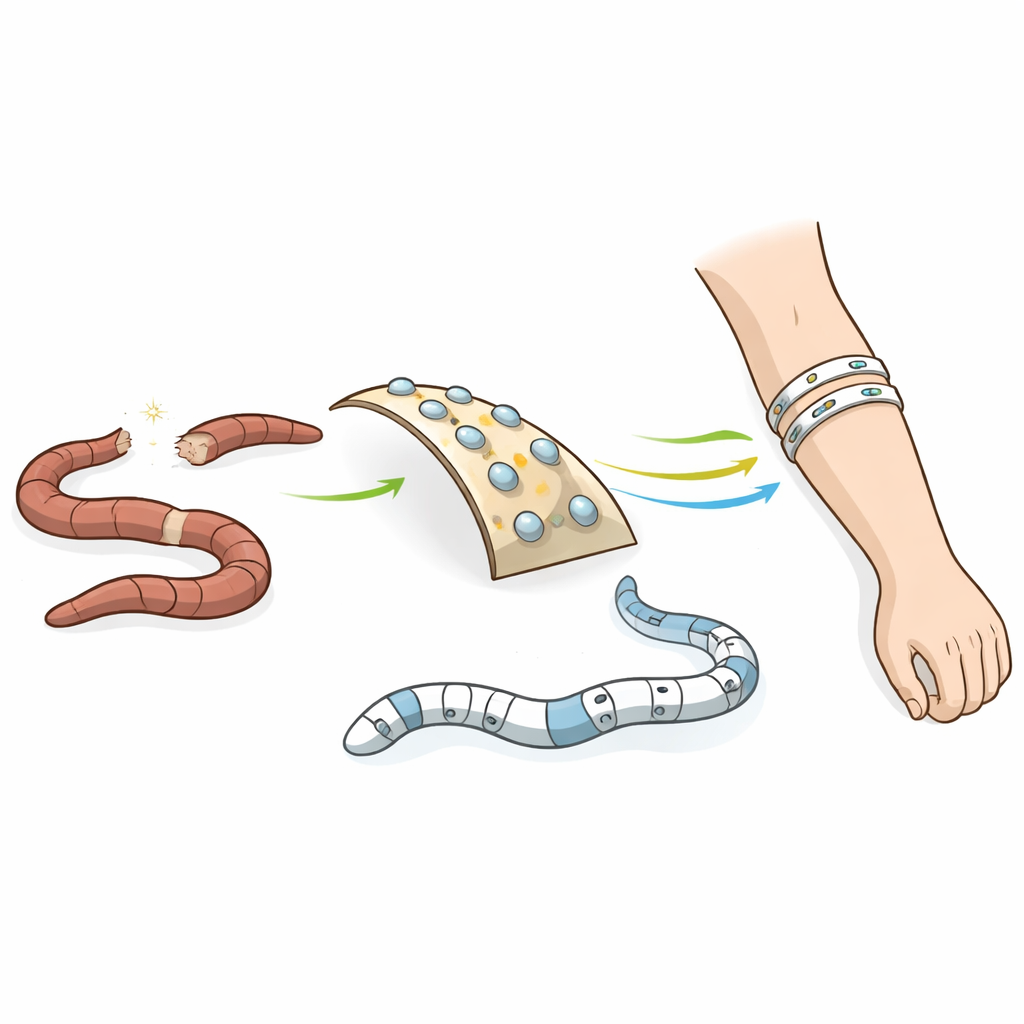
A tiny gel dome that behaves like a synapse
At the heart of each unit is a specially designed ionogel, a soft solid containing a network of polymer chains and a non-evaporating ionic liquid. Lithium ions move through this network under an applied current, creating electrical responses that resemble the way biological synapses strengthen or weaken with repeated activity. The dome’s core is rich in lithium ions, while its outer shell contains tiny nickel oxide particles that help corral and slow the ions. This core–shell design yields stable, tunable signal pulses that can store “memory” over many seconds, support dozens of distinct levels, and change smoothly as the pattern of input pulses changes. Crucially, when a dome is cut in half and allowed to heal, its signal strength rebounds to nearly its original value, and the material can even recover its shape after severe deformation.
Built to survive cuts, curves, and the outdoors
Because the device is made of an array of independent domes, it behaves more like a collection of resilient nerve endings than a brittle single sheet. Individual units can be detached and reattached to new substrates and still work normally. A chip containing over a hundred domes showed uniform behavior and remained stable even when bent to strong curvatures. The ionogel’s chemistry also resists drying and degradation: after a year in normal air, the signal response was still over 90% of its original value. This combination of segment-by-segment architecture, self-healing material, and shape memory gives the system multiple layers of protection against real-world wear and tear. 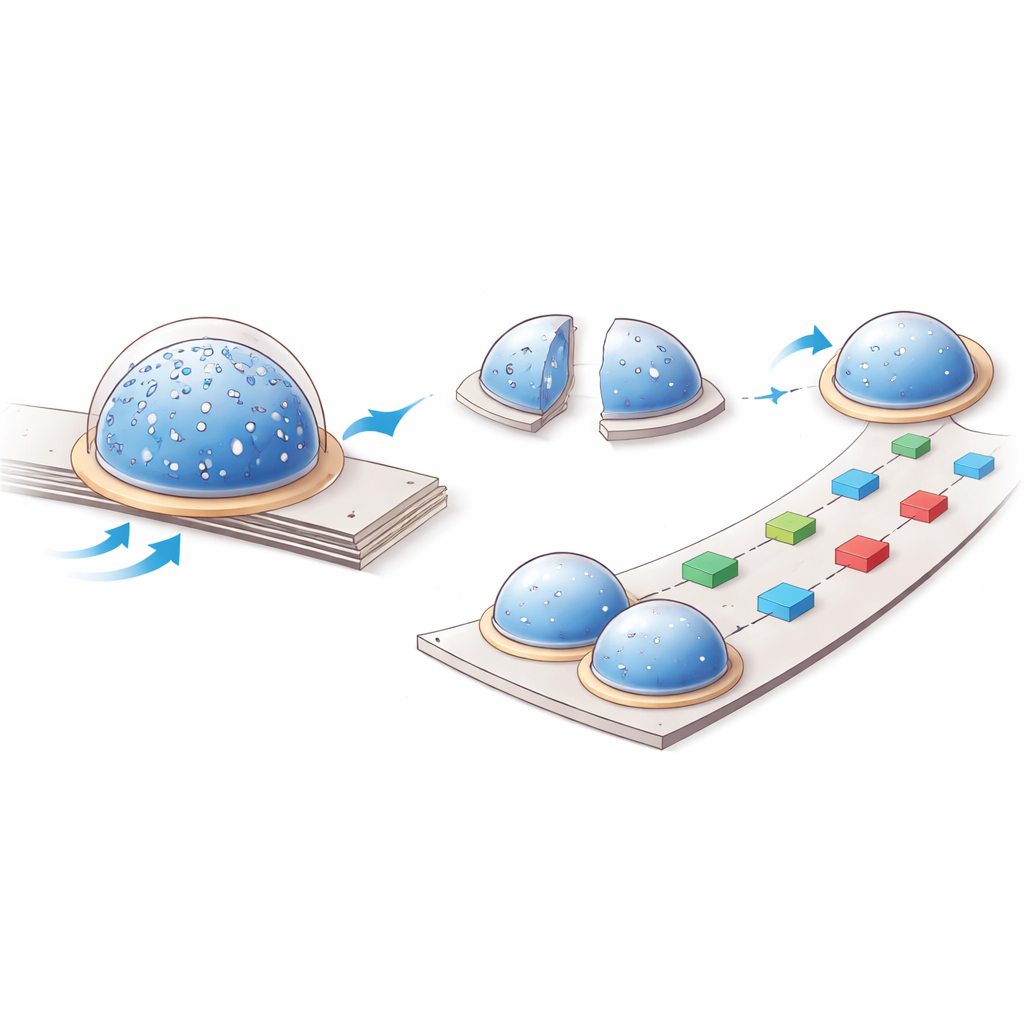
Teaching a soft “nerve” to read human motion
To show what these devices can do, the team built a simple motion-cognition system. A small motion sensor in a person’s hand measured acceleration and turning, then converted those signals into electrical pulses sent to one of the gel domes. The dome’s response depended on the pattern and history of pulses, effectively encoding how the arm had moved along a path. After training, the system could distinguish among several paths and turning sequences with up to 98% accuracy. Even more impressively, when the dome was cut in half and then allowed to heal, the recognition accuracy dropped only slightly, remaining around 96%. The decoded path instructions were then sent wirelessly to a snake-like robot, which successfully followed the human-indicated routes.
Toward damage-proof wearables and robots
In simple terms, this work shows how to build flexible “nerves” for machines that can both learn from motion and recover from serious damage. By mimicking the earthworm’s segmented, redundant body plan and combining it with a self-healing ion-based material, the authors create neuromorphic devices that keep working in conditions that would disable conventional circuits. Such technology could ultimately lead to prosthetics that stay dependable after accidents, soft rehabilitation gear that survives daily abuse, and robots that remain responsive even in harsh, unpredictable environments.
Citation: Li, Y., Chen, J., Tang, S. et al. Self-revival iontronic neuromorphic devices for robust human-machine interaction. npj Flex Electron 10, 59 (2026). https://doi.org/10.1038/s41528-026-00566-0
Keywords: flexible neuromorphic devices, self-healing electronics, ionogel, human-robot interaction, wearable sensors