Clear Sky Science · en
Electrochemically synchronized, self-indicating iontophoretic patch with fully eco-degradable and self-powered system
Smarter Skin Patches for Everyday Treatment
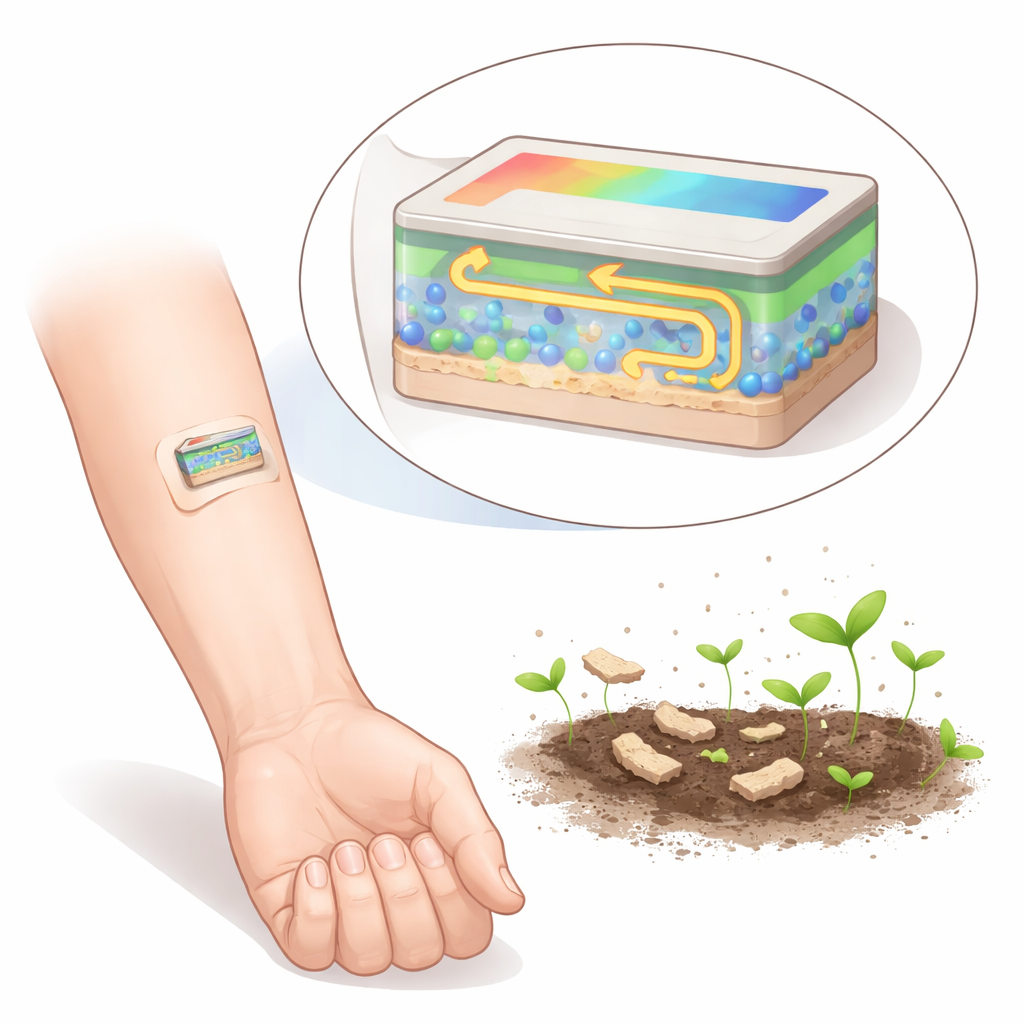
Imagine a bandage-like patch that can gently push medicine through your skin, show you exactly how much has been delivered with a simple color bar, power itself without a battery, and then safely break down in soil after you throw it away. This study introduces just such a patch: a soft, self-powered, and fully eco-degradable device that delivers drugs through the skin while visually tracking the dose in real time, aiming to make treatments easier for patients and kinder to the environment.
Why Moving Drugs Through Skin Is Hard
Transdermal patches are attractive because they avoid needles, can be worn comfortably, and release drugs steadily. A special type, called iontophoretic patches, uses a mild electric current to drive charged drug molecules through the outer skin barrier. But current devices face a three-way struggle. Simple patches are thin and flexible but usually rely on fixed treatment times and cannot tell you how much drug really passed through the skin, which varies from person to person and changes with conditions like dryness or disease. More advanced systems add sensors, chips, and displays to adjust dosing, but that makes them bulkier, more expensive, and harder to recycle, contributing to growing piles of electronic and plastic waste.
A Patch That Powers and Measures Itself
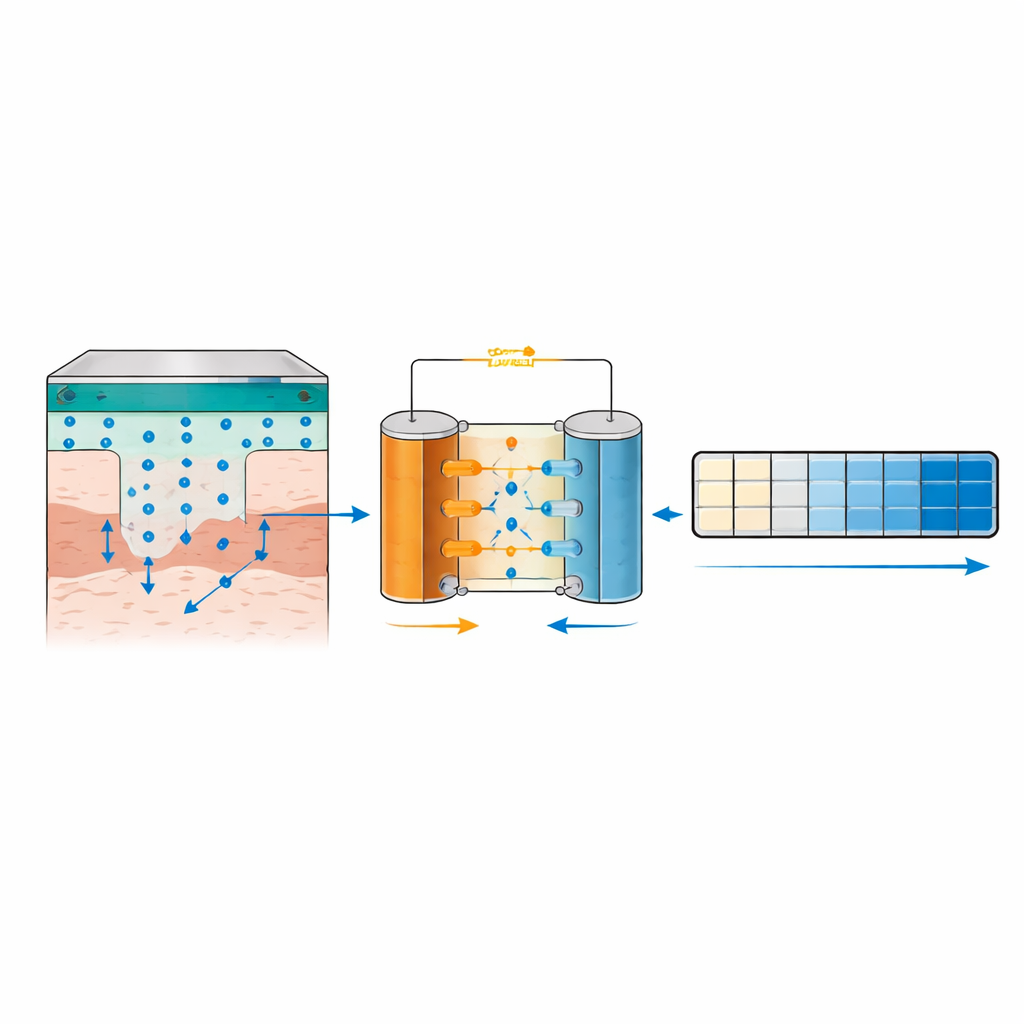
The researchers solved this by tightly linking three needs—simplicity, adaptability, and sustainability—into one design. Their patch stacks thin, soft layers on a flexible biodegradable plastic film. In the lower part sits a tiny built-in galvanic cell made from magnesium and molybdenum oxide, which works like a disposable battery when moistened by gel. This same electrochemical reaction does double duty: the ionic current travels through drug- and buffer-filled gels into the skin, driving drug molecules across; simultaneously, the electronic current flows upward into an electrochromic strip in the top layer. There, special tungsten oxide nanoparticles change color, advancing a blue “front” along the strip in proportion to the total electrical charge that has flowed. Because the transported charge and delivered drug are tightly linked, the length of the colored region serves as a simple visual gauge of how much medicine has been administered.
Making the Patch Gentle, Reliable, and Visible
To keep the skin environment safe and comfortable, the team tuned the chemistry around the magnesium anode. A mildly acidic citrate buffer keeps the local pH near neutral during operation, preventing the buildup of irritating alkaline byproducts while also stabilizing the voltage needed for drug delivery. They engineered a thick, paste-like electrochromic layer so it could handle the relatively large currents needed for iontophoresis without wearing out quickly. Arranged beside a metal current collector rather than on top of it, this layer switches color from one side to the other in a controlled, stepwise fashion, much like a fuel gauge filling up. Tests on pig skin showed that the distance the color front traveled increased linearly with the actual amount of niacinamide—a vitamin-based drug used here as a model—measured in a receptor solution beneath the skin, confirming that the moving color bar reliably reflects the delivered dose.
Helping Psoriasis While Watching the Dose
To see how the system behaves in disease conditions, the researchers used a mouse model of psoriasis, a chronic skin disorder with thickened, scaly patches and higher electrical resistance that makes drug delivery harder. They loaded the patch with niacinamide, which is known to support barrier repair and calm inflammation, and applied a fresh patch each day until the color bar fully saturated. As the skin improved and its impedance dropped, the time needed for the gauge to reach the end shortened, showing that the patch automatically adjusted its behavior to changing skin properties while still reporting the cumulative charge—and thus the dose—via the visible color progression. Microscopic examination of the treated skin revealed that the iontophoretic patch achieved healing effects comparable to a high-dose cream, but without signs of tissue stress seen at the highest passive dose, and blood tests indicated no systemic toxicity.
Designed to Disappear After Use
Beyond function and comfort, the device is built to vanish safely after disposal. The main substrate, gels, binders, and electrolyte matrix are all made from materials designed to break down in moist soil or compost into small molecules such as simple acids, ions, and monomers. The metallic and electrochromic components gradually corrode into benign oxides and related species. In soil tests with oat seeds, the patch swelled, fragmented, and largely degraded over several weeks, while plants grew normally alongside. Additional experiments under standardized composting conditions confirmed that all key components are transient rather than persistent plastics or metals, addressing the environmental concerns raised by frequent use of disposable medical patches.
What This Could Mean for Future Care
By unifying power, delivery, and visual feedback into one synchronized electrochemical loop, this patch avoids bulky electronics and external readers while still adapting to each wearer’s skin and offering an easy-to-read indication of how much medicine has gone in. The approach is modular, so other charged drugs or even more complex delivery interfaces, such as microneedles, could be paired with the same charge-based color gauge after proper calibration. In the long term, such eco-degradable, self-indicating patches could make at-home treatment of chronic skin and systemic conditions more intuitive for patients and caregivers, while reducing electronic waste and simplifying end-of-life handling.
Citation: Choi, SG., Kang, SH., Lee, SH. et al. Electrochemically synchronized, self-indicating iontophoretic patch with fully eco-degradable and self-powered system. npj Flex Electron 10, 60 (2026). https://doi.org/10.1038/s41528-026-00562-4
Keywords: transdermal drug delivery, iontophoresis, electrochromic patch, biodegradable electronics, psoriasis therapy