Clear Sky Science · en
Smart wearable and implantable biosensors for continuous health monitoring: materials, biocompatibility, and AI integration
Why continuous body monitoring matters
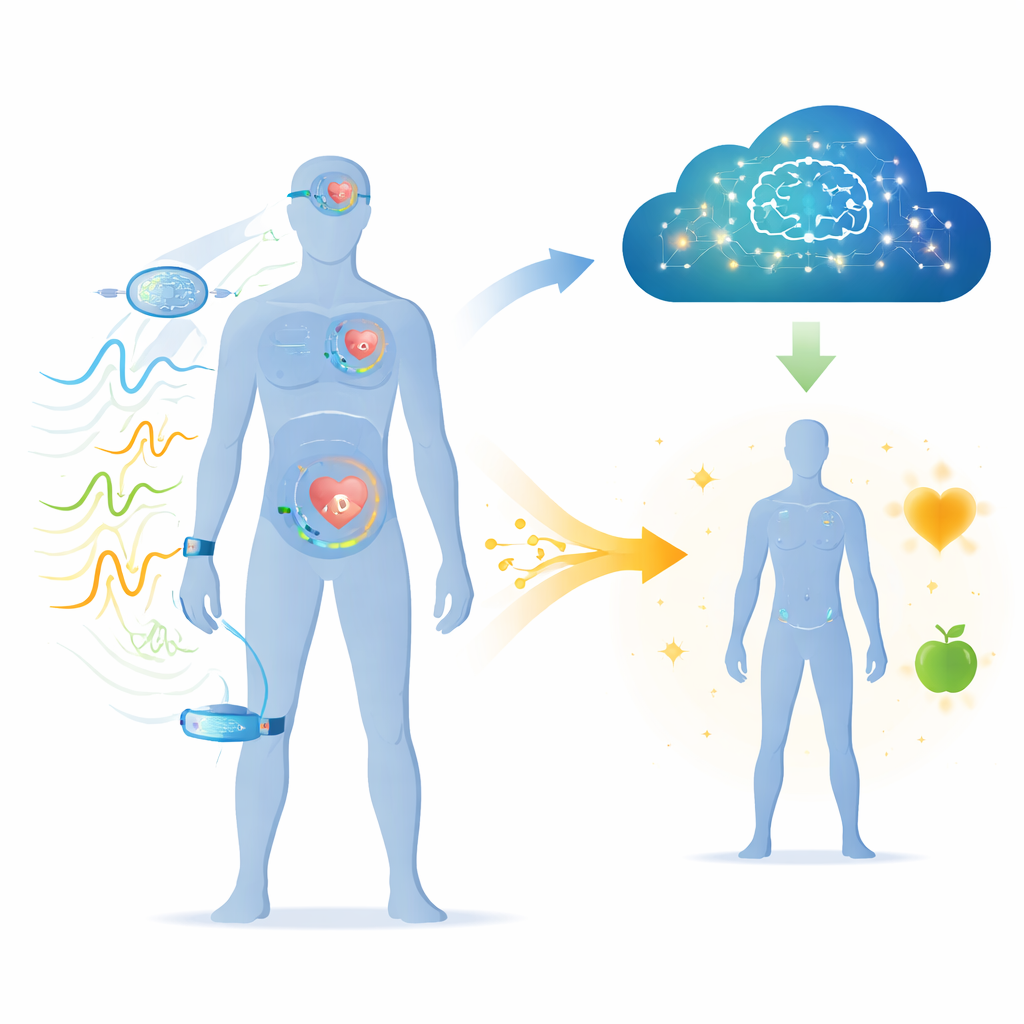
Imagine if your watch, your shirt, or even a tiny thread under your skin could quietly track your health all day, every day—spotting trouble long before you feel sick. This review article explores how a new generation of soft, skin-like and even implantable biosensors, combined with artificial intelligence (AI), could shift medicine from “treating illness” to truly “staying well.” It explains how these devices are built to move with our bodies, how they safely live on or inside us for long periods, and how smart algorithms turn torrents of raw data into clear, useful insights for doctors and patients.
Devices that move like skin and organs
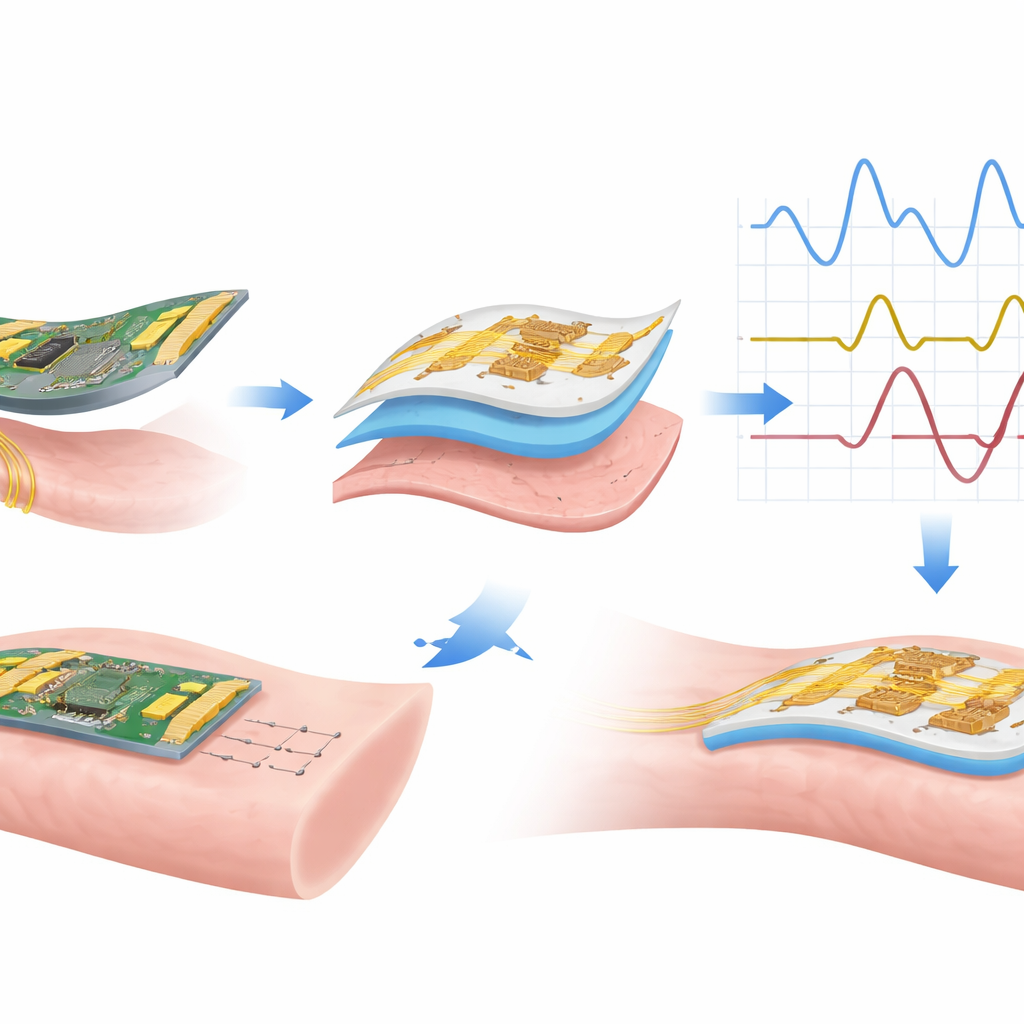
Unlike the rigid electronics in a smartphone, the body is soft, stretchy, and constantly in motion. The authors show that making sensors that work reliably on skin or inside organs starts with mechanics: devices must bend, stretch, and twist without breaking or losing accuracy. To do this, engineers use ultra-thin layers, rubbery substrates, and clever patterns like serpentine traces and kirigami-style cuts that let circuits elongate without snapping. These structures can match the softness of skin, muscle, or even the brain, preventing irritation and keeping sensors in close contact so that heart signals, muscle activity, or tiny pressure changes can be captured cleanly over weeks or months.
Safe materials that the body can live with
Comfort and safety are as important as clever mechanics. The article surveys a wide palette of materials—textiles, paper, polymers, hydrogels, and nanomaterials—that can host biosensors while remaining gentle on tissue. Wearable devices often rely on breathable fabrics or soft plastics; implantable ones turn to biocompatible and sometimes biodegradable polymers that slowly dissolve after their job is done. Conductive polymers and nanoscale components such as graphene or metal nanoparticles boost sensitivity but must be carefully coated to avoid toxicity and fouling by proteins. The authors describe how surface treatments and “self-mimicking” coatings can calm the immune system, reduce scarring around implants, and keep electrical contact stable for long-term monitoring.
From simple trackers to continuous health guardians
Today’s wearables already track steps, heart rate, and sleep, but the devices reviewed here go much further. They can sample sweat to measure electrolytes, glucose, or vitamins; read electrical signals from the heart and brain; or measure pressure inside the skull, bladder, or blood vessels. Some are powered directly by the body through motion, heat, or biochemical reactions, removing the need for bulky batteries. Implantable versions sit on the heart, in the brain, or in the eye, offering stable, round-the-clock readings that surface sensors cannot easily reach. These systems enable early warnings for problems such as infection around a dental implant, creeping pressure in the brain, organ rejection after a transplant, or dangerous swings in blood sugar.
Letting AI make sense of the data deluge
Because these sensors can stream information continuously, the challenge quickly becomes less about measuring and more about understanding. The review explains how AI—especially machine learning and deep learning—filters noisy signals, corrects for motion, and pulls out patterns linked to disease. Lightweight models running on the device (“edge AI”) can flag irregular heartbeats or alarming trends without shipping every data point to the cloud, improving speed and privacy. More advanced systems combine many data types at once—electrical signals, chemical markers, and even molecular fingerprints—to build a richer picture of health. With enough diverse, well-validated data, these algorithms can predict flare-ups, guide treatment choices, and personalize care to each individual’s baseline rather than generic norms.
What this means for everyday health
Taken together, the work reviewed in this article outlines a path to health devices that are as comfortable and unobtrusive as clothing, yet as informative as a hospital monitor. By uniting soft, body-matched materials with careful mechanical design, these biosensors can stay in place and function reliably for long periods. By pairing them with AI, the raw numbers they collect become early warnings, personalized recommendations, and decision aids for clinicians. The authors conclude that overcoming remaining hurdles—such as long-term durability, battery-free operation, fair and transparent algorithms, and strong data security—could turn these smart wearable and implantable biosensors into everyday tools that quietly safeguard health in the background of our lives.
Citation: Suryaprabha, T., Choi, C., Wu, Y. et al. Smart wearable and implantable biosensors for continuous health monitoring: materials, biocompatibility, and AI integration. npj Flex Electron 10, 46 (2026). https://doi.org/10.1038/s41528-026-00560-6
Keywords: wearable biosensors, implantable sensors, flexible electronics, continuous health monitoring, AI in healthcare