Clear Sky Science · en
Advances in flexible piezoelectrics for wearable and implantable medical devices
Powering Health from Everyday Motion
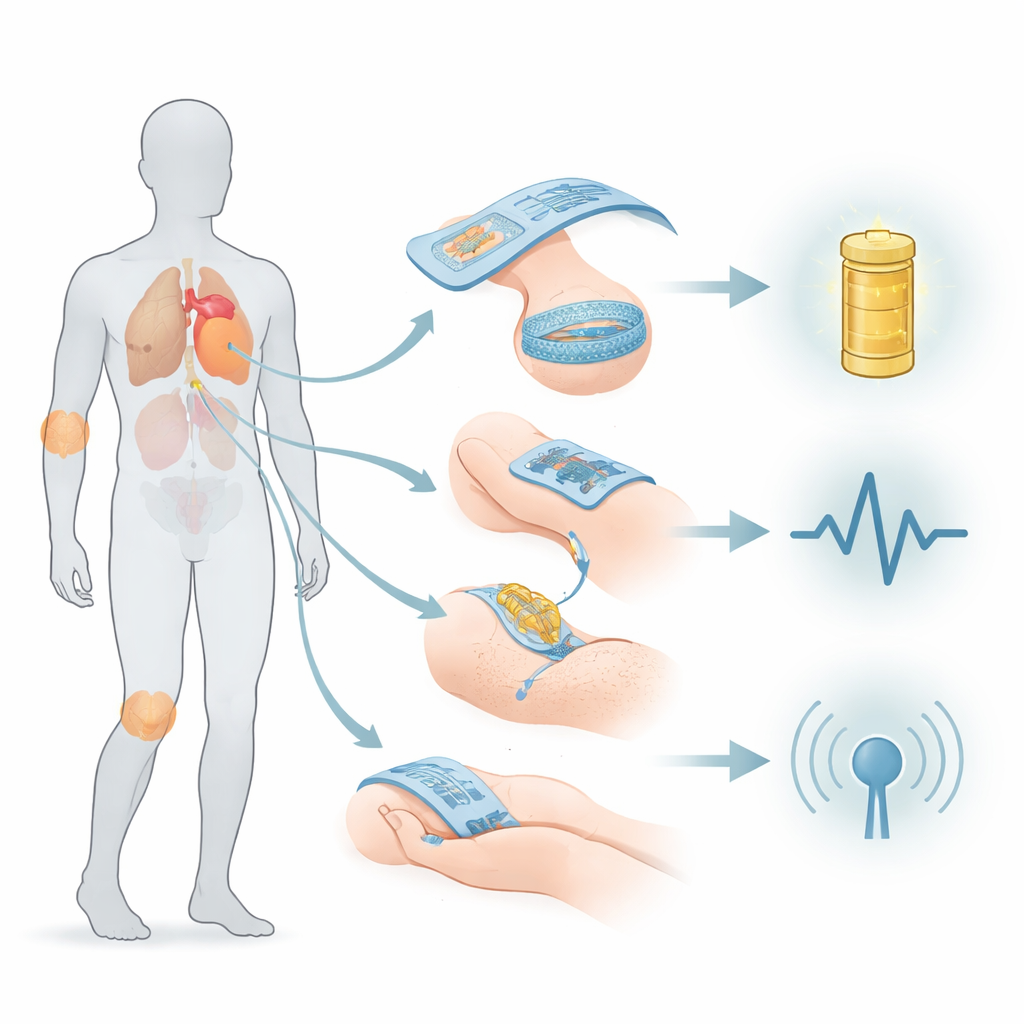
Imagine a future where heart implants, bandage-like patches, and smart masks quietly power themselves using nothing more than your own movements and breathing. This review article explores flexible piezoelectric nanogenerators—tiny devices that turn bending, stretching, and pulsing inside the body into electricity. For a lay reader, the appeal is clear: fewer batteries to charge, fewer surgeries to replace them, and medical gadgets that can continuously watch over our health and even help tissues heal, all by harvesting the energy our bodies naturally produce.
From Bulky Batteries to Self-Powered Care
Many modern medical gadgets, from wrist-worn heart monitors to implanted pacemakers, rely on batteries. Wearables can lose power at inconvenient moments, interrupting continuous monitoring, while implants sometimes require surgery when their batteries run out. The paper explains how flexible piezoelectric materials can offer an alternative. When these special materials are bent or squeezed by heartbeats, breathing, or muscle contractions, they generate an electrical pulse. Built into “piezoelectric nanogenerators,” or PENGs, these materials can act as miniature power plants inside or on the surface of the body, trimming dependence on traditional batteries and supporting long-term monitoring and therapy.
Soft Materials that Match the Body
To work safely in or on the body, these generators must be both effective and gentle. The article surveys three broad families of piezoelectric materials. Inorganic ceramics such as classic lead-based compounds and newer lead-free versions offer strong electrical output but tend to be stiff and, in some cases, toxic without careful sealing. Organic polymers like PVDF are softer and can bend with skin or organs but produce less power unless their internal structure is carefully tuned. A third route blends hard and soft ingredients into composites, combining the power of ceramics with the flexibility of polymers. The review also highlights biodegradable materials—such as silk, collagen, and certain plastics—that can gradually dissolve after their job is done, opening the door to temporary implants that do not require surgical removal.
Making Tiny Generators and Keeping Them Safe
Turning these materials into working devices calls for clever manufacturing. For hard, crystal-like materials, techniques borrowed from the chip industry can lay down ultra-thin layers on flexible backings. For softer polymers and composites, methods like electrospinning (which produces fine fibers) and printable inks make it possible to cover large, bendable surfaces. Yet there are trade-offs: very flexible devices often produce weaker signals, and high-output devices can be fragile. Another central challenge is shielding the generators from the harsh, wet environment inside the body. Common protective coatings can either let in too much moisture or feel too stiff against moving tissues. The article stresses that robust, long-lived encapsulation remains one of the largest barriers to real-world implants.
Wearable Patches and Implanted Helpers
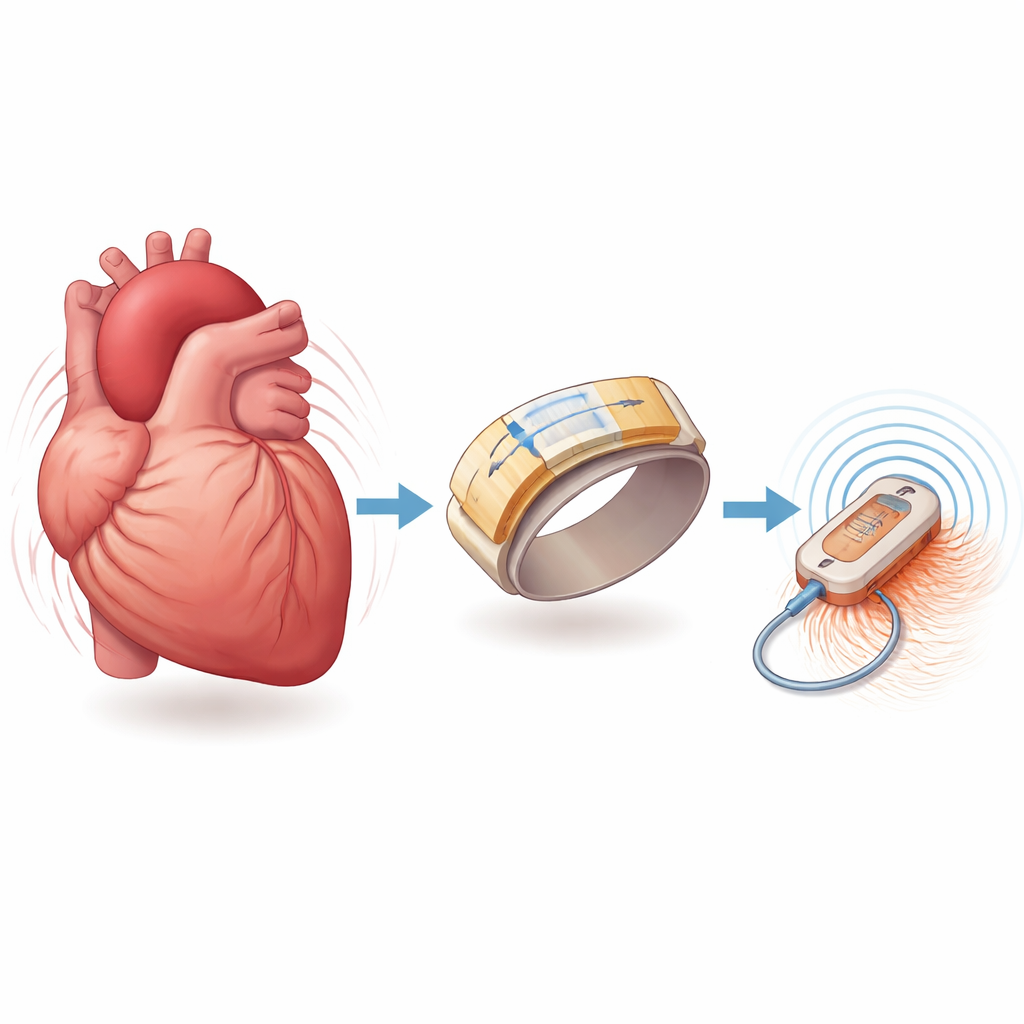
The review then moves from materials to real devices. On the skin, flexible PENGs have been built into patches that harvest energy from walking, joint bending, or even finger taps, sometimes producing enough power to light hundreds of tiny LEDs. Similar devices double as sensitive sensors: placed over an artery, they can pick up pulse waves; embedded in a mask, they can track breathing patterns; attached near muscles, they can record contractions useful for rehabilitation or controlling assistive devices. Inside the body, PENGs have been sewn onto the heart to harvest each beat’s motion and demonstrated enough energy to run a commercial pacemaker. Others wrap around blood vessels or the stomach wall to monitor pressure and movement continuously. Some systems go further, using energy delivered by focused ultrasound from outside the body to drive implanted generators that stimulate nerves, aid bone repair, or help heal skin wounds, all without internal batteries.
Linking to the Cloud and the Doctor’s Office
Because PENGs can sense and power at the same time, they fit naturally into connected health systems. The article describes how data from these devices can be sent via Bluetooth, Wi‑Fi, or cellular links to phones and cloud platforms, where artificial intelligence tools sift through long streams of signals. Algorithms can learn to recognize abnormal heart rhythms, changes in blood pressure trends, irregular breathing, or altered movement patterns, enabling early warnings and more tailored treatment. In the longer term, this could support closed-loop care: the same PENG device that senses a problem could automatically adjust a stimulation pattern or drug delivery rate in response to guidance generated by remote analysis.
What This Means for Future Medicine
In plain terms, the article concludes that flexible piezoelectric generators could help medical devices become more like quiet, long-term partners than fragile gadgets. By drawing power from natural body motion, they promise fewer battery changes, more continuous monitoring, and new forms of gentle electrical therapy that support healing. To reach everyday clinical use, researchers still need to boost energy output, prove long-term safety, perfect protective coatings, and integrate secure wireless and data systems. If these hurdles are cleared, the technology could underpin a new generation of self-powered, connected medical implants and wearables that work in the background to keep people healthier for longer.
Citation: Liang, J., Liu, X., Du, J. et al. Advances in flexible piezoelectrics for wearable and implantable medical devices. npj Flex Electron 10, 61 (2026). https://doi.org/10.1038/s41528-026-00559-z
Keywords: flexible piezoelectric nanogenerator, wearable medical devices, implantable medical devices, self-powered biosensors, wireless neuromodulation