Clear Sky Science · en
Highly robust ECG electrodes constructed from semi-liquid metal fibers for reliable emergency rescue monitoring
Why Heart Monitoring in Chaos Matters
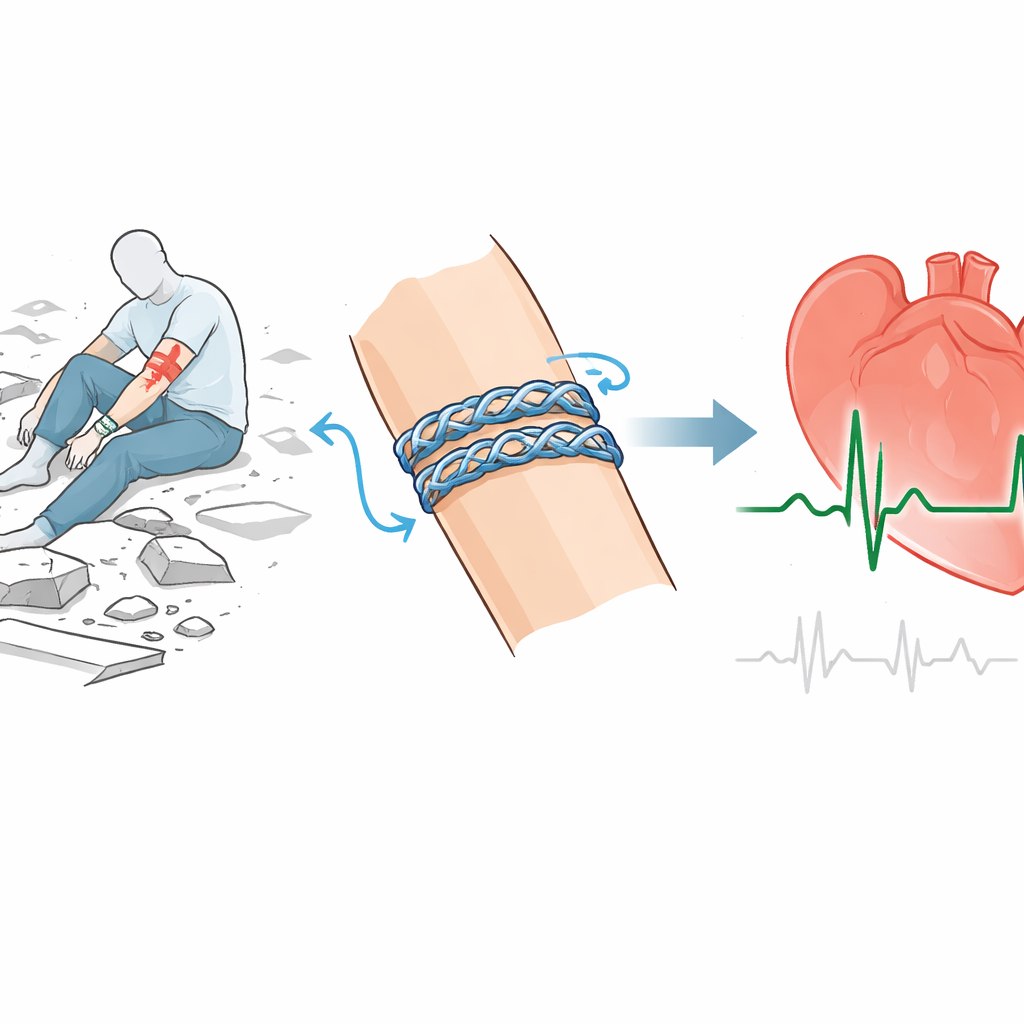
When earthquakes, explosions, or traffic accidents strike, rescuers need to know in seconds whether a victim’s heart is in trouble. Yet in these chaotic conditions, the sticky patches normally used to record heart signals often fall off sweaty, bloody, or dusty skin and can irritate fragile wounds. This paper introduces a new kind of soft, fiber-based electrode that can be quickly wrapped around arms, legs, or fingers to capture clear electrocardiogram (ECG) readings, even on dirty or injured skin, and stay comfortable for long-term hospital monitoring.
A New Kind of Wrap-Around Wire
Instead of relying on glue to hold flat patches to the chest, the researchers designed slender elastic fibers that act more like a soft bracelet or bandage. These fibers are stretched and then wrapped several times around a limb. As they relax, they gently squeeze the skin, creating a mechanical "anchoring" effect that keeps them in place. The conductive part of the electrode is a semi-liquid metal coating on a stretchable polyurethane core, arranged in a double-helix shape. This twisted structure increases the area of metal touching the skin and helps the fiber follow every curve and wrinkle, which lowers electrical resistance and improves signal pickup.
Metal That Acts Like Both Solid and Liquid
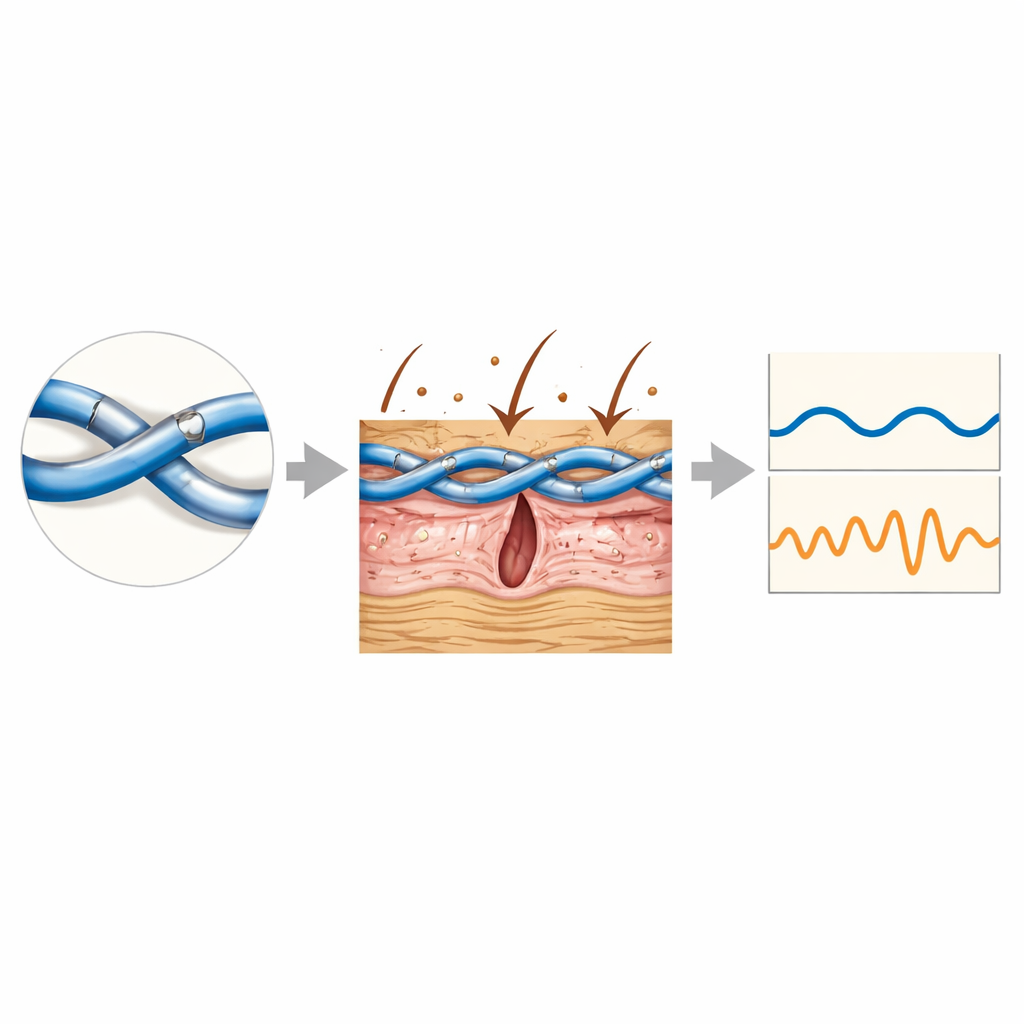
At the heart of the design is a special gallium-based alloy that flows like a liquid at room temperature but conducts electricity almost as well as a solid metal wire. By mixing this liquid with tiny silver-coated copper particles, the team created a "semi-liquid" paste that sticks to the prepared fiber surface instead of dripping off. A thin adhesive layer between the metal and the fiber lets the coating hold its shape, stretch with the fiber, and maintain a continuous conductive path. Tests showed that these fibers can elongate to nearly six times their original length without breaking the conductive layer and still keep high conductivity, even after 10,000 stretch cycles, changes in temperature and humidity, and varying levels of tightness when wrapped around a finger.
Stays Put on Dirty, Hairy, or Wet Skin
To mimic disaster conditions, the researchers covered volunteers’ skin with hair, water, oil, mud, and dust, then compared the wrapped fibers to standard silver/silver-chloride gel patches. Traditional patches quickly lost their stickiness and essentially peeled off with no measurable holding force under these challenges. In contrast, the wrapped fiber electrodes kept strong grip through simple knotting or overlapping methods, with peel forces many times higher than patches. They also showed much lower electrical impedance at the skin surface, meaning better signal transfer, especially when dust or other contaminants would normally block contact. Meanwhile, because the fibers are arranged with gaps between them, air and moisture can pass through freely, making breathability close to that of uncovered skin and far better than commercial breathable patches or medical tape.
Safe for Skin and Kinder to the Environment
Since these electrodes are meant to stay on the body for extended periods, the team checked whether their materials harmed cells or irritated skin. Cell culture tests with extracts from the polyurethane fiber, the adhesive, and the semi-liquid metal all showed high cell survival and normal cell shapes, suggesting low toxicity. In real use, small traces of metal left on the skin could be easily wiped away with alcohol. Importantly, the metal coating can be stripped off used fibers in a basic solution, merging into reusable droplets with a recovery rate of about 98%. This recyclability cuts material waste compared with fully disposable patch electrodes that are thrown away after each patient.
From Disaster Zone to Intensive Care
In volunteer tests, wrapped fiber electrodes recorded ECG waveforms that closely matched those from standard hospital patches, clearly showing the familiar P waves, QRS complexes, and T waves. They could be placed not only on fingers, but also on wrists, arms, thighs, knees, and ankles, giving rescuers flexibility when the chest is burned, crushed, or inaccessible in rubble. The electrodes continued to deliver stable signals during walking, limb movement, and 40 minutes of continuous monitoring. In intensive care units, doctors used the fibers for one-hour and 24-hour post-surgery monitoring and successfully detected a range of dangerous heart rhythm problems, such as heart attacks and irregular beats. Patients reported better comfort and showed fewer signs of skin irritation than with standard patches.
What This Could Mean for Future Care
Overall, the study shows that soft, semi-liquid-metal fibers wrapped around limbs can provide fast, reliable, and comfortable heart monitoring when it matters most—from the first minutes after a disaster to the long hours of intensive care. By trading sticky patches for gentle mechanical anchoring and by using breathable, recyclable materials, this approach could help rescuers and clinicians track heart health with fewer signal failures, less skin damage, and lower waste, bringing hospital-grade monitoring closer to where emergencies actually happen.
Citation: Liu, X., Xu, H., Chen, L. et al. Highly robust ECG electrodes constructed from semi-liquid metal fibers for reliable emergency rescue monitoring. npj Flex Electron 10, 56 (2026). https://doi.org/10.1038/s41528-026-00556-2
Keywords: emergency ECG monitoring, flexible wearable electrodes, liquid metal fibers, disaster medicine, cardiac arrhythmia detection