Clear Sky Science · en
Wearable ultrasound microneedle patch for on-demand and sustained management of gouty arthritis
Making Joint Pain Treatment Easier
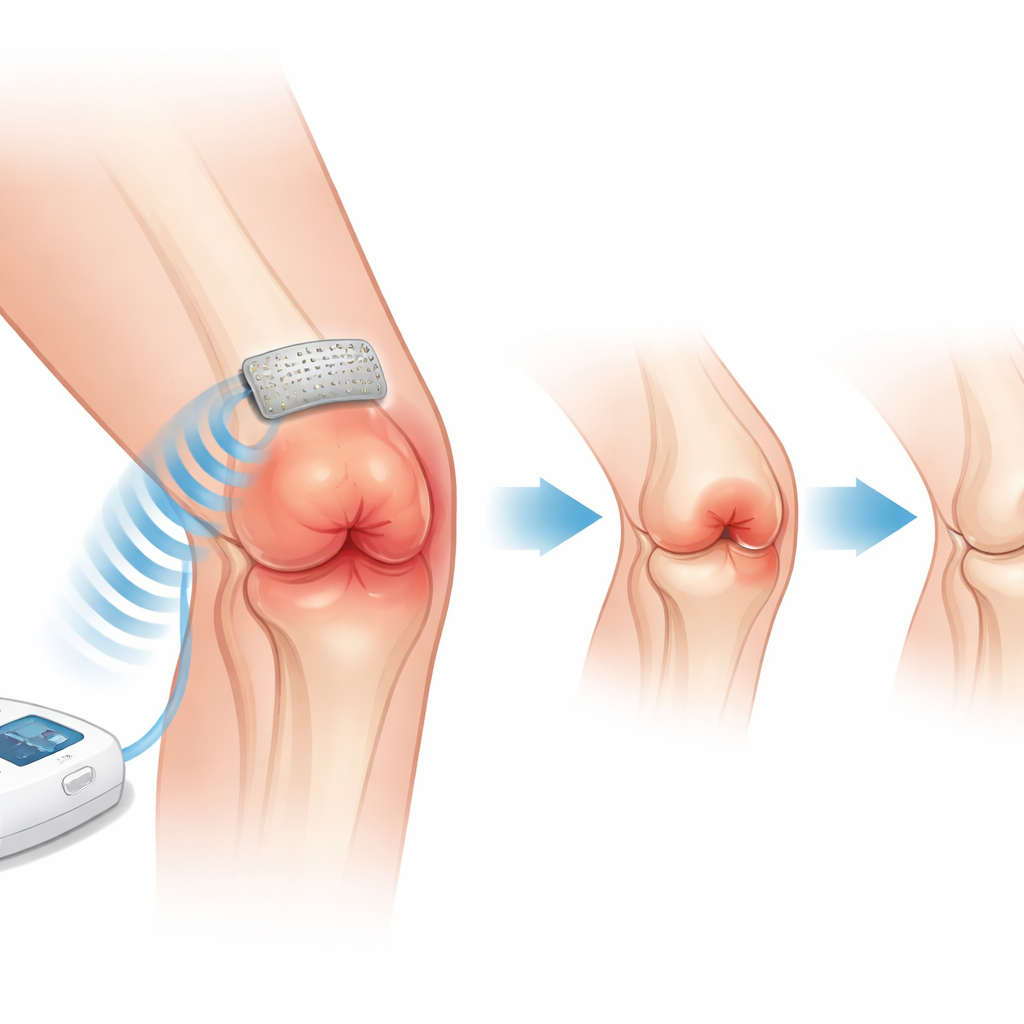
Gouty arthritis can turn a simple step or bend of the knee into sharp, throbbing pain. Today, people usually rely on pills or injections that can upset the stomach, strain other organs, or fail to bring enough medicine directly to the sore joint. This study introduces a soft, wearable patch that sits on the skin and uses tiny needles plus gentle ultrasound waves to push medicine straight into the problem area, with the timing and dose controlled from a smartphone—offering a glimpse of more comfortable, personalized care for people living with gout.
A Smart Patch for Sore Joints
The heart of the system is a flexible microneedle patch mounted on a thin, stretchable backing that adheres comfortably to curved body parts such as fingers and knees. Each patch contains an array of microscopic needles made from a biocompatible polymer. They are long and strong enough to pierce the outer skin layer but short enough to avoid pain and bleeding. Beneath the needles sits a grid of tiny ceramic elements that convert electrical signals into ultrasound vibrations. A lightweight circuit board, powered by a small battery and controlled via Bluetooth from a phone, drives these elements to generate precisely tuned sound waves at the press of a button.
From Sound Waves to Deeper Drug Delivery
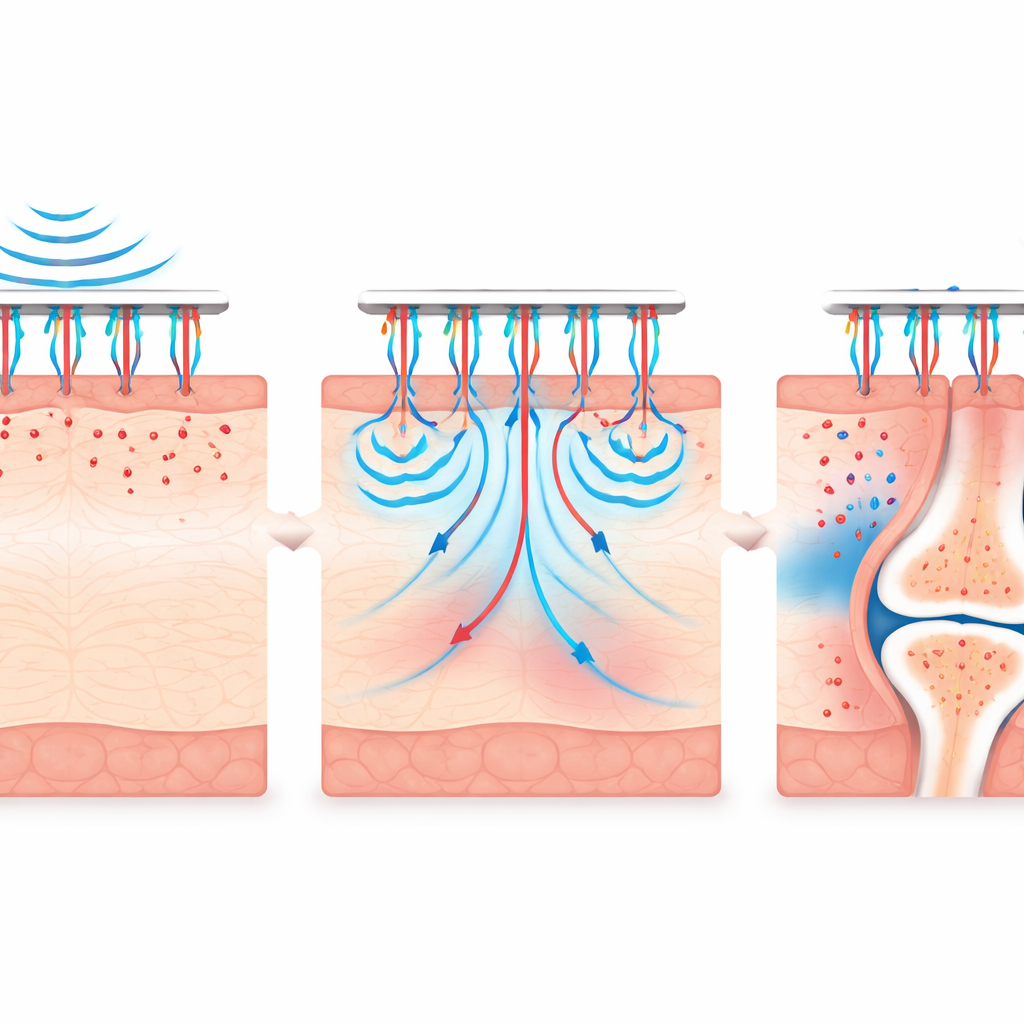
What makes this patch different from earlier microneedle designs is that it does not rely on slow, passive seepage of medicine. When the ultrasound is switched on, the ceramic layer vibrates, shaking the microneedles and the fluid around their tips. These vibrations create microscopic flows in the surrounding tissue, known as acoustic streaming, which act like tiny currents carrying the drug away from the needle tips and deeper into the skin and joint space. Computer simulations and gel-based experiments with fluorescent dyes showed that, compared with no ultrasound, the active patch pushed the drug several times farther and faster into a tissue-like material. Higher ultrasound power produced quicker release, while lower power stretched the release over many hours.
Comfortable, Safe, and Built to Move
Because gout often strikes joints that flex and twist, the researchers tested whether the patch could bend and stretch with the body. A serpentine metal wiring pattern allows the ultrasound layer to elongate by about 30 percent—similar to human skin—without losing function. The patch stayed intact and kept working after repeated stretching and bending, and its acoustic performance barely changed when wrapped around curved surfaces. Safety tests showed that skin punctures from the microneedles healed within minutes, with no lasting redness or inflammation. Surface temperatures during use stayed below harmful levels, and the amount of lead ions leaching from the ceramic components into artificial sweat was far under accepted safety limits. Cell culture and animal skin studies also found no meaningful damage to living tissue in contact with the device.
Helping Both Sudden Flares and Long-Lasting Damage
To see whether the patch could actually help diseased joints, the team tested it in rats with gout-like arthritis caused by injecting needle-shaped urate crystals into the knee. When loaded with the gout drug colchicine and driven at high ultrasound power for brief periods, the patch delivered medicine quickly into the joint. Compared with untreated animals, or animals that wore the patch without ultrasound, these rats showed much faster reduction in swelling and pain, and their joint fluid contained far lower levels of inflammatory molecules. Oral colchicine, the current standard treatment, did reduce swelling but left higher inflammation in the joint and produced higher drug levels in the blood, hinting at more strain on the rest of the body. In a separate long-term model mimicking chronic gout, using the patch at low ultrasound power over many days provided slow, steady drug release that greatly reduced bone erosion and preserved joint structure compared with control groups.
Toward Personalized Wearable Care
Taken together, this work shows that a soft, wearable microneedle patch driven by programmable ultrasound can deliver gout medicine directly and efficiently to sore joints, either in fast bursts for painful flares or in gentle, sustained doses to protect against long-term damage. By shifting control from the clinic to a small, phone-guided device on the skin, the approach points toward future treatments that adapt in real time to a patient’s symptoms and disease stage, potentially improving relief while reducing side effects on the rest of the body.
Citation: Zhang, S., Zhou, Z., Chen, L. et al. Wearable ultrasound microneedle patch for on-demand and sustained management of gouty arthritis. npj Flex Electron 10, 53 (2026). https://doi.org/10.1038/s41528-026-00554-4
Keywords: wearable drug delivery, microneedle patch, ultrasound therapy, gouty arthritis, personalized medicine