Clear Sky Science · en
Strain-transformative integration of perovskite thin-film optoelectronics for in-plane multiaxial stretchable and 3D curvy artificial compound eye arrays
Electronics That Can Stretch and Bend
Imagine a camera or medical sensor that wraps smoothly around a moving body, or a robot eye shaped like a dome, all without the delicate parts cracking when they bend. This paper introduces a clever way to build such stretchable, curvy electronics using extremely thin light-sensing films called perovskites. The authors show how a special supporting frame lets these fragile films survive big stretches and even form a curved “compound eye” similar to that of an insect.
Why Stretchable Gadgets Break So Easily
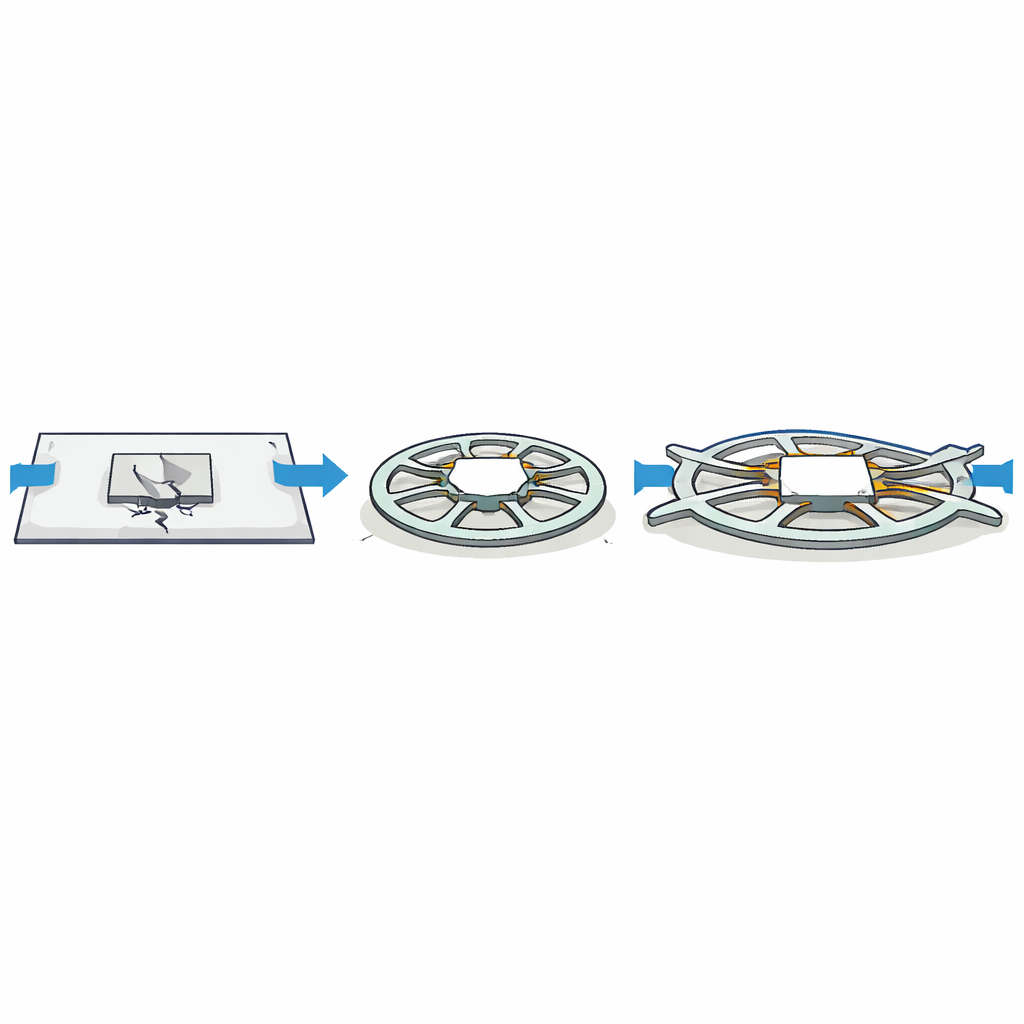
Most stretchable electronic systems today are built from tiny rigid “islands” connected by wavy, spring-like “bridges” that can elongate. This works reasonably well for thicker, tougher semiconductor blocks, but it fails for ultrathin films. When the whole sheet is pulled or bent over a curved surface, the stiff island and soft rubbery base tug on each other. That mismatch in motion concentrates stress where they meet, so thin films crack, peel off, or warp long before the rest of the device reaches its limit. Previous fixes either required inventing entirely new, rubbery electronic materials or complicated reshaping of the soft substrate—approaches that are powerful but hard to generalize and scale.
A Clever Frame That Redirects Stress
The team’s solution is a support called a stress transform structure, or STS. At rest, an STS looks like a flat frame with a central platform for the electronic film and a thin ring and beam network cut out around it. Because it is flat, it works smoothly with existing chip and thin-film manufacturing steps. When the device is stretched, the outer ring pulls apart and the beams buckle upward, nudging the central platform into a gentle arch. In other words, large pulling forces in the plane are converted into tiny bending of the film, keeping the strain in the fragile layer below about one percent—safe for many thin semiconductors. At the same time, the central support partially lifts away from the stretchy base, reducing the tug-of-war at their interface.
Finding the Best Shape Through Virtual Testing
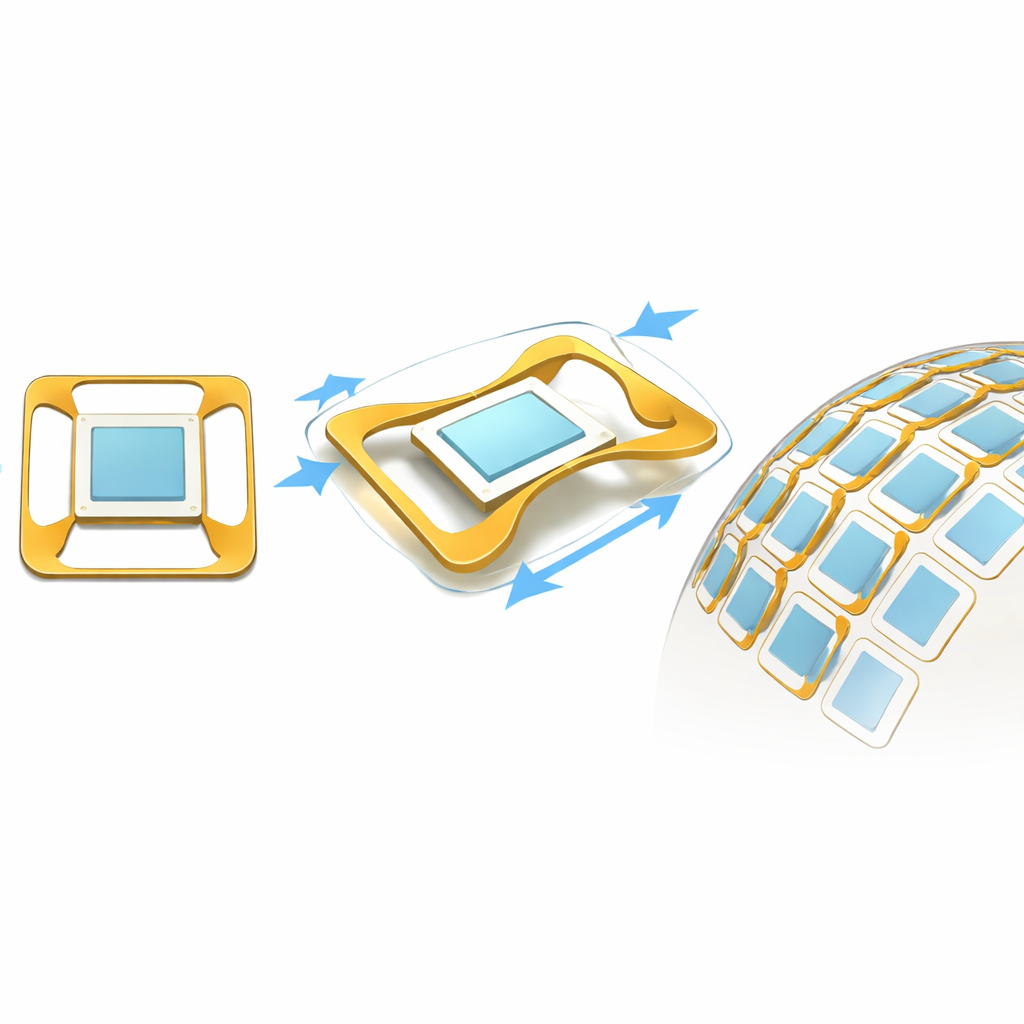
To make this stress redirecting frame as effective as possible, the researchers ran extensive computer simulations. They changed the shape of the outer ring (from circular to multi-sided polygons), its width, the sizes of the beams, the area of the central platform, and the thickness of the whole structure. The simulations showed that a four-sided ring performs best: it keeps the bending of the central support very low even when the entire frame is stretched by half its length. Fine-tuning the geometry further—narrower rings, wider beams, a moderate platform area, and thin plastic sheets—produced designs that survived up to about 60 percent stretching in experiments while keeping the delicate film’s strain in a safe range.
From Single Sensor to Stretchable Arrays and a Curved “Eye”
Using this optimized frame, the team built light sensors from perovskite films on flexible circuit boards. They measured how the devices behaved while stretching them again and again. Even when the support was pulled by 50 percent over 4000 cycles, the light response, dark current, and switching speed of the sensors stayed almost unchanged, and microscope images showed no cracks or peeling. The same building blocks were then tiled into arrays: a 5×5 grid that could be stretched in one direction, and another that could stretch in two directions at once. These arrays could still form clear images of a simple “H” shaped light pattern while under heavy strain, showing that many sensors can work together reliably on a moving surface. Finally, the authors pushed the concept into three dimensions, pressing a 15×15 sensor array onto a hemisphere to create an artificial compound eye with 185 pixels. Each pixel sat on its own STS, allowing the whole sheet to conform to the dome. When illuminated with patterned light, the curved array could pick out where the light fell and reconstruct simple shapes.
What This Could Mean for Future Devices
In simple terms, this work shows how to cradle very fragile, very thin electronic films so they can be stretched and wrapped onto complex shapes without breaking or losing function. By turning dangerous pulling forces into gentle bending, the new support frames open the door to high-performance, thin-film cameras and light sensors that can be worn on the skin, wrapped around soft robots, or molded into curved vision systems. While further miniaturization and design balance will be needed for real-world products, the core idea offers a broadly compatible mechanical “trick” that could help many different thin electronic materials become part of the next generation of flexible, body-friendly and bio-inspired devices.
Citation: Zhang, K., Yang, J., Huang, Y. et al. Strain-transformative integration of perovskite thin-film optoelectronics for in-plane multiaxial stretchable and 3D curvy artificial compound eye arrays. npj Flex Electron 10, 54 (2026). https://doi.org/10.1038/s41528-026-00552-6
Keywords: stretchable electronics, perovskite photodetectors, flexible sensors, compound eye imaging, stress-transform structures