Clear Sky Science · en
Biodegradable chitosan-cellulose and sub-spherical nanocrystals composite piezoelectric thin film
Turning Natural Waste into Smart Devices
Imagine a medical bandage or implant that can listen to your body with ultrasound, help doctors monitor your health, and then safely vanish instead of becoming plastic waste. This article describes a new flexible material made from everyday biological leftovers—like shells and plant fibers—that can convert motion into electricity. The work shows how these “green” building blocks can rival common plastic-based electronic materials, opening the door to medical devices that are both high‑performance and environmentally friendly. 
Why We Need Greener Electronics
Modern sensors and ultrasound probes often rely on brittle ceramics or plastics derived from fossil fuels. These materials work well but raise concerns: they can be toxic, hard to dispose of, and unsuitable for long‑term contact with the body. As flexible electronics spread into wearable gadgets and soft medical implants, there is growing pressure to replace such materials with safer, degradable alternatives. The authors focus on a special class of substances that generate electric signals when squeezed or bent, a property known as the piezoelectric effect. Their goal is to recreate this effect using ingredients that come from renewable resources and can break down harmlessly after use.
Building a Film from Shells and Plants
The team combines two natural materials: chitosan, obtained from the shells of crustaceans and certain fungi, and tiny particles of cellulose from plant fibers, called cellulose nanocrystals. These nanocrystals are shaped into nearly round particles tens of nanometers across and then blended into a thin chitosan film about as thick as a human hair. Careful imaging and structural tests show that the particles are evenly dispersed and help organize the surrounding chitosan chains without disturbing their basic crystal structure. Instead of acting like rigid grit, the nanocrystals subtly reshape the softer regions of the film, making the material slightly more flexible while still well ordered—an important balance for generating strong electrical responses.
Tuning Strength, Water Uptake, and Breakdown
Because future devices must work inside or on the body, the researchers also test how the films behave in water and how they degrade. Compared with pure chitosan, the mixed films soak up less water and swell less, suggesting a tighter internal network that resists unwanted softening. When exposed to an enzyme that mimics how the body slowly digests chitosan, both pure and composite films lose mass over time, confirming that they are biodegradable. The presence of cellulose nanocrystals slightly slows this breakdown, indicating that the particles help the film keep its structure longer before ultimately degrading. Chemical fingerprints taken before and after these tests reveal that key bonds in the material are gradually cut, as expected for a controlled, enzyme‑driven process. 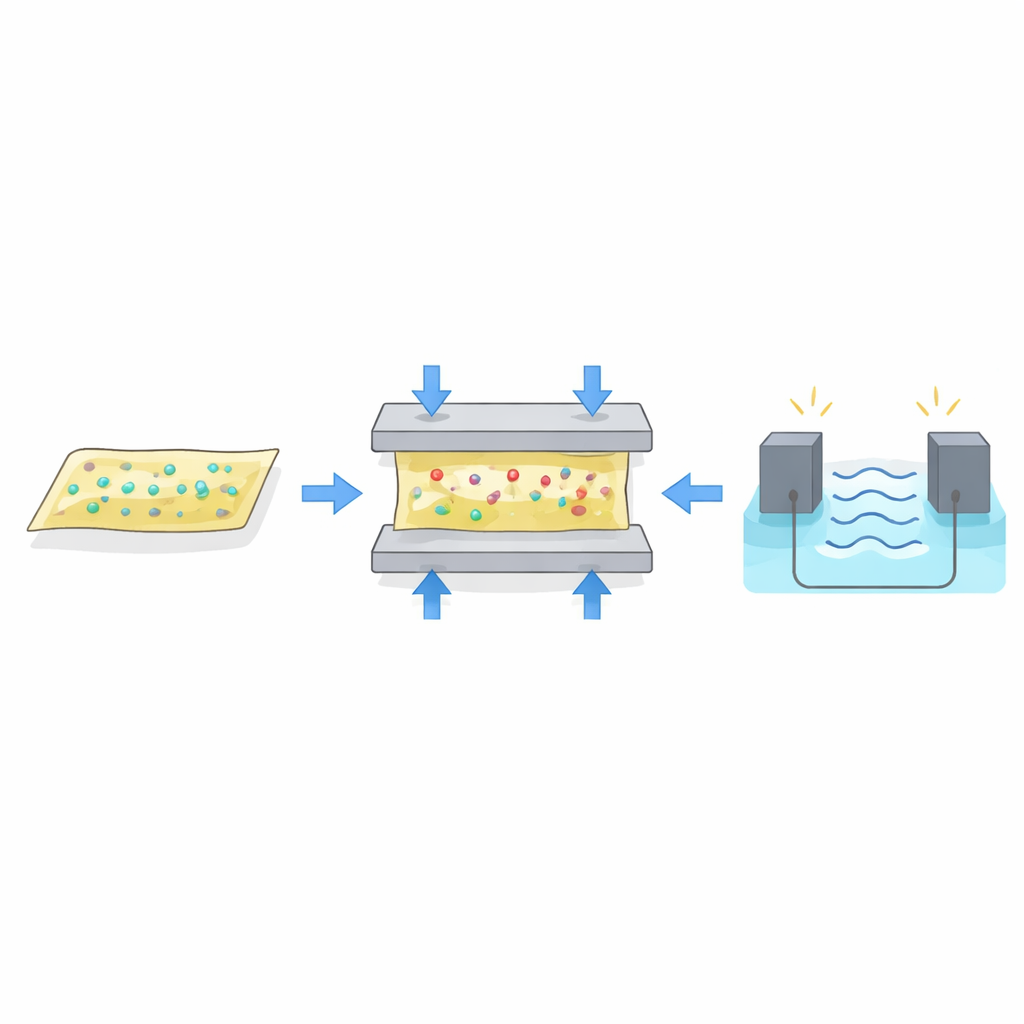
From Lab Film to Working Ultrasound Sensor
To turn the films into devices, the authors place them between thin metal layers to form flexible electrical “sandwiches,” then coat them with a protective biocompatible layer. When they press on these devices with a known force, the best performing films—those containing about 0.74% cellulose nanocrystals by weight—produce an electrical response comparable to that of a widely used plastic called PVDF, reaching a piezoelectric coefficient around 30 picocoulombs per newton. The same devices are then tested in water as ultrasound receivers. At this optimal particle content, the films not only detect incoming ultrasound waves clearly but do so with stable, low‑noise signals, suggesting that the internal structure is both uniform and efficient at channeling mechanical vibrations into electricity.
What This Means for Future Health Tech
By blending chitosan and carefully shaped cellulose nanocrystals, the researchers have created a fully biodegradable film that matches the performance of established synthetic materials while avoiding their environmental and safety drawbacks. The films can act as the active heart of flexible ultrasound transducers, suitable for wearable health monitors or temporary implants that do their job and then safely disappear. Although questions remain about long‑term stability, large‑scale manufacturing, and performance inside the human body, this work marks an important step toward medical electronics that care not only for patients but also for the planet.
Citation: Antonaci, V., de Marzo, G., Blasi, L. et al. Biodegradable chitosan-cellulose and sub-spherical nanocrystals composite piezoelectric thin film. npj Flex Electron 10, 55 (2026). https://doi.org/10.1038/s41528-026-00550-8
Keywords: biodegradable electronics, piezoelectric film, chitosan, cellulose nanocrystals, ultrasound sensors