Clear Sky Science · en
Quantitative surface-enhanced Raman spectroscopy analysis of sweat integrated with a skin-mounted soft microfluidic reactor
Why a Sweat Patch Matters for Everyday Health
Imagine checking key health markers just by sweating, without a needle stick or a trip to the clinic. This paper describes a soft, bandage-like patch that sits on the skin, routes sweat through tiny channels, and turns invisible molecules into signals that can be read by a handheld light probe or even a smartphone camera. The goal is reliable, on-the-body measurement of substances linked to kidney function and blood sugar, opening the door to more comfortable and frequent health checks.
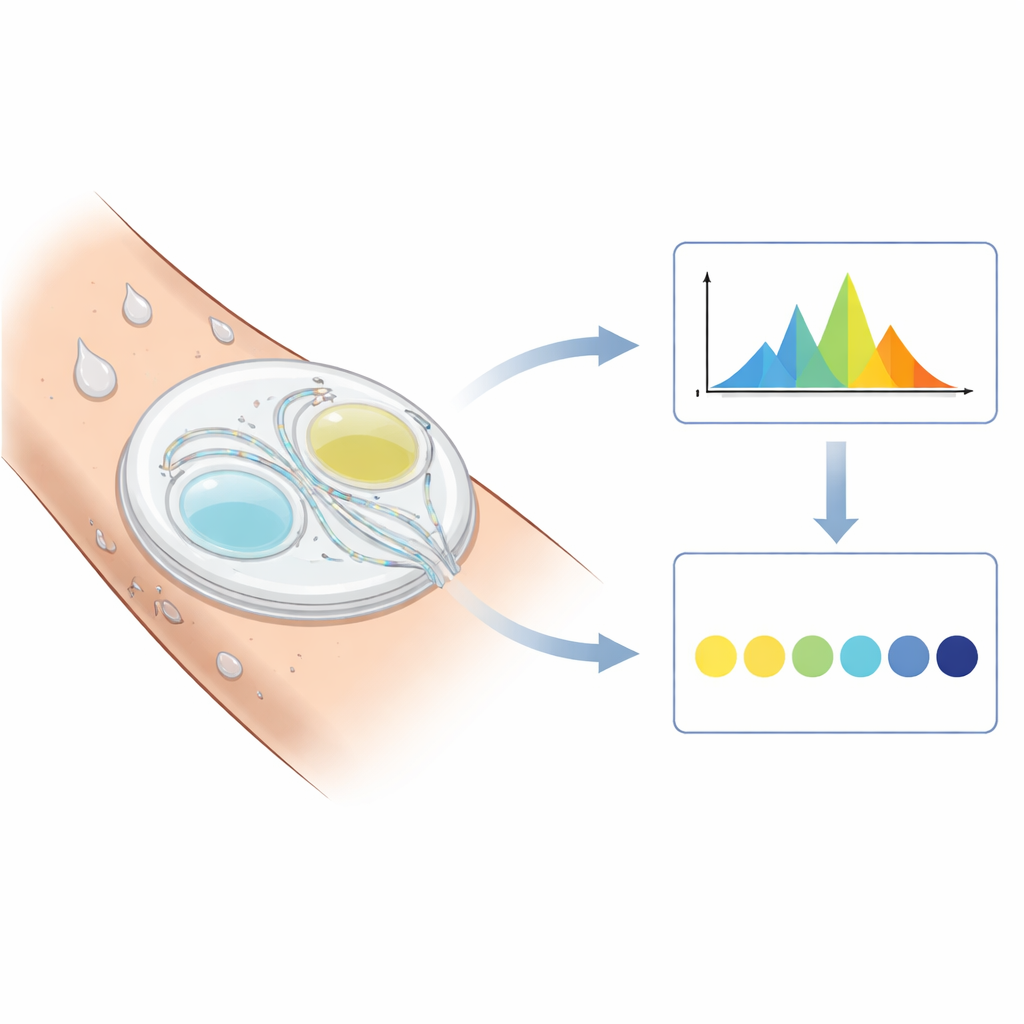
A Gentle Patch that Listens to Your Skin
The researchers built a thin, flexible microfluidic device—essentially a soft maze of tiny channels molded in silicone—that conforms to the skin and passively collects sweat as it appears. Inside are paired pathways: one leads to a region designed for a light-based technique called Raman sensing, and the other to a shallow viewing well for color changes. As sweat wicks through, it fills these miniature chambers without pumps or electronics, letting the patch work during everyday activities like cycling or sitting in a warm room.
Turning Silent Molecules into Visible Signals
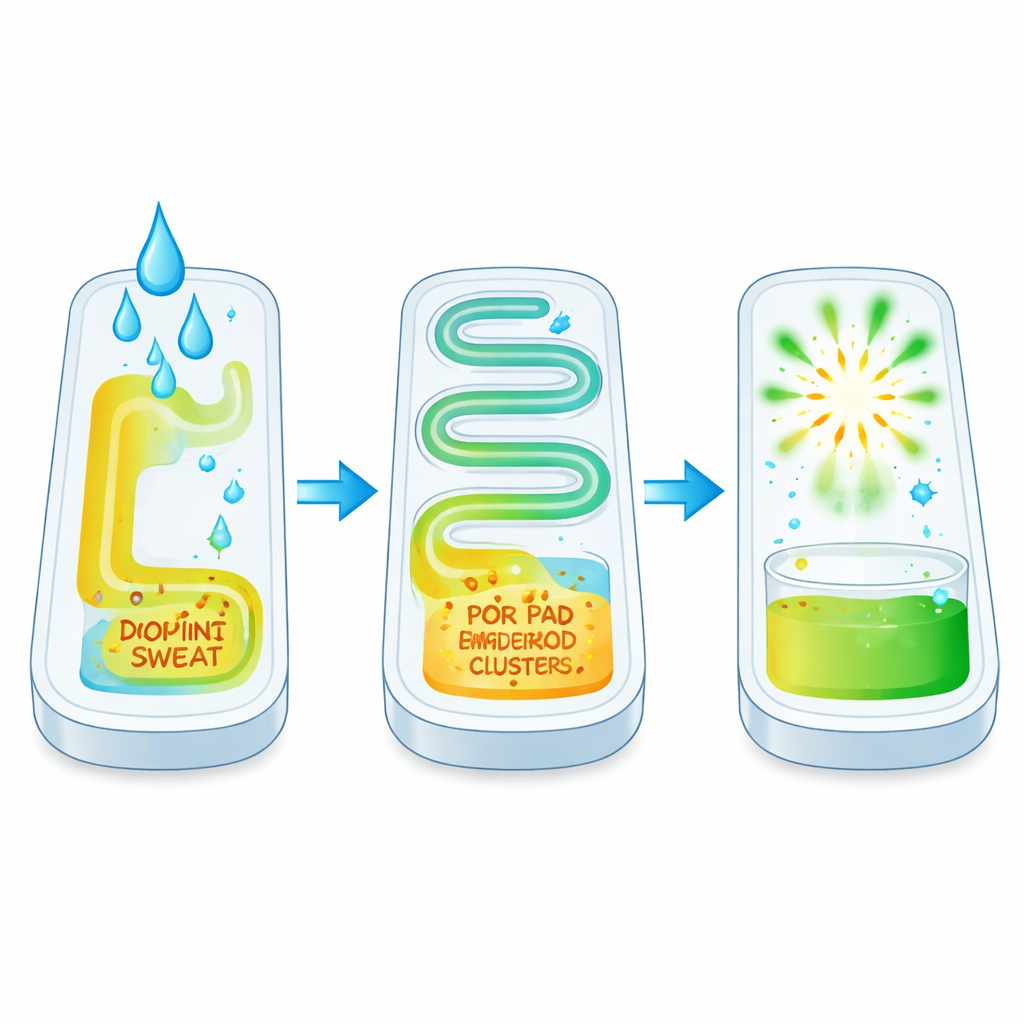
Many important molecules in sweat, such as creatinine (linked to kidney health) and glucose (related to blood sugar), are almost invisible to direct optical measurements. To solve this, the team uses a clever chemical trick. They preload the patch with an enzyme “cocktail” and a colorless dye called leucomalachite green. When a target molecule is present, the enzymes convert this dye into malachite green, which is both strongly visible (it becomes green) and gives a powerful light-scattering signature. The more of the target in the sweat, the more malachite green appears, tying color and light signal directly to the amount of biomarker.
Making Measurements Trustworthy in the Real World
In practice, measurements on the body can be messy. Light alignment may shift, the patch may bend, and the sensitive surfaces inside do not enhance signals evenly everywhere. To add stability, the researchers pre-mix a second dye, rhodamine 6G, into the sweat stream before it reaches the sensing pad. This dye has a well-behaved, constant signal that serves as an internal ruler: the malachite green response is always compared to this fixed reference, correcting for variations in instrument position and hotspot strength. They also do not trust a single spot; instead, they sample multiple tiny regions inside the sensing pad and average the results, smoothing out randomness and improving the reliability of the reading.
Color as a Quick Check, Light as the Final Judge
The same chemical reaction that powers the light signal also changes the color of a neighboring well from nearly white to green. Users and clinicians can glance at this well for an instant, qualitative sense of whether creatinine or glucose levels are low or high. But lighting conditions and camera settings normally make color-based measurements unreliable. To address this, the team converts the colors captured by a simple camera into a standardized color space and uses a metric that reflects how our eyes perceive differences in color. This processing sharply reduces errors caused by different room lights and helps the color readout agree better with the more precise light-scattering measurements and with standard laboratory test kits.
Proving Performance on Real People
After extensive tests on the bench, the team attached the patches to thirteen volunteers, who produced sweat either by sitting in a dry-heat sauna or pedaling a stationary bike. The patch successfully collected sweat from various body sites and produced consistent readings for creatinine and glucose. When these values were compared with those from commercial test kits and blood tests, they fell in the expected healthy ranges and tracked the reference methods reasonably well. Occasional mismatches—due to issues like low sweat flow or condensation—could often be caught because the two modes (color and light) did not agree, allowing suspect readings to be flagged instead of trusted blindly.
What This Means for Needle-Free Monitoring
Altogether, the work shows that a soft, skin-mounted patch can turn sweat into a dependable window on internal health by combining chemical amplification, dual optical readouts, and statistical safeguards. While more and larger clinical studies are needed, this platform offers a promising route toward wearable diagnostics that can continuously and comfortably track kidney- and glucose-related markers, and potentially many other biomarkers, without breaking the skin.
Citation: Sung, D., Jekal, B., Lee, S.I. et al. Quantitative surface-enhanced Raman spectroscopy analysis of sweat integrated with a skin-mounted soft microfluidic reactor. npj Flex Electron 10, 47 (2026). https://doi.org/10.1038/s41528-026-00549-1
Keywords: wearable sweat sensor, noninvasive diagnostics, Raman spectroscopy, microfluidic patch, glucose and creatinine monitoring