Clear Sky Science · en
Achieving intrinsically stretchable high-performance n-type semiconducting polymers by tuning side chain ordering inspired by oleic acid
Soft electronics that move with your body
Imagine a medical sensor that bends and stretches with your skin like a second layer of flesh, instead of sitting on it like a stiff bandage. To make such truly comfortable electronics, we need materials that can carry electrical signals while being pulled, twisted, and flexed thousands of times. This paper shows how tiny changes to the "tails" of plastic-like molecules can turn a normally brittle electronic material into one that stretches and snaps back, without losing its ability to move charges efficiently.
Why stretchable plastics are hard to design
Flexible electronics often rely on special plastics called semiconducting polymers, which can conduct electricity yet still be processed like ordinary plastics. But these materials face a built-in conflict. To move electrical charges quickly, their long molecular backbones like to pack in neat, crystalline stacks. To stretch without breaking, they instead need softer, disordered regions that can rearrange under stress. For the negatively charged, or n-type, materials that are essential for full electronic circuits, finding a good balance between fast charge transport and mechanical stretchability has been especially difficult.
Borrowing a trick from everyday fats
To solve this problem, the researchers took inspiration from common fatty acids such as those found in cooking oils. A fat like stearic acid, which is fully saturated, packs tightly and behaves like a waxy solid. Oleic acid, found in olive oil, has a small bend—a cis double bond—along its chain that disrupts tight packing and makes it fluid at room temperature. The team mimicked this idea in an advanced n-type semiconducting polymer. They started from a high-performance backbone known for fast electron transport, and attached two types of long side chains: one set perfectly straight (saturated), the other carrying internal kinks (unsaturated), directly analogous to the difference between stearic and oleic acid. 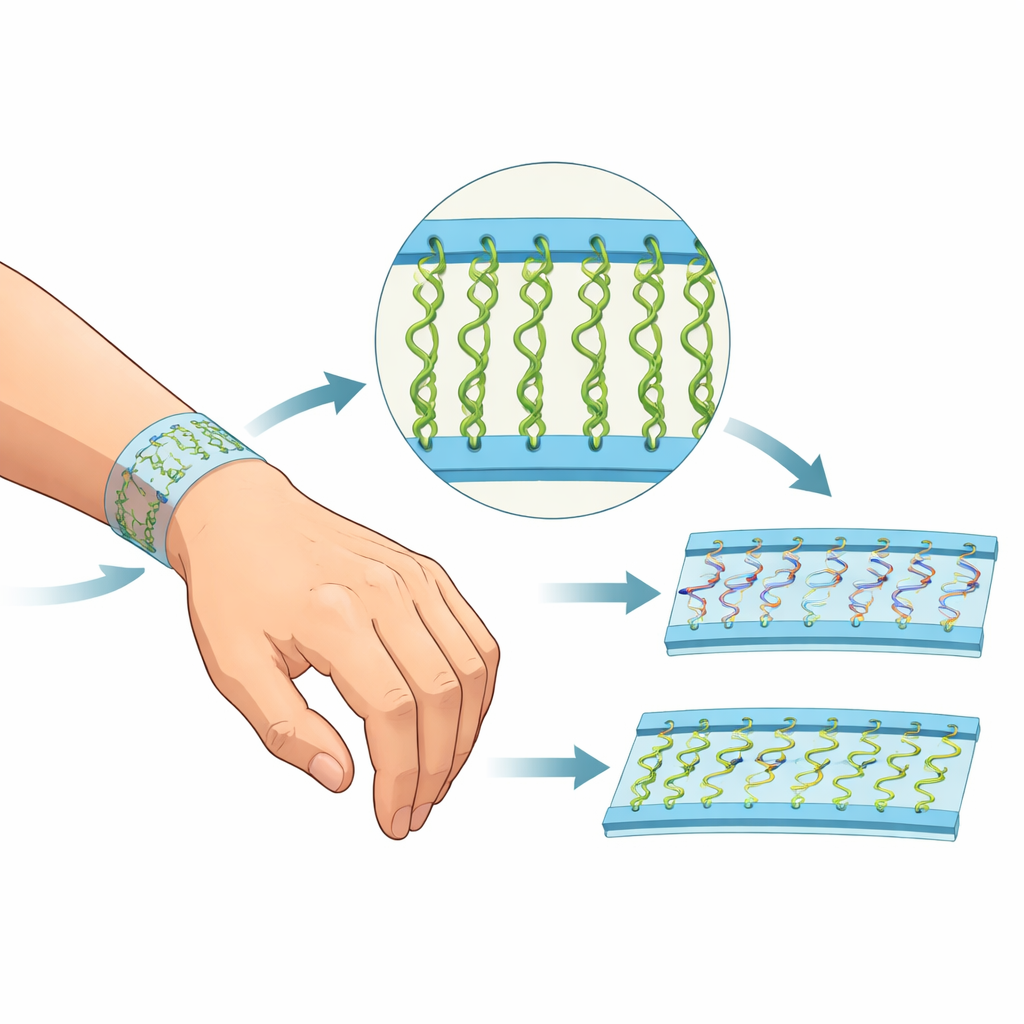
How molecular disorder softens the film
Using a suite of thermal, mechanical, and X-ray techniques, the scientists showed that adding kinks to the side chains leaves the backbone’s electronic structure essentially unchanged but dramatically alters how the side chains pack. The straight side chains form ordered, crystalline domains that melt near room temperature and give rise to stiff, brittle films that crack early under strain. In contrast, the kinked side chains refuse to crystallize, remaining amorphous and more mobile. This extra molecular motion creates free space between chains, making the overall film softer, more elastic, and better able to dissipate local stress before it concentrates into damaging cracks.
Stretching without losing performance
The team then built tiny transistors from both versions of the polymer and systematically stretched the films. Devices based on the straight-tailed polymer quickly lost mobility as strain increased and as the films were cycled repeatedly. Those made from the kinked-side-chain polymer maintained robust electron mobilities around 0.4 square centimeters per volt-second even when stretched to 50% or after 2,000 stretch–release cycles at 25% strain. Microscopy and scattering measurements under strain revealed why: in the softer material, crystalline regions rotate and align along the stretching direction, while chains in both ordered and disordered zones slide past each other instead of snapping. This multiscale rearrangement allows the film to stretch significantly before serious cracking appears. 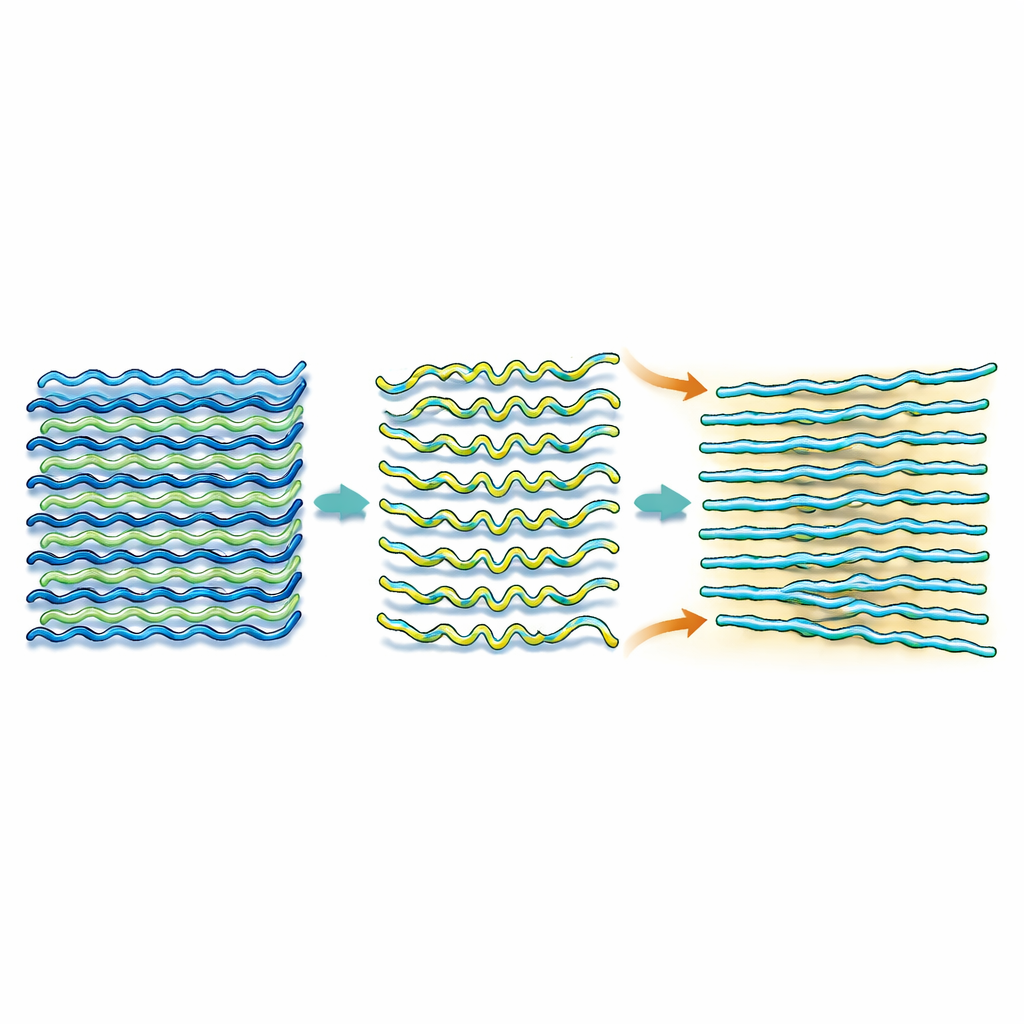
A recipe for gentler, smarter devices on skin
Altogether, the work demonstrates that carefully introducing molecular "messiness" in the side chains—while keeping the main conducting backbone intact—can yield n-type polymers that are both highly stretchable and electronically strong. For non-specialists, the main message is that the feel and durability of future wearable and implantable electronics can be tuned by details as small as a bend in a molecular tail. This oleic-acid-inspired design strategy can, in principle, be applied to many other electronic plastics, bringing us closer to soft, reliable devices that move effortlessly with the human body.
Citation: Zhang, XY., Yu, ZD., Liu, NF. et al. Achieving intrinsically stretchable high-performance n-type semiconducting polymers by tuning side chain ordering inspired by oleic acid. npj Flex Electron 10, 45 (2026). https://doi.org/10.1038/s41528-026-00547-3
Keywords: stretchable electronics, semiconducting polymers, n-type materials, wearable devices, molecular design