Clear Sky Science · en
Sub-1V, flexible, all-polymer complementary logic circuits based on electrolyte-gated transistors
Electronics That Can Bend and Run on a Watch Battery
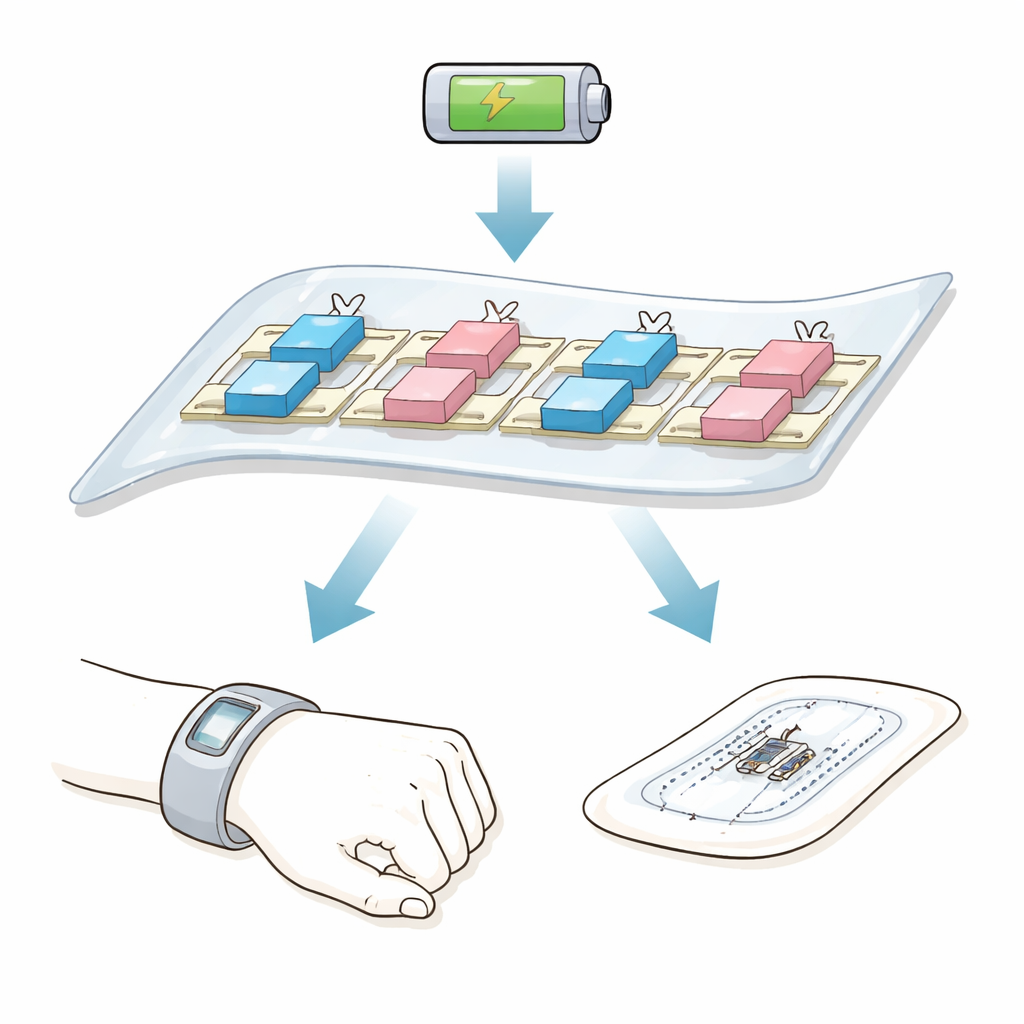
Imagine flexible electronic circuits that wrap around your skin, listen to your heartbeat, or sniff out chemicals in the air, all while running on less than a single volt—about the power of a small watch battery. This paper reports a key step toward that vision: a new kind of soft, plastic-based transistor that works reliably at very low voltages and can be woven into simple logic circuits, the basic building blocks of computing.
Why Soft Transistors Matter
Most of today’s electronics are built from rigid silicon chips that prefer dry, flat circuit boards and higher operating voltages. For wearable sensors, on-skin health patches, and paper-thin gadgets, engineers are turning to “polymer” electronics—devices made from flexible plastics that can be printed from solution like inks. A promising class of these devices, called electrolyte-gated transistors, uses a salty or gel-like material instead of the hard insulating layers found in silicon chips. This lets them switch on and off at very low voltages, making them gentle enough to interface with living tissue and efficient enough for portable, battery-powered systems.
Solving the Missing Half of the Circuit
To build useful logic gates—the small circuits that perform AND, OR, and NOT operations—engineers need both p-type devices (which carry positive charges) and n-type devices (which carry negative charges). Polymer electrolyte-gated transistors have long worked well in the p-type mode, but stable, high-performance n-type versions have been rare and fussy. In this work, the authors tackle that gap using a robust n-type polymer known as BBL, paired with a solid, jelly-like electrolyte called an ionogel. The ionogel is a sponge-like plastic filled with an ionic liquid, a salt that is molten at room temperature, providing mobile ions without the evaporation problems of water-based electrolytes.
How Ions Carve Easy Pathways
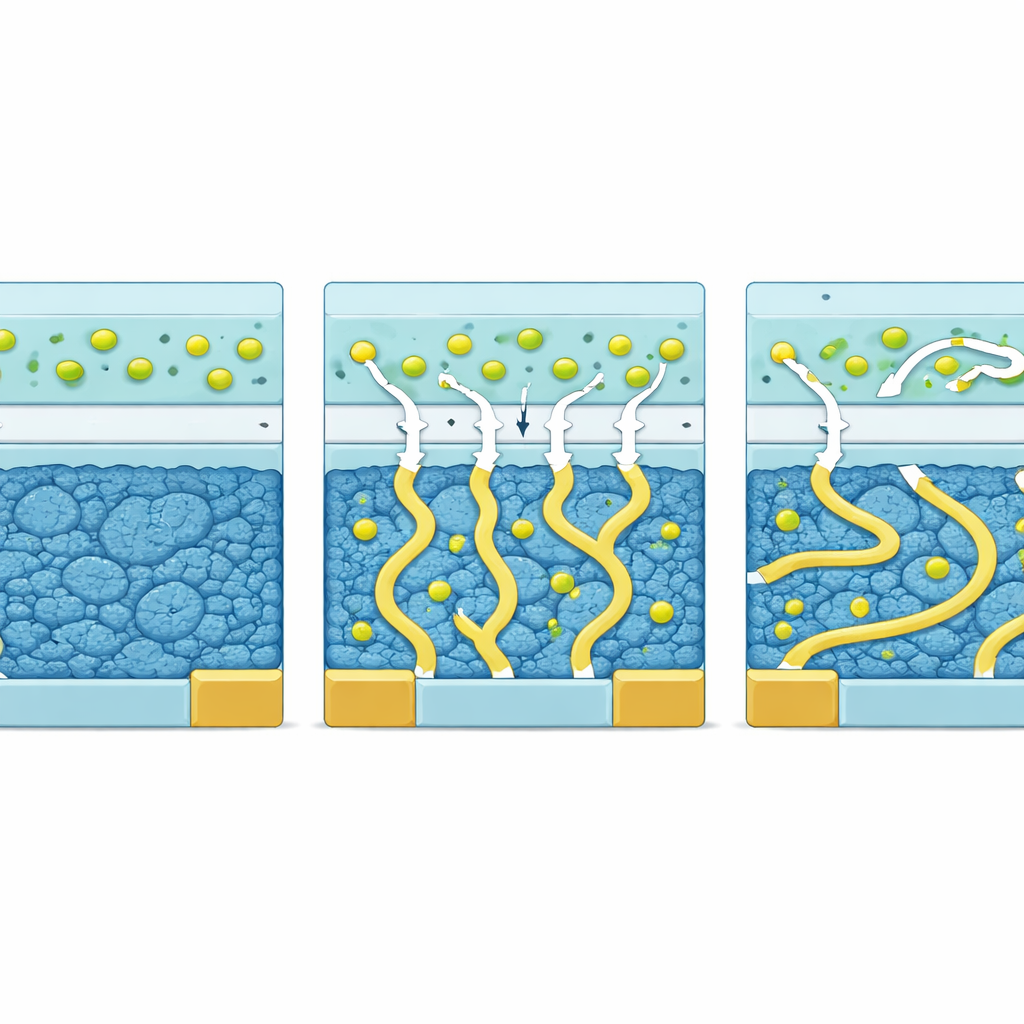
When the researchers first apply voltage to their BBL transistors, the devices behave oddly: they only turn on at a relatively high gate voltage and show a large delay between switching on and off, a behavior called hysteresis. During this “break-in” sweep, ions from the ionogel are forced into the polymer film. At a particular level of charging, the internal structure of BBL subtly reorganizes, especially in its more disordered, or amorphous, regions. This reorganization opens up channels that allow ions to move in and out much more easily. After this initial conditioning, the transistor turns on at far lower voltages, switches sharply between on and off states, and shows almost no hysteresis, even when the voltage is swept quickly.
Proving the Hidden Rebuild
To confirm what is happening inside the material, the team combines electrical tests with optical and structural measurements. Light-absorption experiments reveal the growth of electronic states associated with added electrons, and they grow more efficiently after the first cycle, consistent with easier access for ions. Atomic force microscopy images show that the surface pattern of the polymer film changes after ion exposure, while X-ray scattering indicates that the tightly packed crystalline regions remain largely intact. Together, these results paint a picture in which ions mainly invade the softer, less ordered parts of the film, carving out mixed ion–electron “highways” that feed the more orderly domains where electrons race along.
From Single Devices to Working Logic on Plastic
With the break-in effect understood and harnessed, the BBL transistors deliver impressive numbers: a very large difference between on and off current, strong amplification of input signals, and operation below 1 volt, all while remaining stable in air and at elevated temperatures. The authors then pair the n-type BBL devices with established p-type polymer transistors made from a material called P3HT. By wiring these together, they demonstrate simple but complete logic elements: inverters (NOT), as well as NAND and NOR gates, which can be combined to build more complex circuits. They go further by fabricating these circuits on flexible plastic sheets, showing that both single transistors and inverters keep working after repeated bending and under tight curvatures.
What This Means for Everyday Tech
For a non-specialist, the key takeaway is that the study delivers a reliable “missing piece” for soft, low-voltage electronics: high-performing n-type transistors made entirely from polymers and solid electrolytes. By showing how a controlled dose of mobile ions can permanently improve the internal pathways in the BBL polymer without damaging its skeleton, the authors unlock fast, stable switching at tiny voltages on bendable substrates. This paves the way for simple logic and sensing circuits that can be printed, wrapped, and worn—bringing computing closer to the softness and shape of everyday objects and even the human body.
Citation: Kim, S.J., Park, D.H., Lee, Y.N. et al. Sub-1V, flexible, all-polymer complementary logic circuits based on electrolyte-gated transistors. npj Flex Electron 10, 44 (2026). https://doi.org/10.1038/s41528-026-00530-y
Keywords: flexible electronics, polymer transistors, electrolyte gating, low-voltage logic, ionogel materials