Clear Sky Science · en
Release and recapture of silica nanoparticles from an optical trap in weightlessness
Why Tiny Particles in Free Fall Matter
Physicists are constantly looking for new ways to probe the deepest laws of nature, from gravity to quantum mechanics. One promising tool is a tiny glass bead held in place by a laser, so sensitive that it can feel incredibly small forces. In this study, researchers show that such “optically levitated” nanoparticles can be released and caught again while the whole setup is in weightlessness, a key step toward future space experiments that may test how gravity and quantum physics fit together and improve ultra-precise force sensors.
Floating Beads as Test Particles
The experiment uses silica nanoparticles—glass spheres only about 150 nanometers across—held in a focused infrared laser beam inside a small vacuum chamber. The laser acts like an invisible spring, trapping the particle near its focus so that it wiggles back and forth in three directions. Because the chamber is evacuated and the particle is tiny, outside disturbances are minimized, making the bead an exquisitely sensitive probe of tiny pushes and pulls. This kind of system, known as levitated optomechanics, is especially attractive because the particle’s starting conditions—its position and motion—can be prepared very precisely, which is crucial for tests of quantum behavior at relatively large masses and for next-generation force measurements.
Taking the Lab into Weightlessness
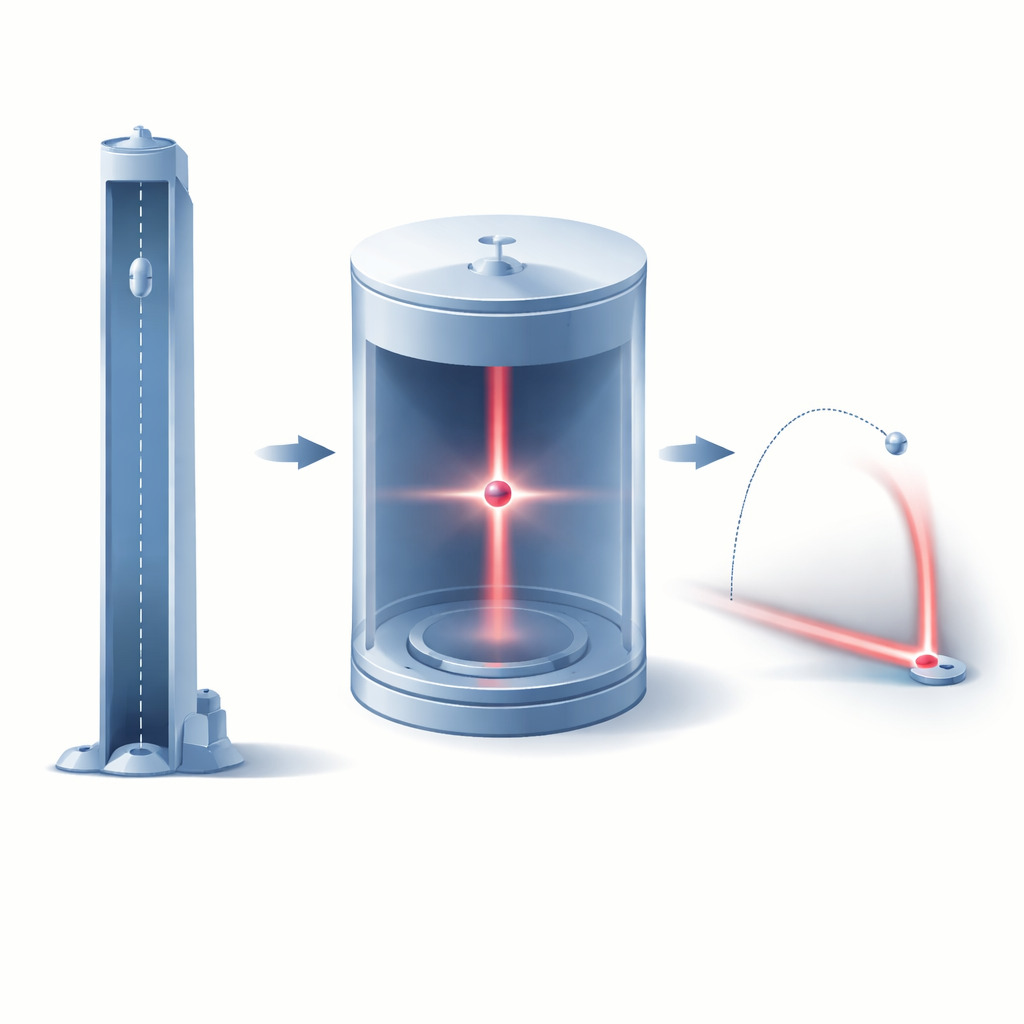
To explore what happens when gravity is effectively removed, the team adapted a full optical trapping setup for operation inside the GraviTower Bremen, a compact drop-tower facility that provides up to a couple of seconds of weightlessness. The laser light is amplified and shaped before being focused by a high-quality parabolic mirror into the vacuum chamber, forming the trap. Light scattered from the nanoparticle is collected back through the same mirror and routed to a single photodiode, which converts the particle’s motion into an electrical signal. The entire system, including optics, electronics, and power, had to be compact, robust, and battery-driven to survive repeated launches and free-fall runs inside the tower while still maintaining the delicate alignment needed to hold a single nanoparticle in place.
Checking That the Trap Behaves the Same
Before performing free-flight tests, the researchers verified that the trap in microgravity behaves just like it does in the lab. They measured how the particle’s natural vibration frequencies in the trap depend on laser power, both on the ground and during drop-tower flights. By analyzing the frequencies in the photodiode signal, they confirmed that the presence or absence of gravity does not noticeably change the trapping behavior, in line with computer simulations. They also adjusted the polarization of the light so that the particle has slightly different stiffness along two sideways directions, an important technical step for future active cooling of the motion, which will be needed to extend the duration of controlled free flights.
Letting Go and Catching Again
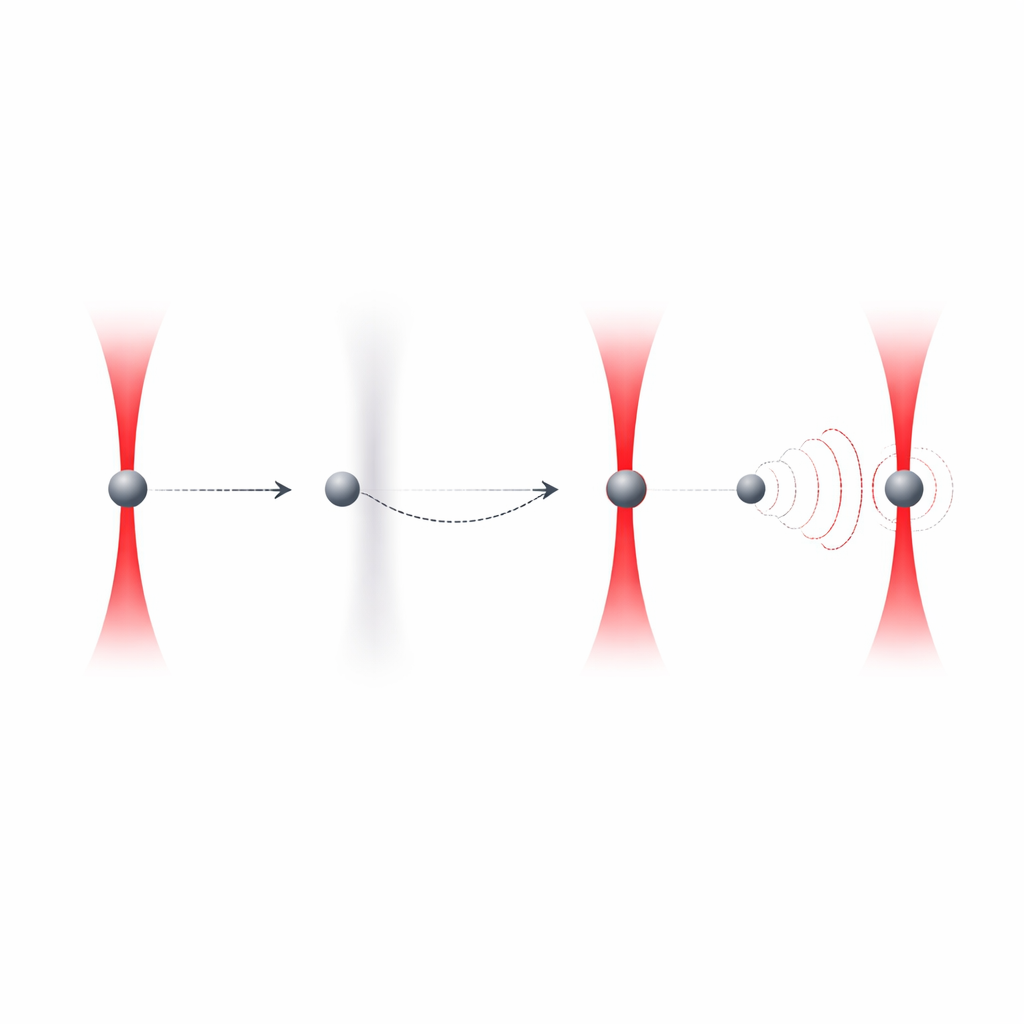
The central experiment involved briefly switching off the trapping laser so that the particle flew freely, then turning the laser back on to recapture it. During the off period, the same laser that usually measures the position is dark, so the motion must be reconstructed from what happens before and after. The team released the nanoparticle for periods up to 10 microseconds in weightlessness. After each release, they examined how strongly the particle oscillated once recaptured and used careful filtering of the signal to separate motion along the three spatial directions. When the particle’s swings remained modest, the trap behaved like a simple spring, and its trajectory during the free flight could be accurately predicted and matched to the measurements. For longer release times or larger excursions, the motion entered more complicated, non‑springlike regions of the optical force, where their single-detector method could no longer cleanly separate the different directions.
Steps Toward Quantum Tests and Better Sensors
The study demonstrates that levitated nanoparticles can be controlled, released, and recaptured in a genuine microgravity environment, with their motion during free flight behaving just as expected from simple physics. This proof-of-principle opens the way to longer, colder, and more delicate experiments where the particle’s motion approaches the quantum regime or is used as an ultra-sensitive test mass for measuring tiny forces, including gravity itself. With planned improvements such as active cooling to reduce the particle’s random motion, similar setups could allow free flights thousands of times longer than those reported here, turning a falling glass bead into a powerful new window on the fundamental workings of the universe.
Citation: Prakash, G., Herrmann, S., Bergmann, R.B. et al. Release and recapture of silica nanoparticles from an optical trap in weightlessness. npj Microgravity 12, 37 (2026). https://doi.org/10.1038/s41526-026-00596-y
Keywords: levitated optomechanics, microgravity, optical trapping, nanoparticles, precision force sensing