Clear Sky Science · en
Modeling the risk of airborne transmission of respiratory viruses in microgravity
Why germs in space matter
As humans plan longer trips in space, from extended stays on the International Space Station to future journeys to the Moon and Mars, one quiet threat rides along with every crew: respiratory viruses. On Earth, germs in the air eventually drift to the ground, and hospitals can step in when people fall ill. In orbit, however, particles float for far longer and medical backup is far away. This study asks a simple but urgent question: how easily could a virus like the one that causes COVID-19 spread through the air in microgravity, and what can be done to protect astronauts?
How floating air changes infection risk
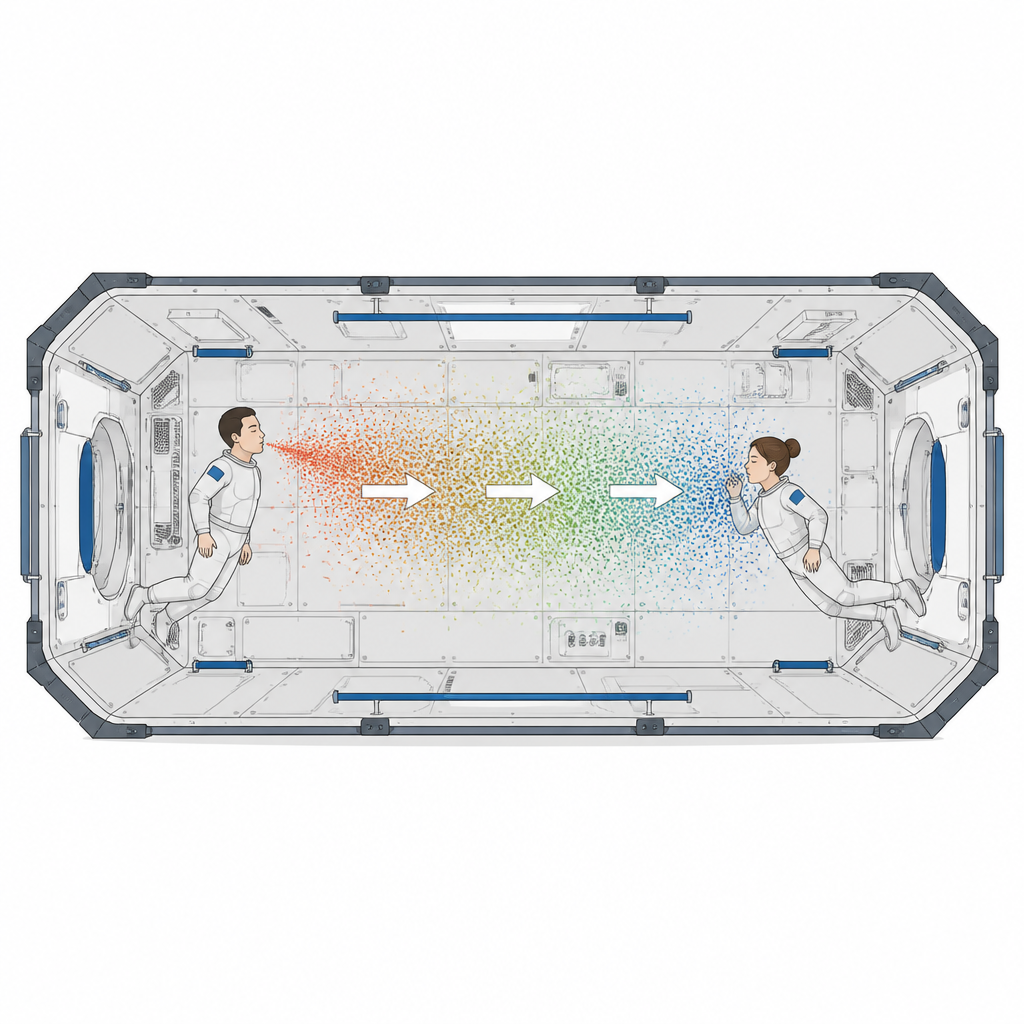
On Earth, gravity helps pull exhaled droplets and aerosols down, so they either land on surfaces or are cleared from the air relatively quickly. In microgravity, that settling force is almost absent. Using a detailed computer model originally built to study COVID-19 spread in rooms on Earth, the researchers adjusted the physics to match conditions on the International Space Station. They showed that particles a few micrometers across, which would fall out of the air in minutes or hours on Earth, can stay suspended for years in microgravity. As a result, virus-carrying particles can build up in the closed air of a space module instead of clearing out.
How much risk goes up in orbit
When the team simulated an infected crew member sharing a module with one healthy person and no special protections, they found that virus levels in the air could become roughly 286 times higher in microgravity than in an Earth-like room. Over a week of exposure, the chance that the healthy astronaut would become infected climbed to about 78 percent, almost double the risk on Earth under the same assumptions. This large jump in risk comes mainly from the way floating particles accumulate rather than fall, turning the shared air of a spacecraft into a more efficient carrier of infection.
What masks and filters can do
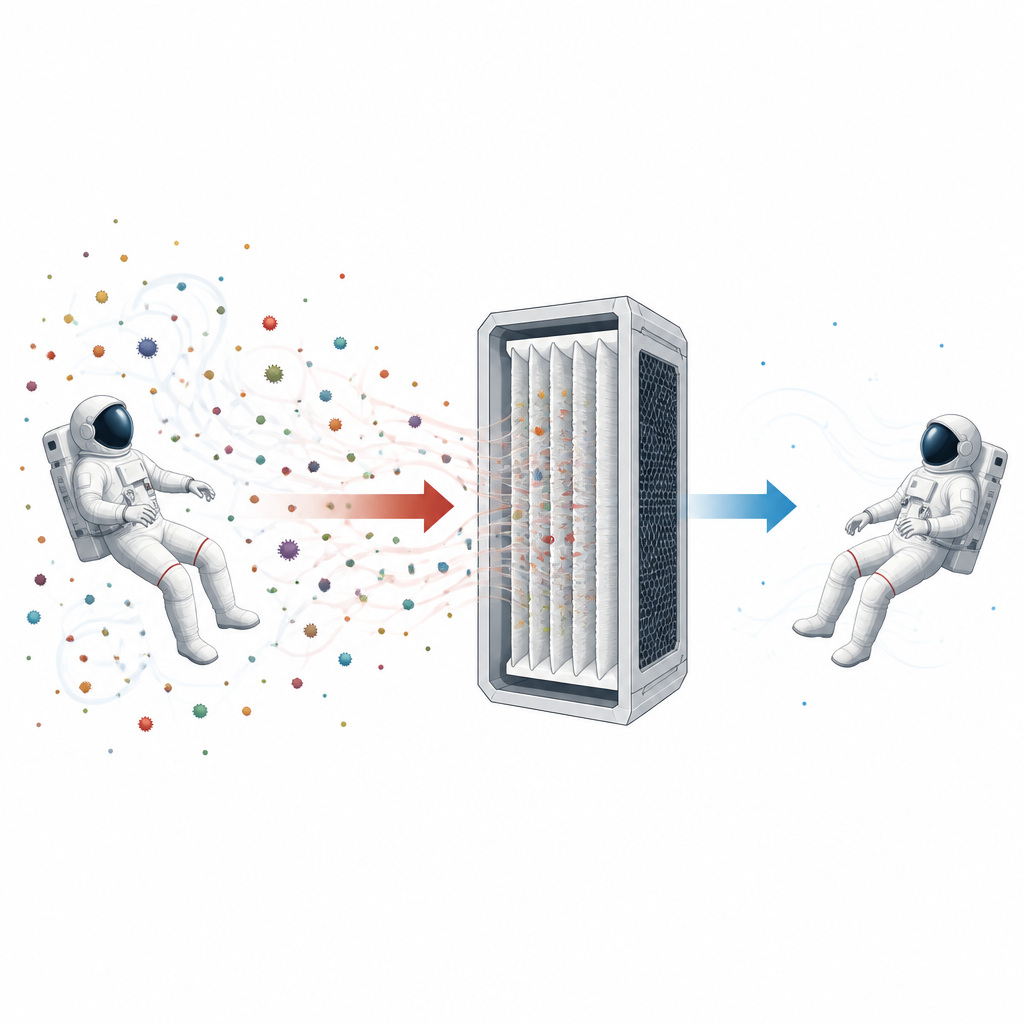
The study then tested common safety measures virtually. If the infected astronaut wore a mask, the number of virus-laden droplets released into the cabin air dropped by about 85 percent. This lowered the infection chance from 78 to 67 percent, and to 60 percent when both crew members wore masks. However, the single most powerful measure was continuous filtration. When air passed through a High-Efficiency Particulate Air, or HEPA, system five times per hour, the model estimated a 99.79 percent drop in airborne virus levels. Under those conditions, infection risk fell to about 25 percent, even lower than the modeled risk on Earth without special controls.
Weaker defenses in stressed bodies
Spaceflight brings not only unusual physics but also unusual biology. Astronauts face confinement, disrupted sleep, radiation, and other stresses that can weaken their immune systems. Past missions have shown that dormant herpesviruses, normally kept in check in healthy people, reactivate more often in space, with much higher levels of virus shedding. To explore what something similar might mean for a respiratory virus, the researchers tested scenarios where an infected astronaut released four, eight, or sixteen times more virus than in their baseline case. In the mid-range eightfold scenario, infection risk without protections rose to about 87 percent. Even with HEPA filtration alone, the chance of infection stayed higher than the Earth baseline, showing how a stressed immune system could quietly amplify transmission.
Layered protection for future crews
The model also looked at the upside of stronger immunity, such as that provided by vaccines or other medical strategies. A hypothetical 50 percent boost in immune protection trimmed infection risk by a few percentage points on its own, and by more than 14 percentage points when combined with HEPA filtration. In some combined scenarios, the overall risk in space fell to roughly match or even beat the Earth baseline. While the work is theoretical and relies on assumptions drawn from different viruses, it points to a clear message for future missions: in microgravity, floating air and stressed bodies both favor respiratory spread, so safety will depend on layered defenses that mix good air cleaning, smart mask use, and strong immune health.
Citation: Sararat, C., Jiravejchakul, N., Nawattanapaiboon, K. et al. Modeling the risk of airborne transmission of respiratory viruses in microgravity. npj Microgravity 12, 44 (2026). https://doi.org/10.1038/s41526-026-00590-4
Keywords: microgravity, airborne transmission, space station, HEPA filtration, astronaut health