Clear Sky Science · en
Kinematic analysis of the European Enhanced Exploration Exercise Device in unpowered mode
Why keeping fit in space matters
When astronauts spend months in weightlessness, their muscles, bones, and hearts begin to weaken because they no longer work against gravity. Exercise devices on the International Space Station help, but they are large, power hungry, and not ideal for cramped spacecraft heading to the Moon or beyond. This study looks at a new, compact exercise machine that can work even when the power is off and asks a simple question: can it let people move in much the same way they would on familiar gym equipment?
A small workout machine for long trips
The European Enhanced Exploration Exercise Device, or E4D, is designed to pack many workouts into one small unit. Astronauts will eventually be able to use it for more than thirty strength exercises plus aerobic training such as cycling and rowing. A key feature is its backup, or “contingency,” mode. In this unpowered setting, a flywheel and mechanical parts provide resistance, while springs pull the cables back, so no motor or electricity is needed. This is crucial on deep space missions where power may be reserved for life support or navigation, yet crews still need to train every day to stay healthy.
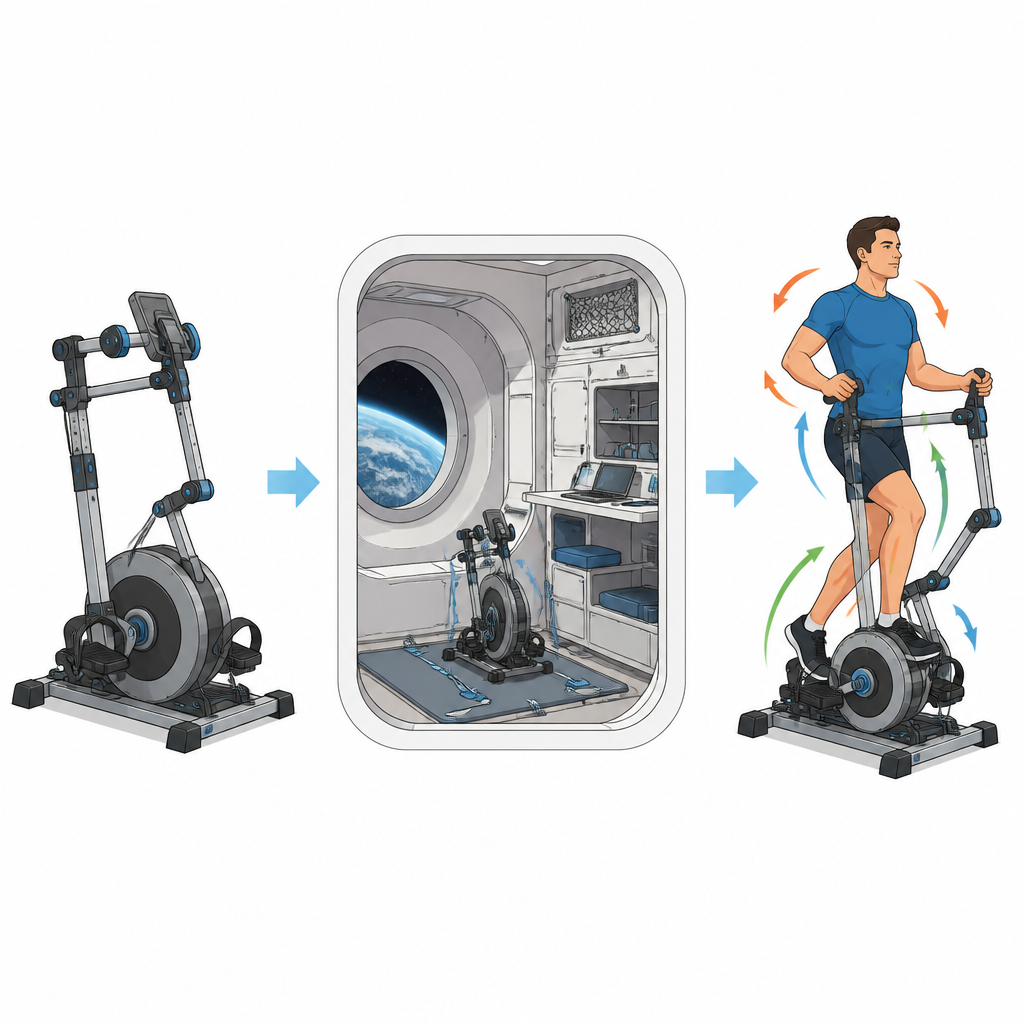
Putting the device to the test
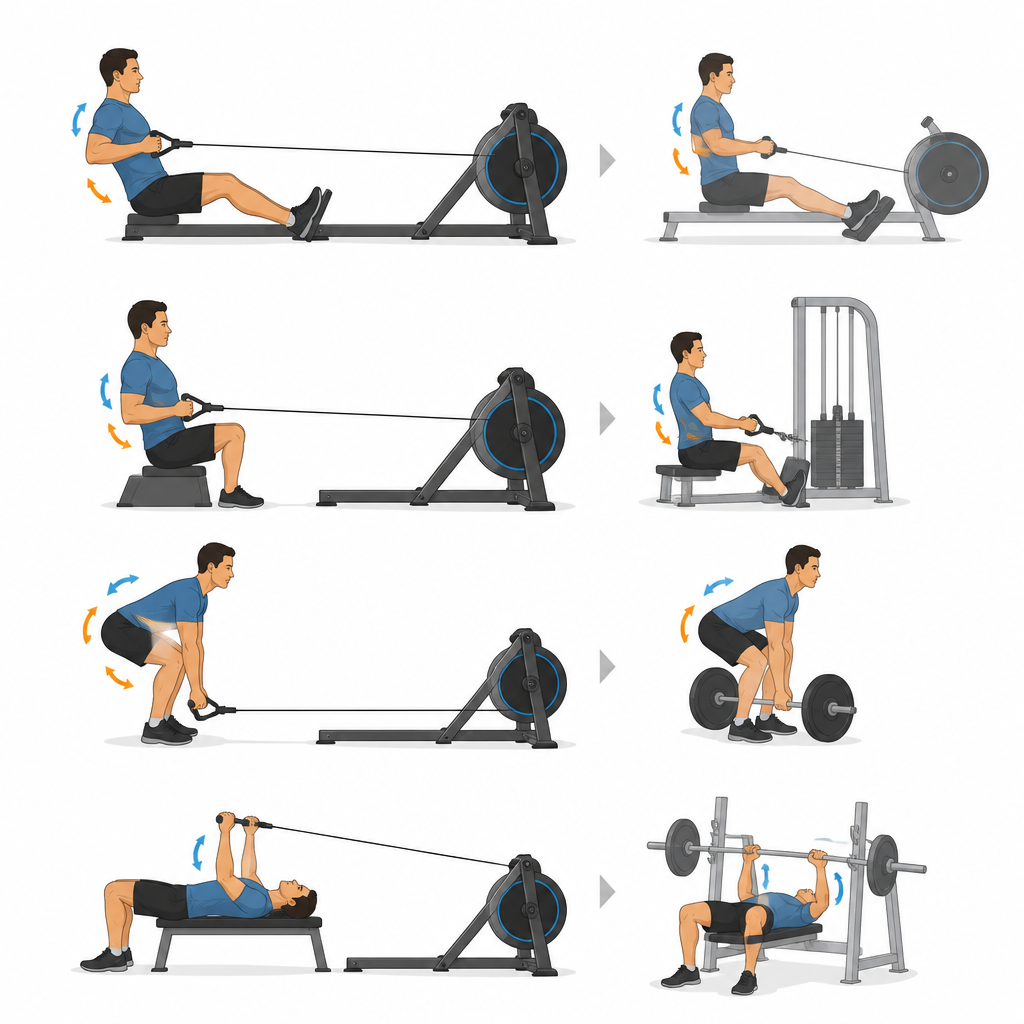
To see how well the E4D works without power, researchers asked fourteen healthy volunteers to perform four common exercises in two ways: on standard gym machines and on the E4D in contingency mode. The chosen exercises were rowing, seated row, deadlift, and bench press, which together work both upper and lower body and combine strength with some aerobic demand. Participants wore a full-body suit with motion sensors that tracked how their joints moved and how fast they moved throughout each exercise. After every set, they also rated how hard the effort felt using a standard scale of perceived exertion.
How movement compared with a normal gym
For rowing, the E4D produced joint movements and speeds that were nearly identical to a commercial rowing machine, even though people said the E4D felt somewhat harder. This suggests the unpowered flywheel can mimic familiar rowing motion while delivering a slightly heavier workout. For deadlifts, overall joint ranges were also similar between the two setups. However, hips and knees tended to move a bit faster during the lift phase with traditional weights, hinting at small differences in how resistance builds and changes over the course of the motion.
Subtle differences in pulling and pressing
In the seated row, people moved their shoulders and elbows through a larger arc and with faster shoulder motion on the E4D, yet reported the exercise as easier than on the gym machine. The researchers trace this to two design factors: the E4D uses flexible rope handles instead of a rigid narrow bar, and its resistance comes from a flywheel rather than a stack of plates. Together, these features encourage a wider pull and slightly quicker movement, without signs that this would harm training benefits at light to moderate effort. During the bench press, the E4D led to greater shoulder bend for most of the movement, partly because it was performed on a modest incline and with a different bar setup than the flat bench in the gym. Despite these shape changes in the motion path, people judged the overall difficulty to be similar.
What this means for future crews
Overall, the study found that the E4D in unpowered mode lets people perform full-body workouts with movement patterns that largely resemble those on standard gym equipment, with only brief portions of each motion showing notable differences. That means astronauts could keep training their hearts and muscles even during power shortages or equipment failures, using a single compact machine instead of several bulky devices. While more research is needed to prove that this approach fully protects health over long missions, the results suggest that smart mechanical design can keep space travelers moving well, even when the lights go out.
Citation: Winther Nielsen, C., Villekjær Østerballe, A., Leisgaard Tougaard, R. et al. Kinematic analysis of the European Enhanced Exploration Exercise Device in unpowered mode. npj Microgravity 12, 41 (2026). https://doi.org/10.1038/s41526-026-00588-y
Keywords: space exercise, microgravity fitness, astronaut training, resistance exercise device, kinematic analysis