Clear Sky Science · en
RIIST, resonance induced instability for surface tension measurement, a new technique with experiments in microgravity
Why vibrating metal drops matter in space
As we set our sights on living and working on the Moon, Mars, and in orbit, we will need to make strong, reliable metal parts far from Earth. To do that well, engineers must know how molten metals behave when they melt, flow, and solidify—especially in the strange conditions of microgravity. This paper presents a new way to measure a key property of liquid metals, called surface tension, by gently levitating and vibrating tiny molten drops aboard the International Space Station. The method promises more accurate data for future space manufacturing and advanced 3D printing on Earth.
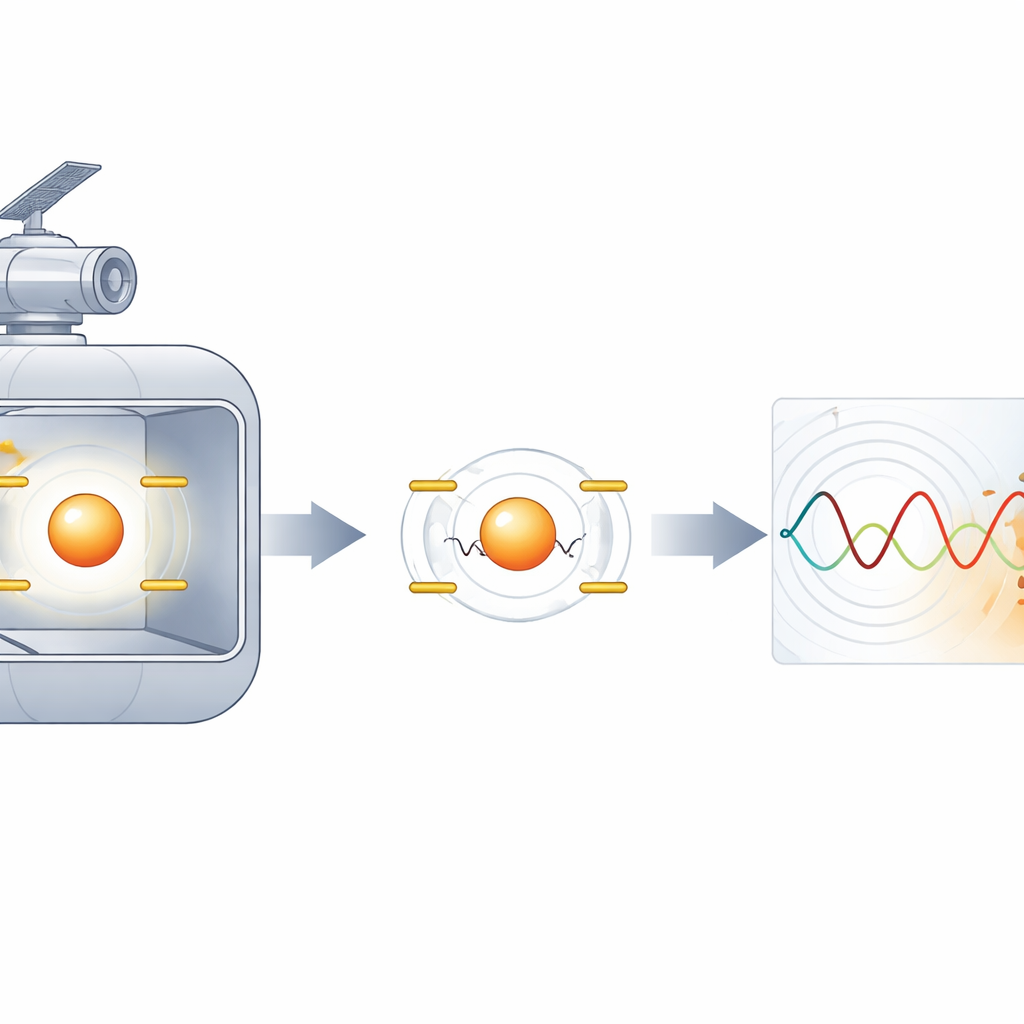
Floating droplets in a weightless furnace
On the International Space Station, researchers use a device called the Electrostatic Levitation Furnace. Instead of sitting in a container, a small metal or oxide sample is held in midair by electric fields, then melted with lasers into a near-perfect sphere. Because nothing touches the liquid, the measurements are not contaminated by container walls, and microgravity keeps the droplet from sagging under its own weight. By applying an alternating electric force with the electrodes, the team makes the droplet jiggle and change shape in a controlled way, a bit like tapping a wine glass until it rings at a particular note.
Listening to more than one note at a time
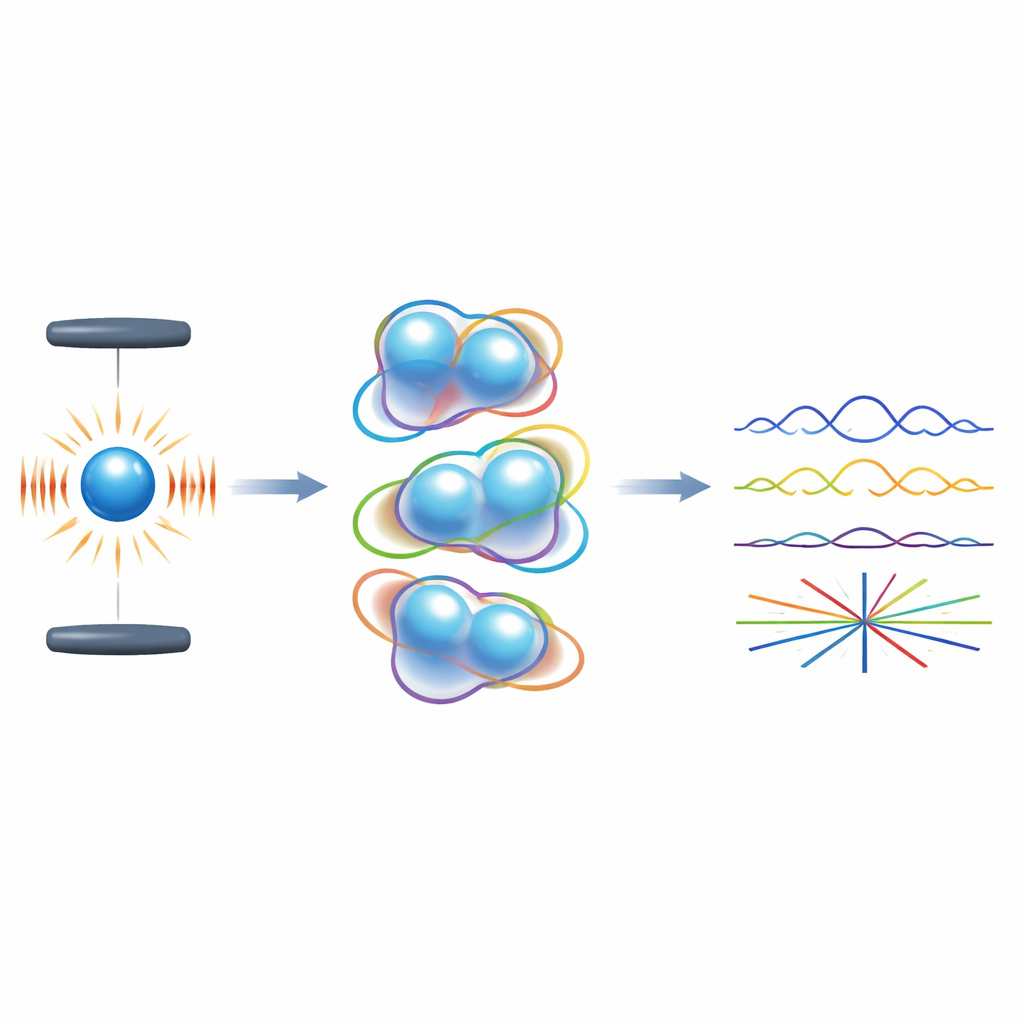
Classical theory going back to Lord Rayleigh predicts how often a perfectly spherical liquid drop will naturally vibrate in different patterns, or “modes,” if you disturb it. Earlier techniques tried to excite just one of these patterns and then watched the droplet slowly relax, using that single tone to back out the surface tension. The new method, called resonance induced instability for surface tension measurement (RIIST), deliberately pushes the droplet a little harder at one chosen mode. When the forcing is strong enough, the drop does not respond with only that main pattern; instead, several vibration patterns appear together, each with its own natural frequency. These extra patterns are called subordinate modes, and they effectively let researchers “hear” a whole chord rather than a single note.
Turning droplet shapes into numbers
To make sense of these complex motions, the team records high-speed video of the glowing droplet while it oscillates—thousands of frames per second. They then analyze the changing outline of the droplet by mathematically breaking its shape into simple building blocks, known as Legendre modes, which correspond to different ways the surface can bulge in and out. For each mode, they track how the deformation grows and shrinks over time and use frequency analysis to find the dominant vibrations. Crucially, the ratios of the frequencies of the subordinate modes to the target mode match Rayleigh’s theoretical ratios with striking precision. Because these ratios do not depend on the material’s mass or surface tension, they provide a built-in self-check: if the ratios are right, the analysis is trustworthy.
Proving the method with real molten materials
The researchers tested RIIST on several materials, including gold, platinum, iron oxide, and a niobium–iron oxide mixture, both on the ground and in orbit. Even when the droplet could only be driven to small visible distortions—common in space, where the available electric charge is lower—the analysis still picked up clear frequency peaks for subordinate modes. Using the measured natural frequencies in the Rayleigh formula, they calculated surface tension values that agreed closely with established literature, typically within a few percent. The fact that measurements derived independently from two different modes in the same droplet agreed with each other showed that the method is not only accurate but internally consistent.
What this means for space factories of the future
In everyday terms, this work shows that by carefully “ringing” a floating molten drop and decoding all of the notes it plays at once, scientists can determine how tightly its surface holds together. RIIST offers a precise, self-checking way to measure surface tension for a specific sample, regardless of its exact composition or impurities, using only a single experimental run. That makes it especially valuable for space missions, where experimental time and hardware capabilities are limited. As materials scientists refine this approach, it will help engineers better predict how metals and other high-temperature liquids behave in low gravity, supporting the design of reliable space-based manufacturing and improving advanced metal processing technologies back on Earth.
Citation: Corbin, T., Livesay, J., Ishikawa, T. et al. RIIST, resonance induced instability for surface tension measurement, a new technique with experiments in microgravity. npj Microgravity 12, 38 (2026). https://doi.org/10.1038/s41526-026-00585-1
Keywords: microgravity materials science, surface tension measurement, levitated liquid droplets, space manufacturing, molten metals