Clear Sky Science · en
Dielectric double shell characterization of yeast cells exposed to simulated microgravity
Why weightlessness matters for tiny cells
As humans plan longer trips in space, from months on the International Space Station to future journeys to the Moon and Mars, our bodies and the microbes that live with us must cope with near weightlessness. This study looks at how brewer’s yeast, a simple organism also used as a stand in for human cells, changes when it is exposed to a microgravity like environment on Earth and then tested with gentle electrical measurements.
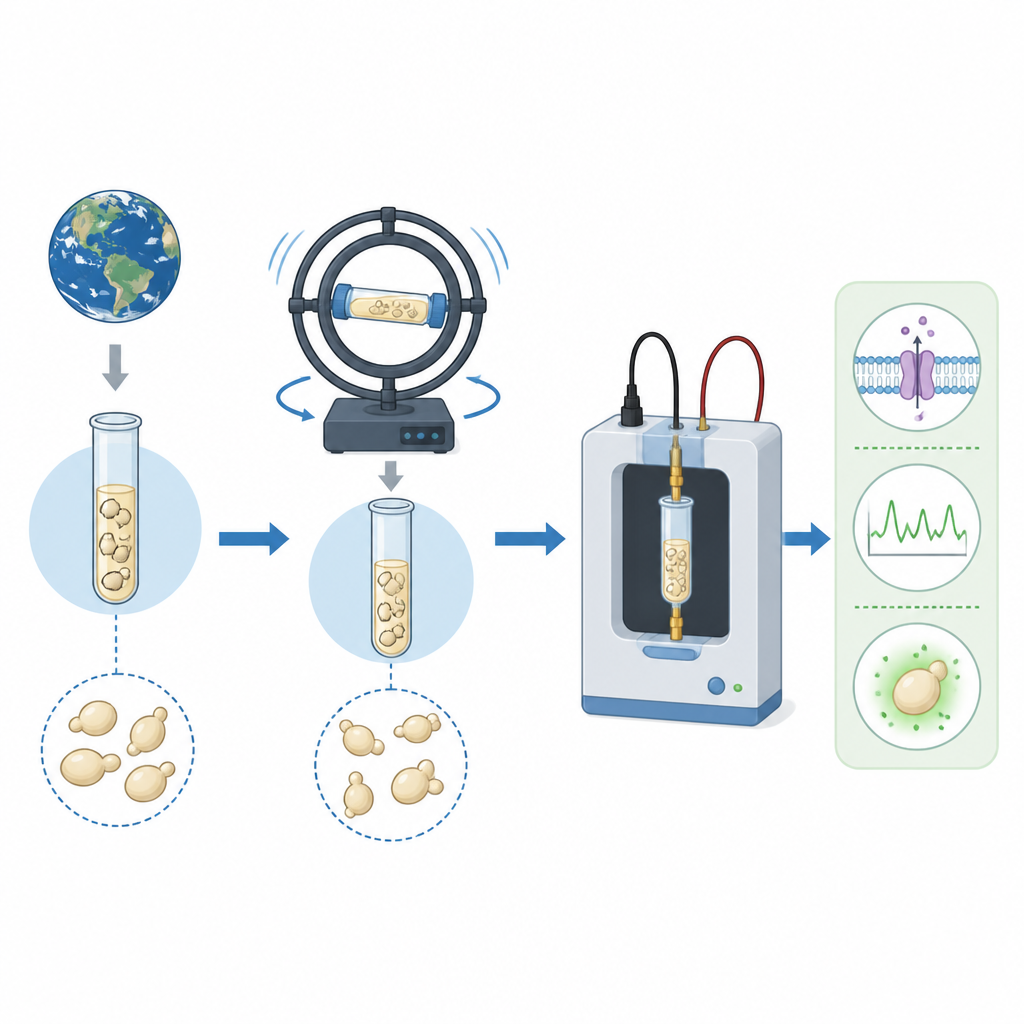
Spinning to imitate space
Sending samples to space is expensive and rare, so the researchers used a tabletop device called a clinostat to imitate microgravity. Yeast cells were placed in small tubes and slowly rotated so that the pull of Earth’s gravity was constantly changing direction, averaging out over time. Some samples stayed under normal gravity, while others experienced this simulated weightlessness for periods ranging from one hour to a full day. This allowed the team to watch how the same kind of cells gradually adjusted, or failed to adjust, to this unusual environment.
Listening to cells with electricity
Instead of adding dyes or genetic labels, which can disturb cells, the team used a technique called dielectrophoresis. In simple terms, they placed yeast cells in tiny wells and exposed them to carefully controlled, uneven electric fields. Depending on how easily charges move across the cell surface and inside the cell, the yeast either drifts toward stronger or weaker parts of the field. By sweeping through many electrical frequencies and tracking how the cells moved, the researchers could work out "electrical fingerprints" that reflect cell size, shape, and the condition of the outer surface and interior.
Changes in the cell’s outer skin
To interpret these electrical fingerprints, the team used a model that treats each yeast cell as a sphere with layers: a wall, a thin outer skin, and the inner fluid. They focused on how easily charges build up on the outer skin and how well that layer conducts current, properties that are closely tied to how folded, leaky, or intact the surface is. Under simulated microgravity, the ability of the membrane to store charge dropped sharply at early time points, and its electrical conductance steadily decreased with longer exposure. A related quantity, the so called crossover frequency at which the cells stop moving one way and start moving the other in the electric field, shifted upward over time, signaling that the surface structure and perhaps size and shape of the cells were being altered.
What this means for cell health
These electrical shifts match changes that, in other systems, are linked to stress, changes in cell identity, or the early steps of programmed cell death. A fall in membrane capacitance often signals that the membrane has become thicker or more rigid, while falling conductance points to reduced movement of ions and lower surface activity. The authors also found that a quantity related to how folded the membrane is became smaller, which suggests that the cells may lose the fine surface structures they use to take up nutrients efficiently. Together, these results hint that even a few hours in microgravity can disturb how yeast cells feed themselves and manage energy.
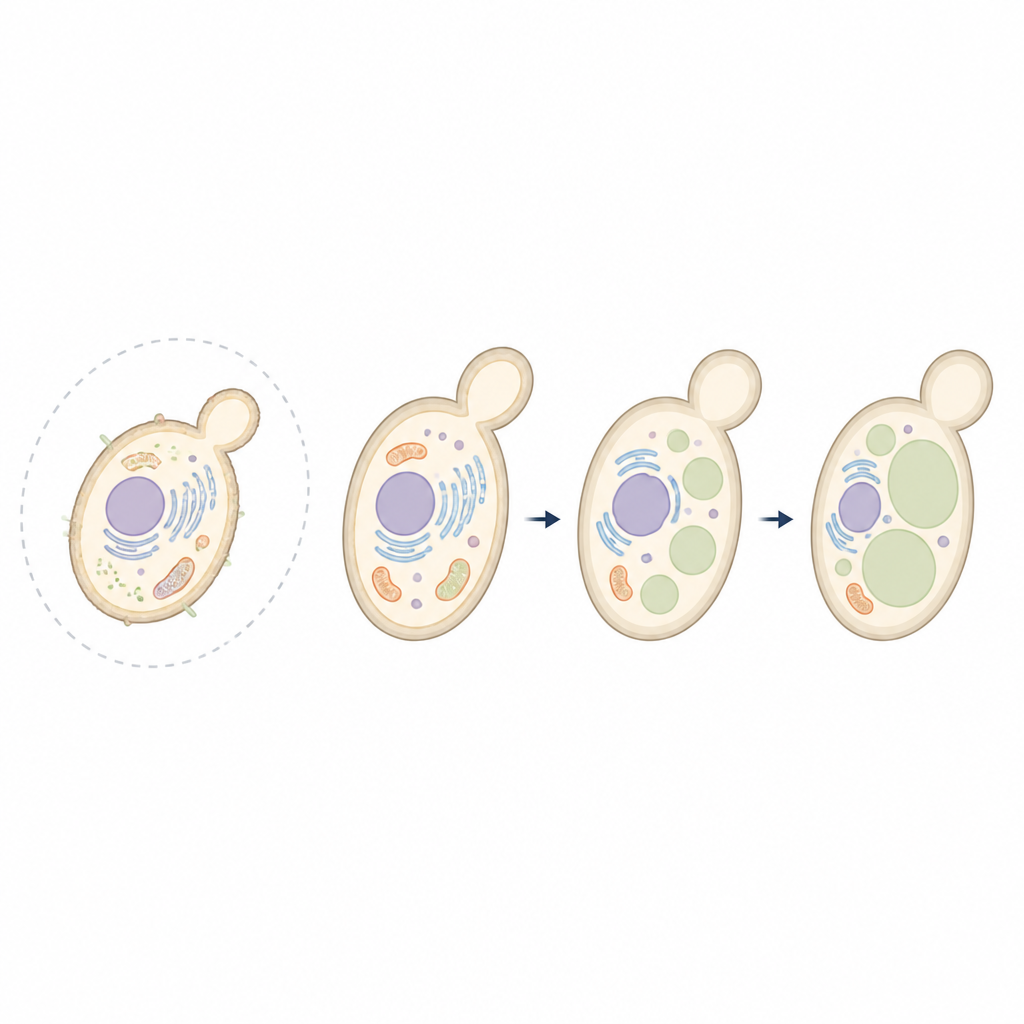
From yeast to astronauts
By showing that simple yeast cells rapidly change their surface and internal electrical properties in microgravity like conditions, this work offers a new, label free way to monitor how living cells respond to space travel. Because yeast shares many basic features with human cells, the findings help explain why long stays in space can stress the body and alter the behavior of microbes, including potential pathogens. The approach also points to practical ground based tools for testing drugs, food production methods, or infection risks under space like conditions long before crews ever leave Earth.
Citation: Yaram, S.D.R., Bostic, A. & Srivastava, S.K. Dielectric double shell characterization of yeast cells exposed to simulated microgravity. npj Microgravity 12, 39 (2026). https://doi.org/10.1038/s41526-026-00583-3
Keywords: microgravity, yeast cells, cell membrane, dielectrophoresis, space biology