Clear Sky Science · en
MicroAge mission: experimental design and hardware for a bespoke culture system supporting tissue-engineered skeletal muscle
Why Space Helps Us Understand Weak Muscles
As we age, our muscles slowly shrink and weaken, making everyday tasks harder and raising the risk of falls and frailty. Astronauts experience a similar loss of muscle in just weeks while living in weightlessness. The MicroAge mission turned the International Space Station (ISS) into a laboratory to study this rapid muscle loss using tiny lab-grown human muscles and custom hardware. By understanding how muscles misbehave in space, the team hopes to uncover new ways to keep muscles stronger for both astronauts and older adults on Earth.
Muscles in Space as a Fast-Forward Button
In orbit, the usual pull of gravity disappears, and muscles no longer work as hard to support the body. Even with strict daily exercise, astronauts still lose 3–10% of muscle volume in just a couple of weeks, and much more during long missions. This pattern looks surprisingly like age-related muscle decline on Earth, only sped up. MicroAge set out to test whether the same underlying biological changes are at work in both situations, focusing on how muscle cells respond to contraction and to the chemical signals that normally help them adapt and stay strong.
Building Miniature Human Muscles
Instead of studying muscle from animals or flat cell layers in a dish, the team engineered three-dimensional human muscle “strips.” They started with a well-characterized human muscle cell line, mixed the cells into a soft gel made from fibrin and other natural materials, and poured this mixture into custom 3D-printed plastic scaffolds. Over about 12 days, the cells pulled on the gel and each other, forming aligned, rope-like muscle bundles stretched between fixed anchor points, closely mimicking the structure of real muscle fibers. Careful microscopic staining confirmed that the cells had organized into mature, striated muscle tissue capable of contraction. 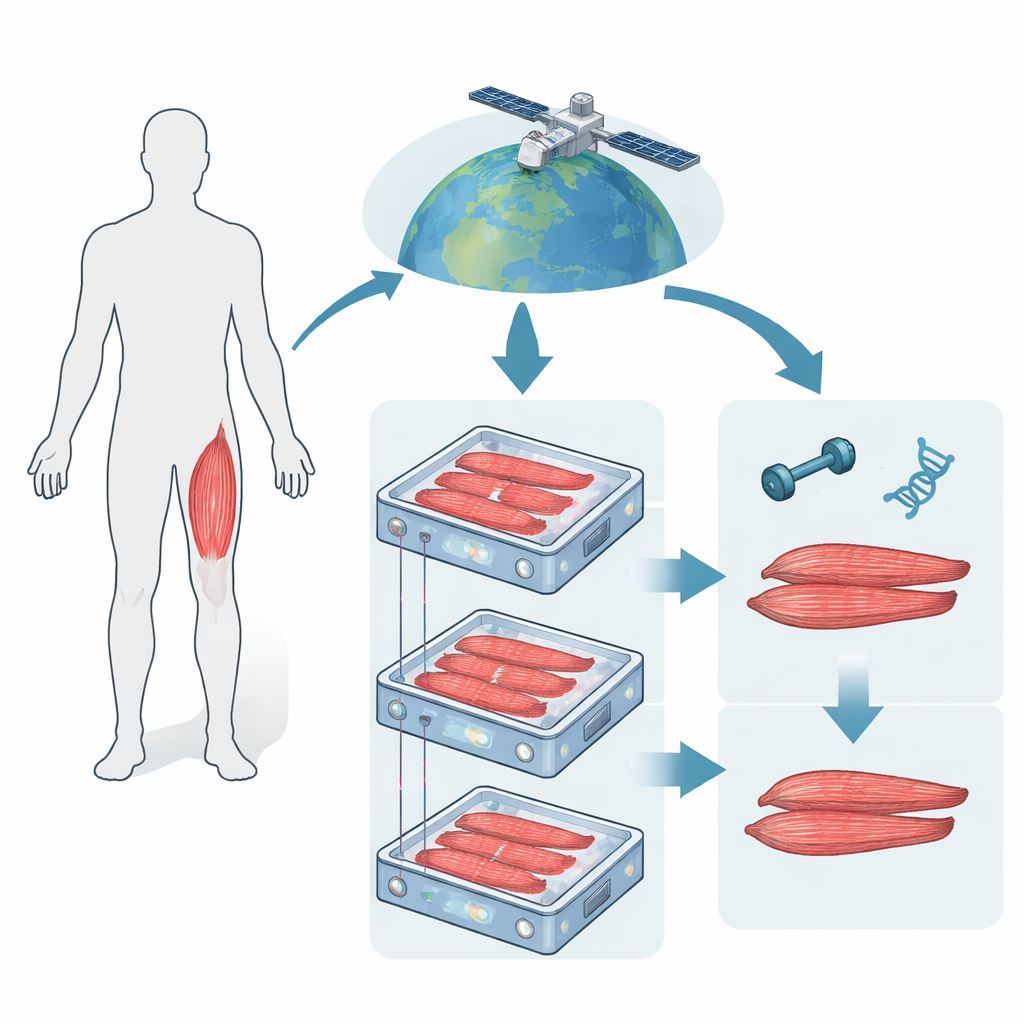
Smart Hardware for Muscles in Orbit
To keep these delicate constructs alive in space, the researchers worked with engineers to design a compact culture system that fit inside the European Space Agency’s Kubik incubator on the ISS. Each experiment unit contained a culture chamber to hold the muscle scaffold, tiny pumps and tubing to refresh nutrients, and a two-part fluid reservoir that stored both fresh growth medium and fixative for later analysis. A thin gas-permeable membrane let oxygen and other gasses diffuse in and out while maintaining liquid containment. The team carefully chose materials that are both biocompatible and robust enough for launch conditions, and validated that fluids could be pumped reliably in microgravity using a flexible membrane that pushed liquids toward the outlet and collected used medium on the opposite side.
Making Muscles Work and Measuring Their Effort
Simply floating in space is not enough to reveal how muscles behave; they also need to “exercise.” Platinum electrodes built into the chamber delivered brief trains of electrical pulses, prompting the muscle strips to contract in a controlled pattern. Because installing force sensors or cameras was impractical in the tight space available, the team used a clever workaround: they monitored electrical impedance, which changes as the shape and internal structure of the contracting tissue shift. By comparing impedance during and after stimulation for empty scaffolds, dead tissues and living constructs, they showed that contracting muscles produced a distinct signature at low frequencies, proving that the system could detect functional activity without moving parts. 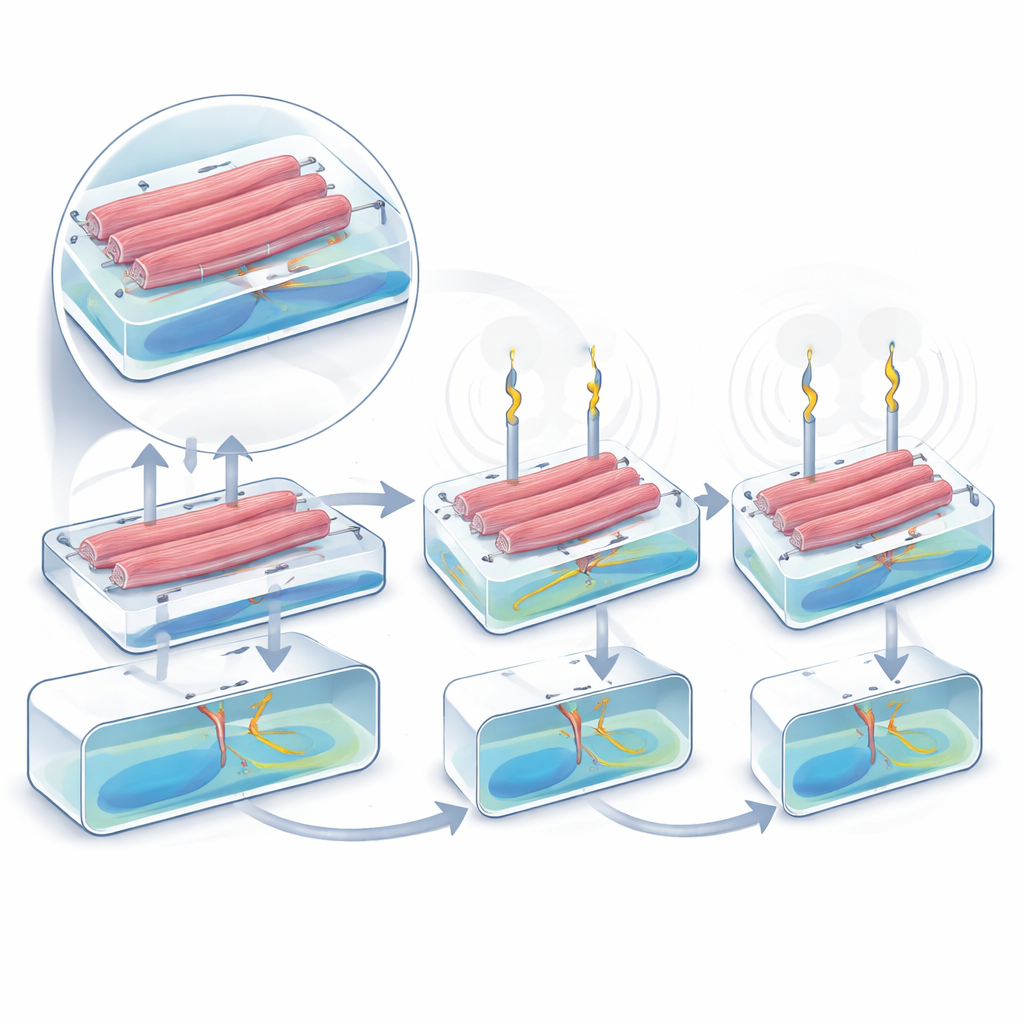
Keeping Cells Alive from Rocket to Space Station
Another major challenge was the time between launch on Earth and installation into the incubator in orbit, when there is no active heating, cooling or controlled carbon dioxide. The team screened different “CO₂-independent” culture media and storage temperatures using flat muscle cell layers. They found that a medium called Leibovitz L-15, which relies on special salts and sugars instead of dissolved CO₂ to hold pH steady, best preserved cell survival. Surprisingly, storing the cultures at a slightly cooler 30 °C, without changing the medium for five days, kept them at least as healthy as standard 37 °C conditions with regular feeding. This strategy reduced metabolic demand and waste buildup, buying precious time during launch and docking.
What This Work Means for Life on Earth and in Space
The MicroAge mission primarily reports how the team built and tested this bespoke culture system rather than the final biological outcomes, which will follow in later papers. Still, the work shows that it is possible to grow realistic human muscle tissue, send it into orbit, stimulate it to contract, and monitor its behavior using compact, semi-automated hardware. This opens the door to studying how genes, exercise-like stimulation and artificial gravity can protect muscles in space, and to using microgravity as an accelerated model of muscle aging. Ultimately, insights from these tiny muscles in orbit may guide new therapies and training strategies to help people on Earth maintain strength, independence and quality of life as they grow older.
Citation: Jones, S.W., Shigdar, S., Temple, J. et al. MicroAge mission: experimental design and hardware for a bespoke culture system supporting tissue-engineered skeletal muscle. npj Microgravity 12, 29 (2026). https://doi.org/10.1038/s41526-026-00579-z
Keywords: microgravity, skeletal muscle, tissue engineering, spaceflight biology, muscle aging