Clear Sky Science · en
A high-fidelity simulator for evaluation of hemodynamic response during cardiopulmonary resuscitation in hypogravity environments
Why Saving a Heart in Space Matters
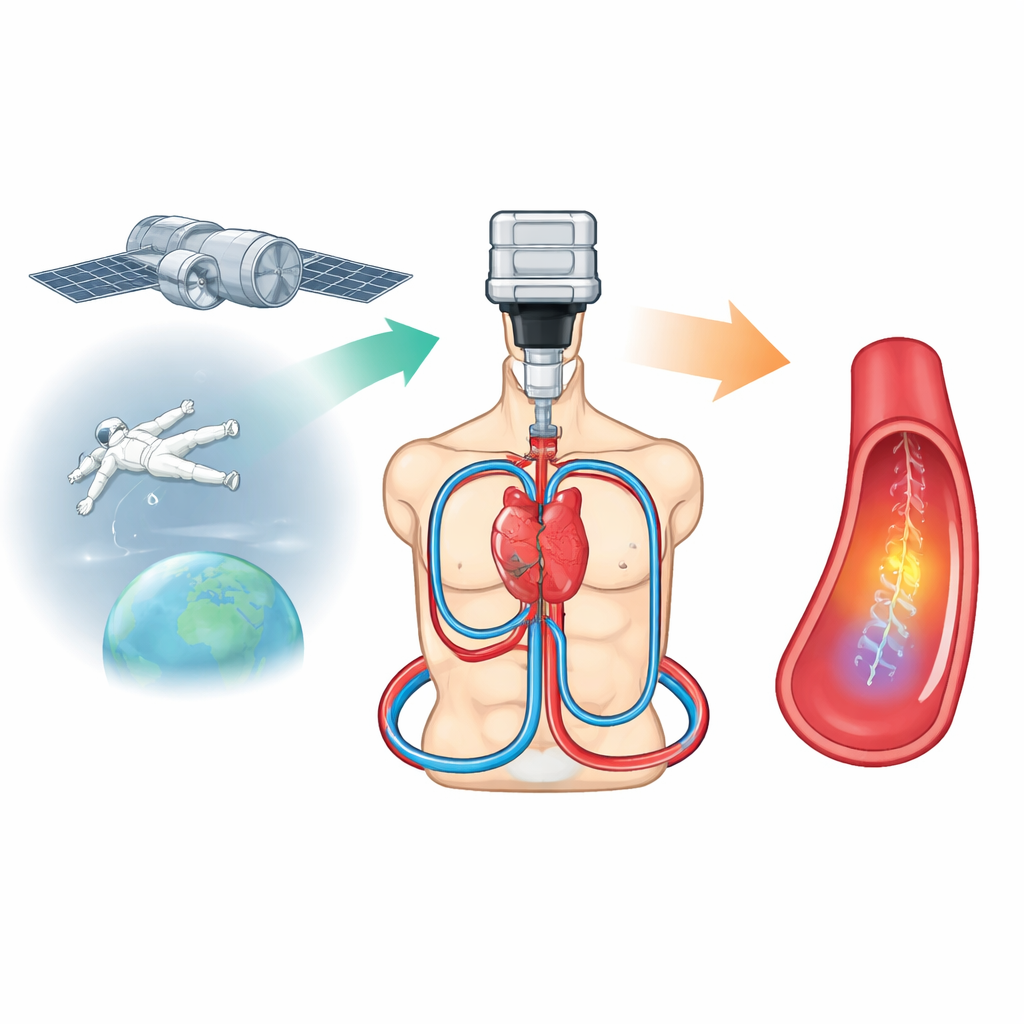
As space agencies plan missions to the Moon and Mars lasting months or years, crews will be far from hospitals and real-time help from Earth. If an astronaut’s heart suddenly stops, the team must perform chest compressions in an environment where gravity is almost absent and bodies float. Existing methods for cardiopulmonary resuscitation (CPR) in space have mostly been judged by how they look from the outside—how fast and how deep compressions are—rather than by what really matters: whether they push enough blood to the brain. This study tackles that problem by building a realistic CPR simulator that can “feel” and measure how blood would move during resuscitation in low-gravity conditions.
Building a Beating Heart in a Manikin
The researchers created a sophisticated CPR testbed by transforming a standard training manikin into a surrogate astronaut chest with a working circulatory system. Inside the manikin, they installed a flexible, 3D-printed heart made from an elastic plastic that can withstand repeated compressions, and a rigid 3D-printed breastbone to mimic real bone. These were connected to silicone versions of major blood vessels and to a closed “mock circulatory loop” filled with a liquid that flows like blood. Special chambers stood in for the brain, lungs, and body tissues, each fitted with one-way valves and compliant balloons so the system would react to pressure changes in a lifelike way.
Turning Machine Compressions into Measurable Signals
Instead of relying on a human rescuer, the team used a compact automated chest compression device similar in function to commercial machines used in ambulances. This device drove a piston into the manikin’s chest at guideline-consistent settings: about 5 centimeters of depth and roughly 110 compressions per minute. A high-precision pressure sensor was threaded into the mock carotid artery, the vessel that in real life feeds the brain, allowing the researchers to record the rise and fall of pressure with each compression and release. They looked for hallmark features of effective CPR waveforms, such as a sharp pressure peak during the downward stroke, a notch when the heart’s main valve would close, and a trough that remains above zero during the relaxation phase.
Taking CPR Science on a Parabolic Flight
To move beyond the laboratory, the simulator flew aboard a research aircraft that performs parabolic maneuvers, producing brief periods of near-weightlessness similar to what astronauts experience. The experimenters collected data during five parabolas at standard Earth gravity on the ground and five more during low-gravity phases in flight, always using the same compression settings. They then compared how high the arterial pressure rose during the squeeze and how low it fell during release under the two conditions. Although the flight segments were short—only about 18 seconds of low gravity at a time—they were long enough to capture more than 150 compression cycles in each environment.
What the Simulator Revealed About Blood Flow in Low Gravity
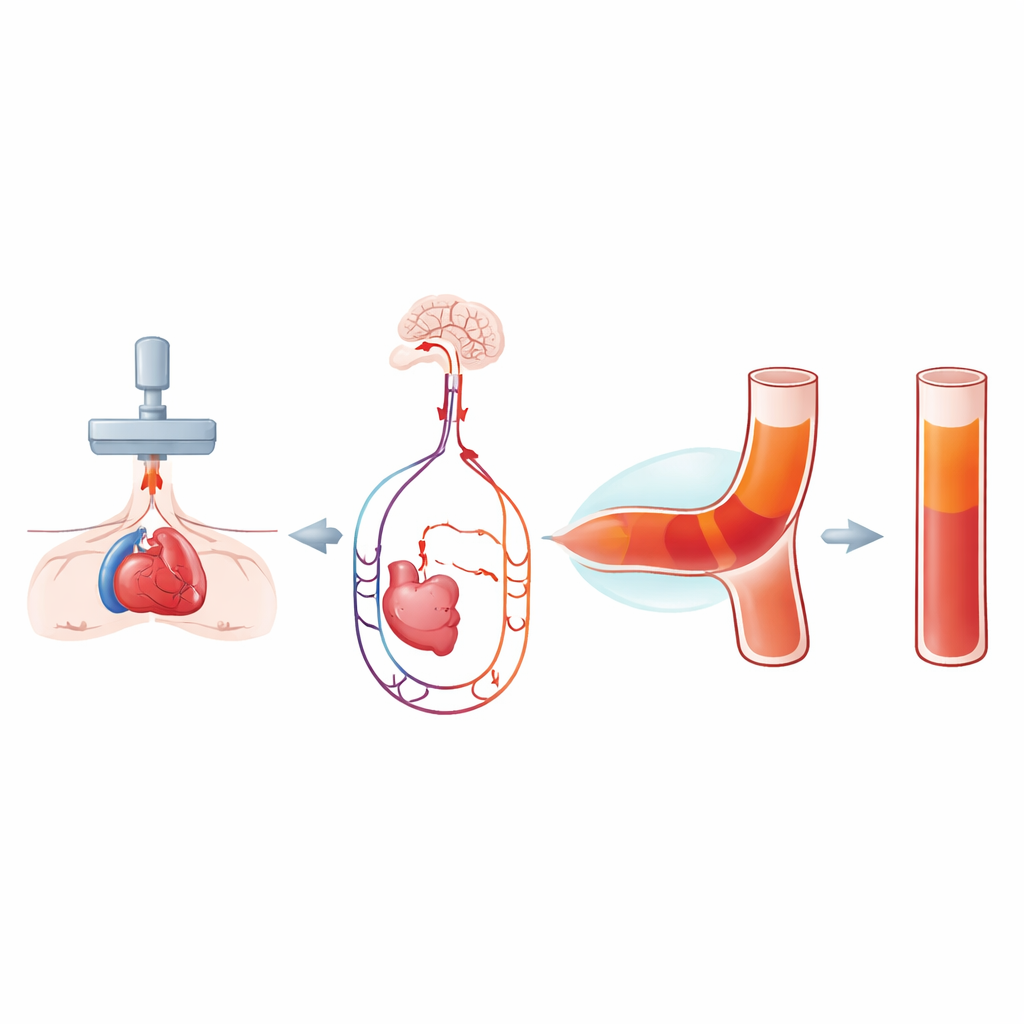
The pressure traces from the manikin closely matched those reported in animal experiments and previous test benches on Earth, suggesting that the new simulator behaves in a physiologically realistic way. Under normal gravity, the system produced pressure peaks and troughs that fell within published ranges. Surprisingly, when the same mechanical compressions were applied in hypogravity, the simulated arterial pressures were consistently higher across all key measures. The peak pressure during the squeeze, the pressure between compressions, and the average pressure over the cycle all rose by around 20–40 percent, even though the compression rate stayed nearly the same. Adjustments for small changes in cabin air pressure could not account for this difference, hinting that low gravity may actually alter how chest compressions drive blood through the body.
Preparing for Medical Emergencies Beyond Earth
For non-specialists, the take-home message is that this high-fidelity CPR simulator provides a powerful new way to test life-saving techniques for spacefarers before anyone needs them in a real emergency. By focusing on internal responses—how much pressure reaches the vessels feeding the brain—rather than just external movement of the chest, the device helps researchers judge which methods and machine settings are most likely to restore circulation in low gravity. The current study is an early but important step toward establishing a reliable CPR protocol for missions to the Moon and Mars, and it shows that carefully engineered simulators can bridge the knowledge gap between Earth-based medicine and the extreme conditions of space.
Citation: Lord, Z., Andrade, C., Leroux, L. et al. A high-fidelity simulator for evaluation of hemodynamic response during cardiopulmonary resuscitation in hypogravity environments. npj Microgravity 12, 33 (2026). https://doi.org/10.1038/s41526-026-00577-1
Keywords: space medicine, cardiopulmonary resuscitation, microgravity, medical simulation, automated chest compression