Clear Sky Science · en
Behavior of mandibular fractures under earth and microgravity conditions: a finite element analysis
Why Space Puts Your Jaw at Risk
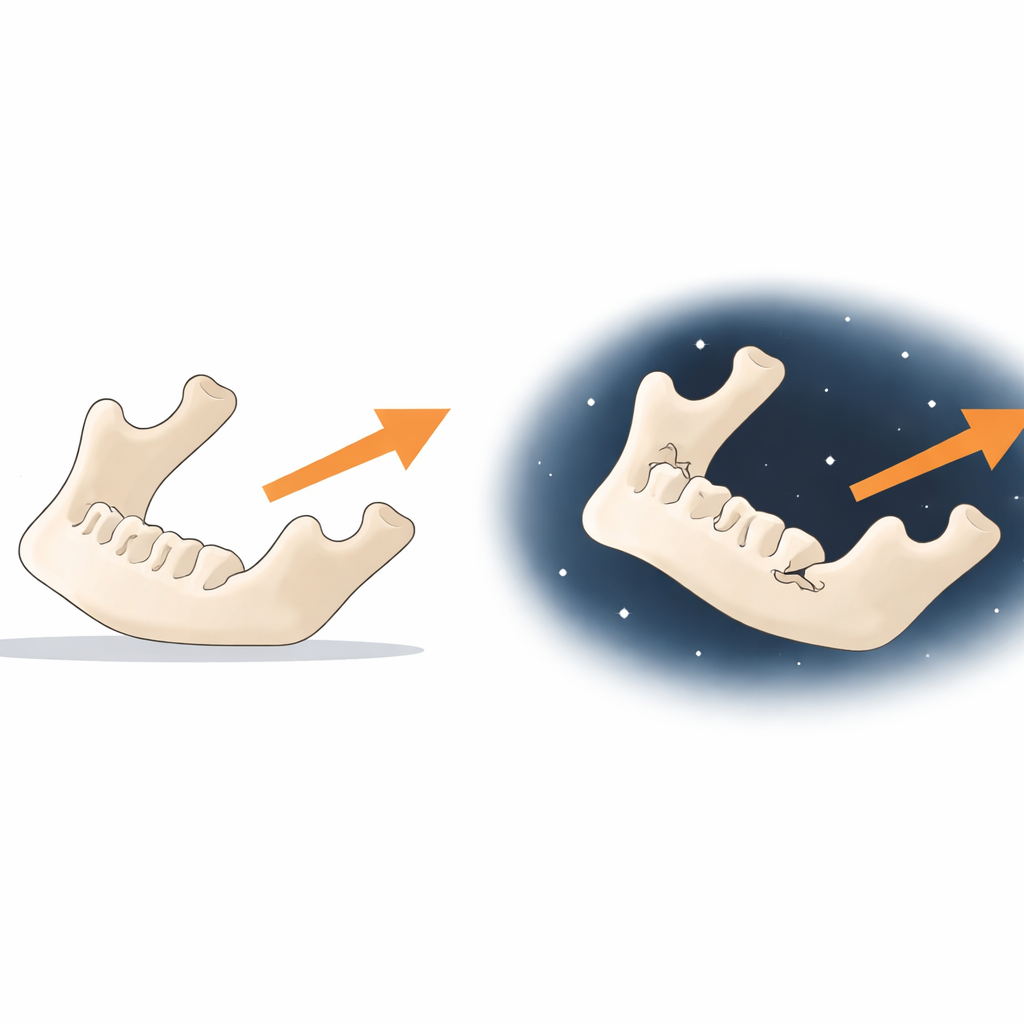
As humans prepare for longer trips to the Moon and Mars, we usually worry about rockets, radiation, and cramped cabins. But there is a quieter threat: our own bones. In weightlessness, astronauts steadily lose bone strength, and this study asks a very down-to-earth question with space-age consequences: if an astronaut takes a hard hit to the lower jaw, how likely is it to break compared with the same impact on Earth?
The Jawbone’s Hidden Job
The lower jaw, or mandible, is more than a frame for our teeth. It helps us chew, speak, and shield the airway. It is also one of the most frequently broken facial bones in car crashes, falls, sports accidents, and fights. Breaks often occur at a corner of the jaw known as the angle, where forces tend to focus during a blow. On long missions, astronauts face both an increased chance of bone weakening and everyday risks of bumping into equipment in cramped, weightless cabins. Even small accidents could have outsized effects if the jawbone has quietly thinned in space.
Virtual Crash Tests on a Digital Jaw
Because real impact experiments on astronauts are impossible, the researchers turned to computer modeling. They built a three-dimensional digital copy of a human jaw from medical scans and used a technique called finite element analysis—a kind of virtual crash test—to see how it behaves under a strong hit. They simulated a force similar to that used in earlier fracture studies: a 2000-newton blow (roughly the force of a serious punch or object strike) delivered at a 45-degree angle to the right jaw angle. Then they ran four scenarios: a normal jawbone and a weakened, osteoporosis-like jawbone, each tested once under Earth gravity and once in microgravity.
What Changes in Space and What Stays the Same
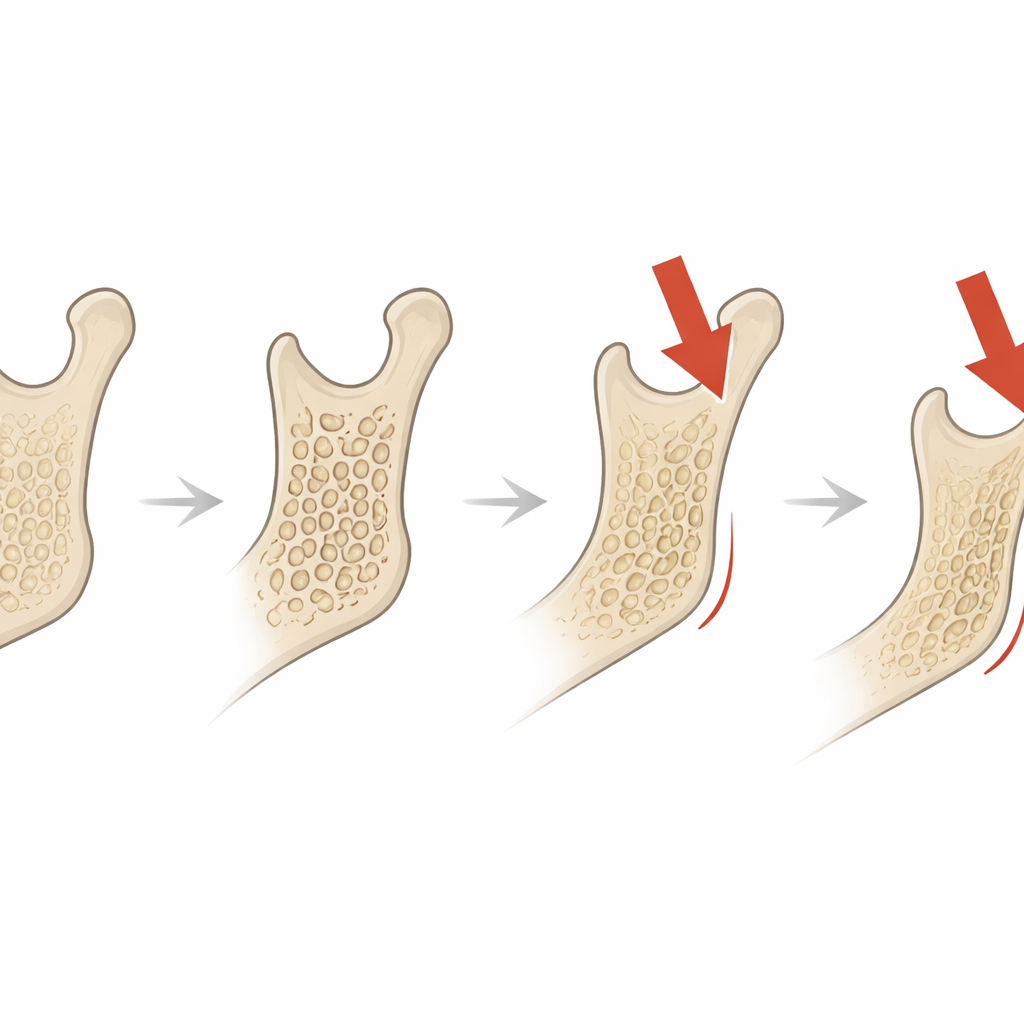
The model tracked three key responses to impact: how much internal force the bone felt (stress), how much it stretched (strain), and how far it bent or shifted (overall deformation. In all four cases, the highest forces concentrated at the same place—the right jaw angle where the impact was applied—showing that bone shape and impact direction largely control where damage starts. Surprisingly, the peak internal forces were almost identical whether gravity was present or not. However, when gravity was removed to mimic space, the jaw stretched and bent nearly twice as much for the same blow. In other words, the bone experienced similar force patterns, but it gave way much more in microgravity.
Extra Weakness in Already Fragile Bone
The simulations also compared healthy bone with a version representing osteoporosis, where the bone is lighter and less stiff. Under Earth gravity, this weaker jaw deformed only slightly more than the healthy one because the way the jaw was anchored in the model limited its motion. In microgravity, both healthy and osteoporotic jaws again showed about double the stretching and bending compared with Earth. The weakened jaw even carried a bit less peak internal force, but only because it could not resist the load as well—it spread the force over a broader area and deformed more easily. This behavior points to a jaw that is less able to safely absorb a hit and more prone to cracking.
What This Means for Future Astronauts
Taken together, the findings suggest that a blow strong enough to risk a jaw fracture on Earth could be even more dangerous in space, especially for astronauts who have already lost bone density during a mission. The overall force pattern in the jaw may not change much, but the increased bending and stretching make breaks more likely. For space agencies, this means jaw protection, smarter cabin design to reduce impacts, and preflight checks of bone strength are not luxuries—they are part of keeping crews safe far from medical help. For the rest of us, the study is a reminder that gravity quietly helps keep our skeletons sturdy, and that life without it demands new ways to protect even something as familiar as the jaw.
Citation: Manoj, S., K.P, M.K. & A.P, V.D. Behavior of mandibular fractures under earth and microgravity conditions: a finite element analysis. npj Microgravity 12, 36 (2026). https://doi.org/10.1038/s41526-025-00558-w
Keywords: microgravity, mandibular fractures, osteoporosis, finite element analysis, space medicine