Clear Sky Science · en
Completely resolved structural variants by optical genome mapping with adaptive sampling from CNV discovery
Why reading DNA in new ways matters
Many families affected by rare genetic conditions never receive a clear answer about what went wrong in their DNA. Standard tests can find small changes and some missing or extra pieces, but often overlook more tangled rearrangements. This study explores a new combination of tools that can untie these knots in our chromosomes, revealing hidden changes that may explain confusing medical cases and improve future genetic diagnosis.
Looking beyond simple gains and losses
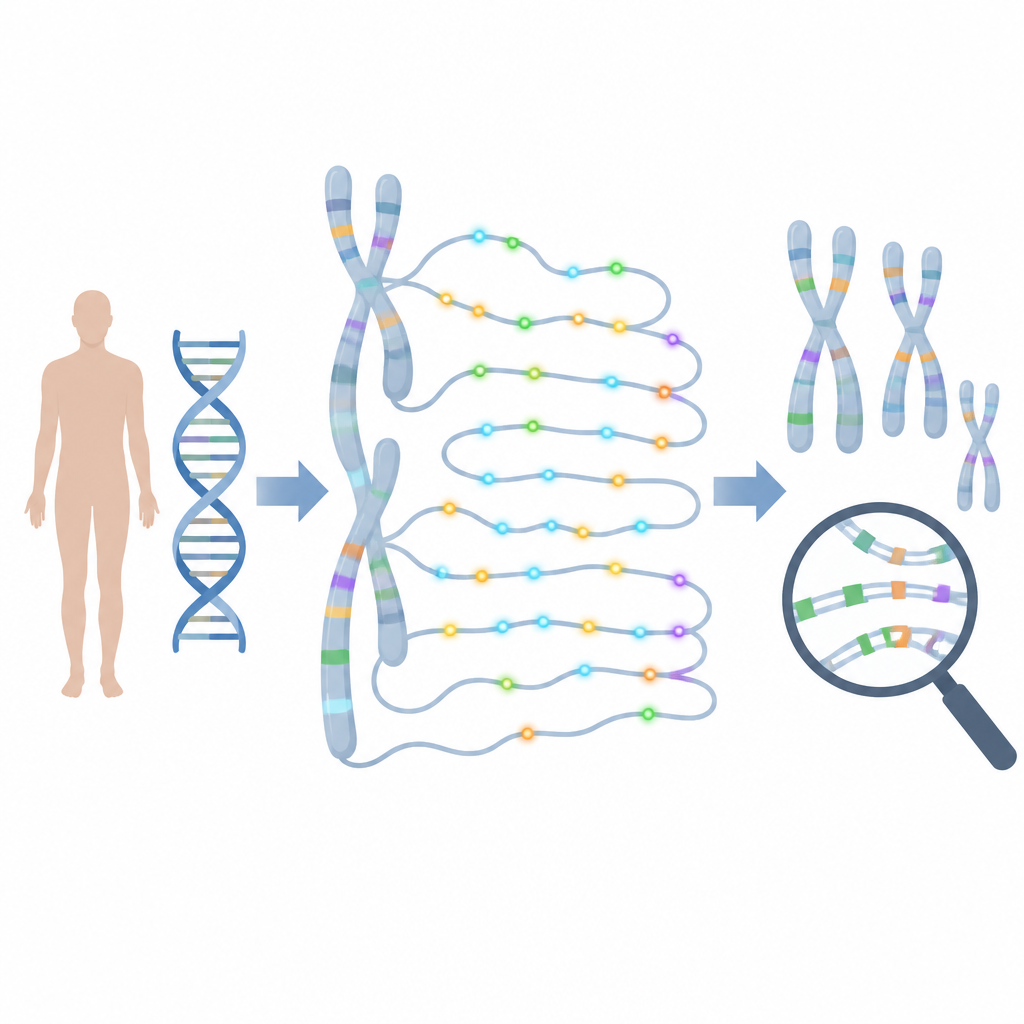
Doctors often begin by scanning the protein-coding portions of a patient’s DNA, known as the exome. This approach can detect stretches of DNA that are missing or present in extra copies. However, it usually cannot show exactly how the affected chromosome pieces have been cut, flipped, or reattached. The authors focused on 30 patients whose exome tests had already revealed such copy changes, yet still left parts of their symptoms unexplained. The key question was whether more intricate rearrangements were hiding behind these simple-looking gains and losses.
Using light to map very long DNA strands
The team turned to optical genome mapping, a method that stretches out extremely long DNA molecules and decorates them with fluorescent tags at repeated sequence sites. When imaged, those tags form distinctive patterns along each molecule, a bit like barcodes on a train of cars. By aligning thousands of these long strands to a reference genome, the system can show where pieces have been deleted, duplicated, inverted, or swapped between chromosomes. Crucially, this works across very large distances in the genome and is less hindered by repetitive regions that confuse many sequencing methods.
Zooming in on breakpoints with long reads
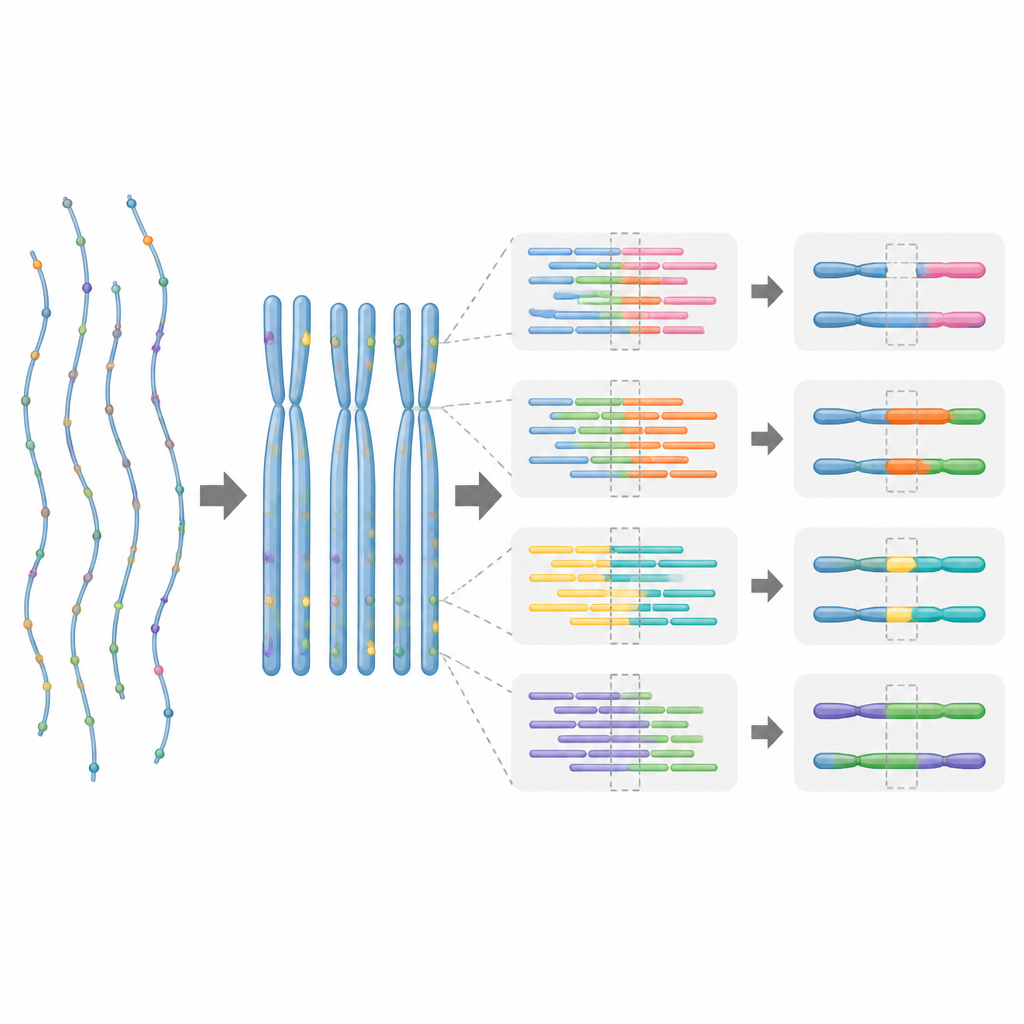
Optical maps provide an excellent bird’s-eye view but not the exact letter-by-letter sequence at each break. To fill this gap, the researchers used long-read DNA sequencing with a feature called adaptive sampling. This allowed them to focus the sequencing effort on regions flagged by the optical maps and earlier exome results. With this targeted zoom, they could pinpoint the precise breakpoints where the DNA strands had snapped and rejoined, and determine which genes had been disrupted or had their copy number altered.
Hidden rearrangements with real clinical impact
When the two methods were combined, the picture changed dramatically. In 14 of the 30 patients, the team uncovered structural variants that the exome test had missed. These included unbalanced exchanges between chromosomes, inverted duplications, insertions within the same chromosome, and highly tangled events resembling chromoplexy and chromothripsis, where many pieces are shuffled at once. In seven patients, the newly clarified structures either disrupted important genes or changed their copy number in ways that lined up with the person’s symptoms, such as certain forms of epilepsy, facial differences, or developmental delay. In some cases, genes that had looked normal in the earlier data were revealed to be broken at a subtle breakpoint.
What this means for future genetic testing
For families, the practical message is that a “normal” or partial result from standard sequencing does not always mean there is no relevant DNA change. This work shows that combining optical genome mapping with targeted long-read sequencing can uncover complex rearrangements that hide behind simple signals of extra or missing DNA. While these advanced tests are not yet routine, they offer a path to more complete genetic answers and, over time, may help guide more precise care and counseling for people living with rare genetic diseases.
Citation: Fu, L., Kim, C.A., Tokita, M. et al. Completely resolved structural variants by optical genome mapping with adaptive sampling from CNV discovery. npj Genom. Med. 11, 26 (2026). https://doi.org/10.1038/s41525-026-00561-4
Keywords: structural variants, optical genome mapping, long-read sequencing, rare genetic diseases, genome diagnostics