Clear Sky Science · en
Symmetry-aware Bayesian flow networks for crystal generation
Why smarter crystal design matters
From batteries and solar cells to computer chips, many technologies rely on crystals whose atoms are arranged in precise patterns. Finding new crystalline materials with useful properties is slow and expensive when done by trial and error. This article presents a new artificial intelligence method that can imagine realistic crystal structures much faster than previous tools, while respecting the intricate patterns of symmetry that real crystals follow. The approach could help scientists explore the huge space of possible materials more efficiently and suggest candidates tailored for specific tasks.
Teaching a model to respect crystal patterns
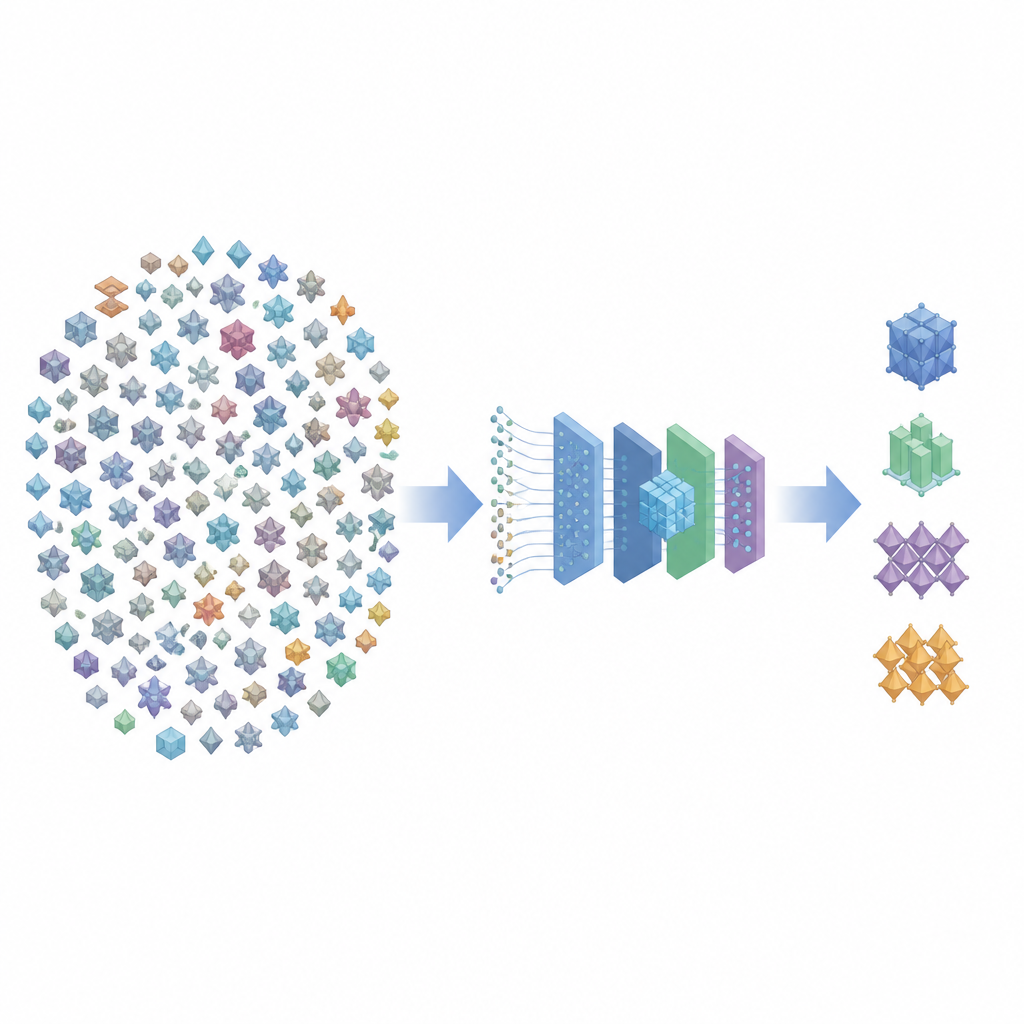
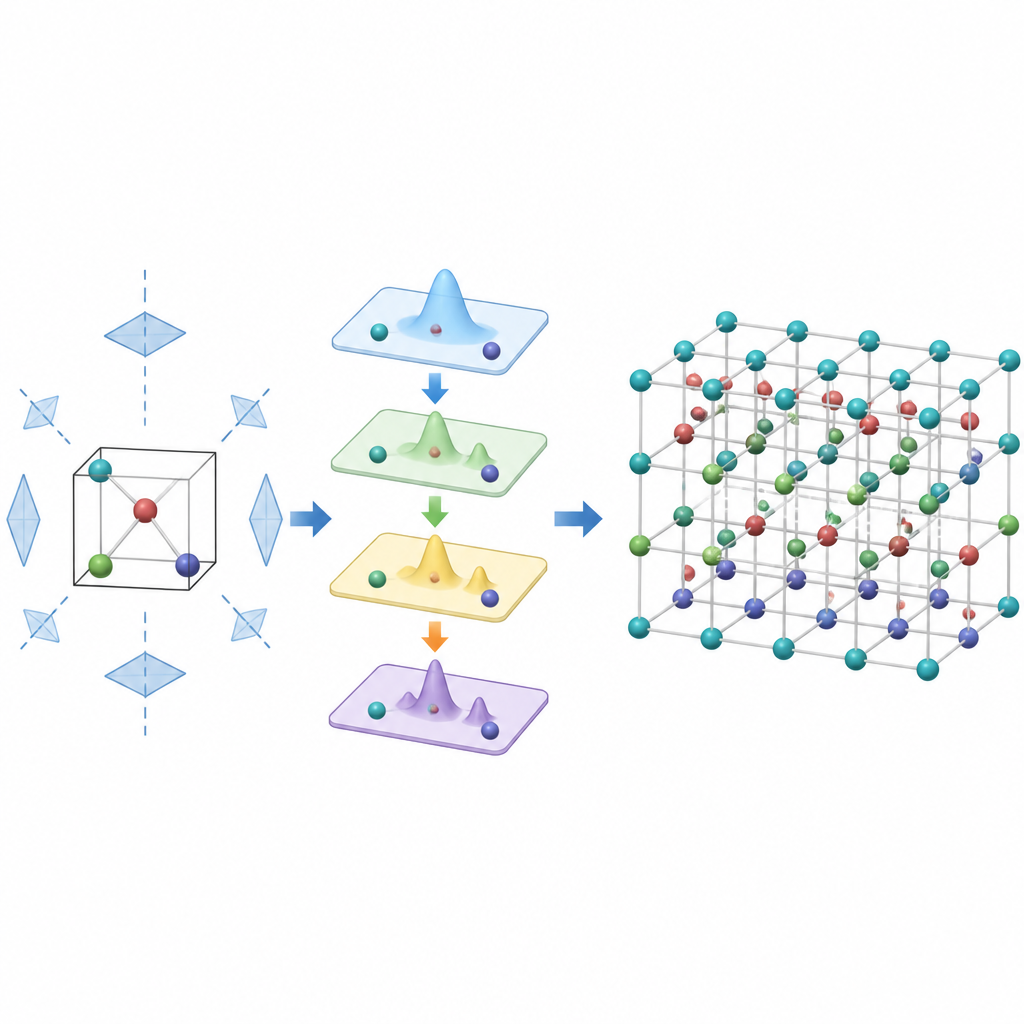
Real crystals are not random piles of atoms; they follow strict symmetry rules, known as space groups, that describe how patterns repeat and rotate in three dimensions. Many earlier AI models for crystal generation ignored these rules and often produced low-symmetry, unrealistic structures that are rare in nature. The authors build on a new type of generative model called a Bayesian Flow Network (BFN), which creates data in small, guided steps, and adapt it to handle crystal structures. Their method, named SymmBFN, uses a symmetry-aware description of crystals that focuses only on the smallest unique chunk of the structure and the symmetry operations needed to rebuild the full crystal. This reduces the complexity of the problem and helps the model faithfully reproduce the range of space groups seen in experimental databases.
Handling many types of information at once
Designing a crystal means deciding several things at the same time: which elements to include, how many atoms are in the smallest repeating unit, how they are positioned, and how the unit cell that repeats in space is shaped. These are a mix of continuous quantities, like positions and lattice lengths, and discrete choices, like element type and symmetry labels. SymmBFN is built to treat all these different types of variables within a single mathematical framework. It works directly with the parameters of probability distributions instead of slowly cleaning up noisy samples, as diffusion models do. By operating in a carefully chosen reference frame that already factors out global rotations and periodic shifts, the method naturally honors the basic symmetries of space without extra machinery.
Speed and realism in generated crystals
The authors test SymmBFN on several standard crystal datasets, including a widely used subset of the Materials Project and more challenging collections with larger unit cells. They compare its output to that of leading diffusion and flow-based models using metrics that assess how well the generated crystals match real materials in density, composition, and distribution of space groups. A key measure focuses on structures that are stable, unique, and not simply repeats of training examples. SymmBFN reaches competitive or better scores on these quality indicators while using only a tenth as many generation steps as many diffusion models. In practical terms, it can be more than an order of magnitude faster at producing stable, novel crystals, and this speed advantage becomes even larger for bigger, more complex structures.
Designing materials for target properties
Beyond generating realistic crystals, SymmBFN can be guided toward structures with specific physical characteristics. The authors show that by feeding the model a desired value for quantities such as formation energy per atom or electronic bandgap, it can tilt the generation process toward crystals with matching behavior. They test target values drawn from both well-sampled and rarely seen regions of the training data. Even when asked for structures with unusually low formation energies or uncommon bandgaps, the model frequently produces stable or metastable candidates that cluster around the requested property values. This suggests that the approach can serve as a steering wheel for exploring promising regions of materials space aligned with practical needs.
What this means for future materials discovery
In simple terms, SymmBFN is a fast and symmetry-aware idea generator for crystalline materials. By respecting the geometric rules that real crystals follow and efficiently juggling many types of atomic information, it can quickly propose realistic, diverse, and property-targeted structures. While actual synthesis in the lab remains the ultimate test, this method reduces the cost of digital exploration and makes it easier to focus experimental work on the most promising candidates. As the approach is extended to multiple properties and linked more closely to experimental efforts, it could become a central tool in the search for next-generation materials for energy, electronics, and beyond.
Citation: Ruple, L., Torresi, L., Schopmans, H. et al. Symmetry-aware Bayesian flow networks for crystal generation. npj Comput Mater 12, 182 (2026). https://doi.org/10.1038/s41524-026-02140-8
Keywords: crystal generation, materials discovery, Bayesian flow networks, symmetry-aware AI, property-conditioned design