Clear Sky Science · en
First-principles Approach to Ultrafast Pump-probe Spectroscopy in Semiconductors
Watching Electrons Move in a Flash
Pump probe experiments let scientists watch how electrons in a material respond to a burst of light in trillionths of a second or faster. These ultrafast changes decide how well a material can detect light, split water, or convert sunlight to electricity. This paper introduces a new way to predict those changes from the basic laws of quantum mechanics, helping connect what experiments see to what the electrons and atoms are actually doing.
Taking a Snapshot of Light Driven Change
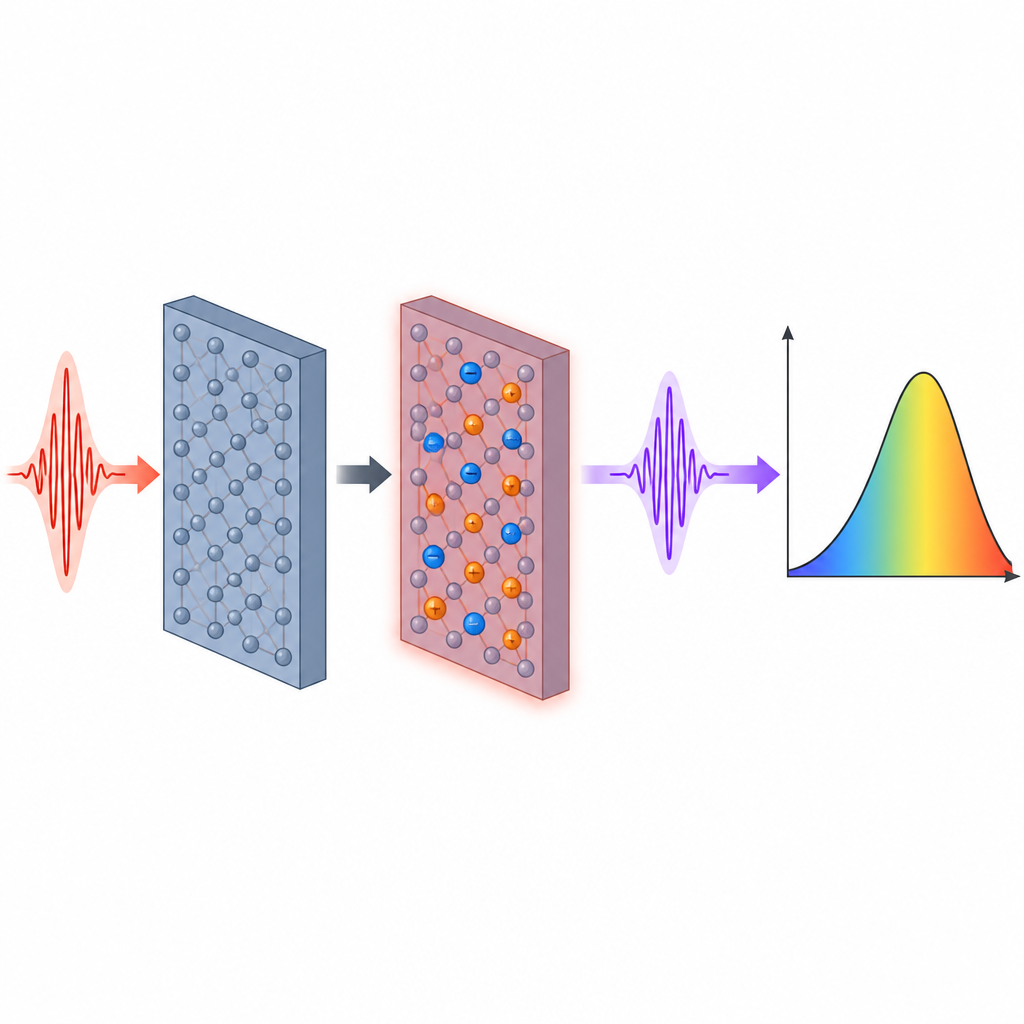
In a pump probe setup, a first light pulse “pumps” a semiconductor, kicking electrons from low energy states to higher ones and leaving behind positively charged holes. A second, weaker pulse then “probes” the excited material after a controlled delay, revealing how its ability to absorb or reflect light has changed. The authors build a detailed computer framework that mimics this sequence: they first compute the material in its calm, unexcited state, then simulate how the pump creates excited electrons and holes, and finally calculate how the probe would see the altered material.
Separating Fast Electrons from Hot Lattices
When a material absorbs light, its electrons react almost instantly, while the atoms in the crystal lattice heat and expand more slowly. The new method separates these two roles. For the earliest moments, it uses real time simulations to track how the pump pulse redistributes electrons and holes in energy and momentum. For later times, when electrons and atoms have shared energy and warmed up together, it approximates the effect as a gentle swelling of the crystal. By feeding these distinct electronic and thermal states into an advanced exciton solver, the approach can tell how each type of change shifts the material’s absorption peaks.
What Really Moves the Spectral Peaks
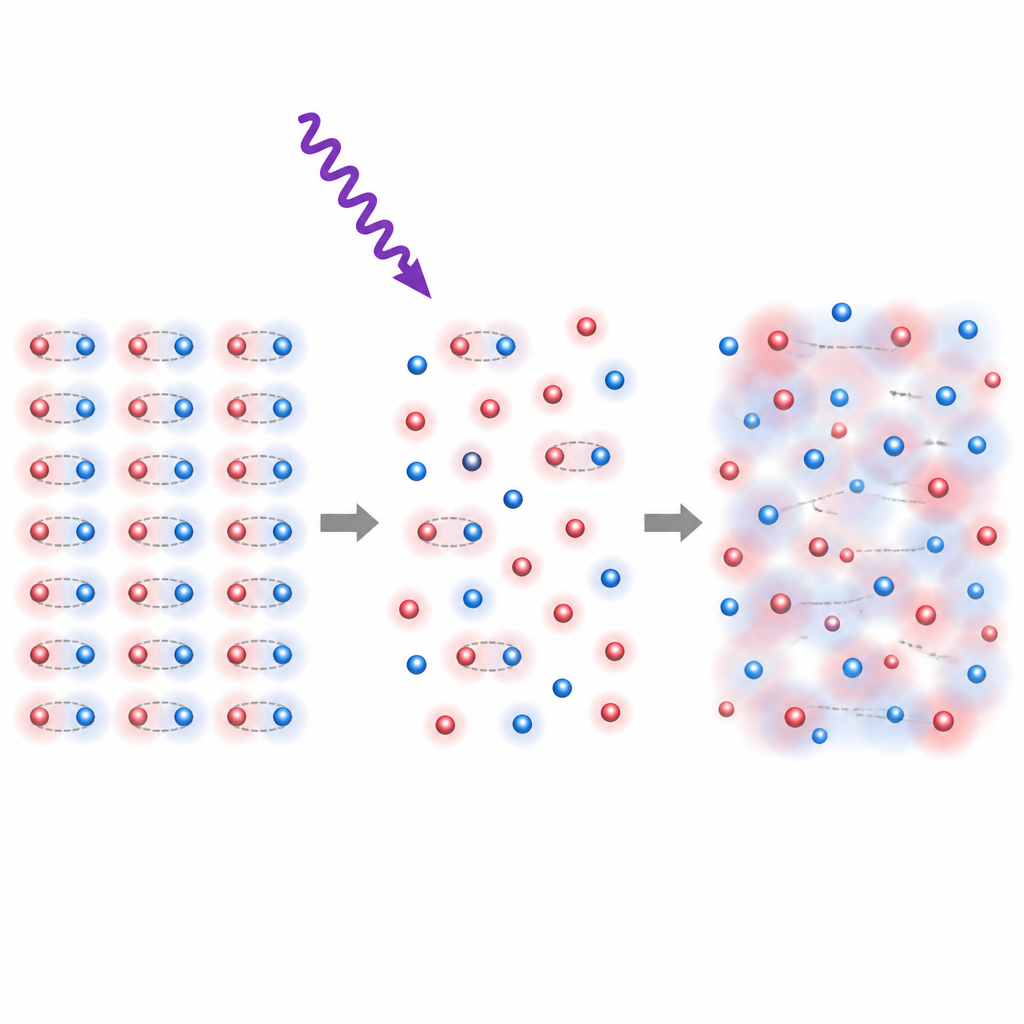
The team tests their framework on three important semiconductors: a layered material (WSe2), a metal halide perovskite (CsPbBr3), and a metal oxide (TiO2), all widely studied for light detection, solar conversion, and photocatalysis. In each case, their computed transient spectra match X ray measurements very well. The analysis shows a clear pattern: extra carriers created by the pump mainly act by screening, that is, by softening the attraction between negatively charged electrons and positively charged holes. This weaker binding pushes exciton resonances to higher energies, a blueshift. A second effect, Pauli blocking, where filled states simply prevent further absorption, turns out to be comparatively small.
Heat Pulls Peaks Back the Other Way
On longer timescales, as the lattice heats and expands, the story changes. In all three materials, a warmer, slightly expanded crystal reduces the energy gap between core and conduction states. This leads to a redshift of the same exciton peaks that were previously pushed up by electronic screening. By tuning how much the lattice expands in the simulations, the authors can reproduce the parts of the experimental signal that do not follow from electronic effects alone, showing how lattice heating and electron dynamics combine to shape the overall transient response.
Dialing In Exciton Energies on Demand
Beyond reproducing known measurements, the study shows how to actively steer exciton energies. The strength of screening, and thus the size of the blueshift, can be controlled not only by how many carriers are excited, but also by how widely they are spread out in momentum space, the polarization of the pump beam, and the pump wavelength. Shorter pump wavelengths and certain polarization choices promote more delocalized carriers and stronger screening. For device designers, this means exciton resonances can be tuned without changing the material itself. The work offers a practical roadmap for engineering energy selective detectors, nonlinear optical components, and other light based technologies that rely on ultrafast exciton control.
Citation: Qiao, L., Pela, R.R. & Draxl, C. First-principles Approach to Ultrafast Pump-probe Spectroscopy in Semiconductors. npj Comput Mater 12, 179 (2026). https://doi.org/10.1038/s41524-026-02128-4
Keywords: pump probe spectroscopy, exciton dynamics, semiconductors, ultrafast X-ray absorption, Coulomb screening