Clear Sky Science · en
Valley polarization of graphene via the saddle point
Turning a Flat Material into a Valley Switch
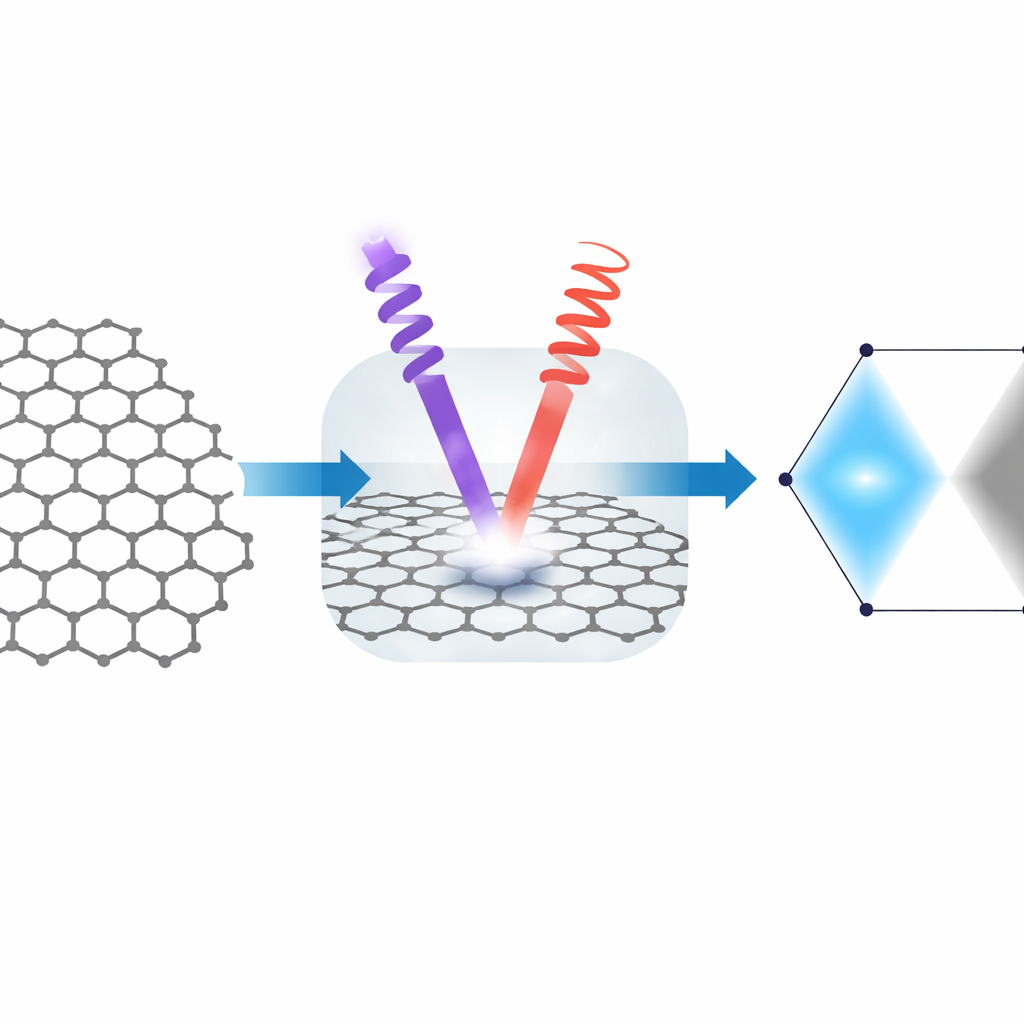
Graphene, a single layer of carbon atoms arranged like chicken wire, is already famous for its strength and unusual electronic behavior. This study shows how carefully shaped flashes of light can make electrons in graphene prefer one “valley” over another—two mirror-image regions in the material’s energy landscape that can play the role of digital 0 and 1. By learning to steer electrons between these valleys using only ultrafast light pulses, researchers outline a route toward a new style of electronics, called valleytronics, that could operate at light-wave speeds in graphene and related materials.
Why Valleys Matter for Future Electronics
In many modern materials, electrons do not just carry charge; they also occupy distinct pockets, or valleys, in momentum space. If we can selectively populate one valley more than the other, that imbalance can encode information, much like a bit in a computer. In some semiconductors with an energy gap, such as certain transition metal dichalcogenides, circularly polarized light naturally couples to one valley or its mirror partner, giving an easy “selection rule” for valley control. Graphene, however, has no such gap, so this simple handle does not exist. Earlier attempts to force a valley preference in graphene using specially shaped light waves only achieved modest valley polarization and tended to excite electrons all over the energy landscape, not just in the desired valleys.
Using a Hidden Saddle Point as a Launchpad
The key idea of this work is to exploit a special point in graphene’s band structure called a saddle point, located at positions known as M points. At these saddle points, the energy bands create a bottleneck that strongly responds to light of the right color and direction. The authors show that a deep ultraviolet pulse, linearly polarized and tuned to the energy difference at one chosen saddle point, can excite electrons there far more strongly than at the other equivalent saddles. This creates a highly localized pocket of excited charge, but still not in the valleys where one would like to store or manipulate information.
Shifting Excited Electrons into a Single Valley
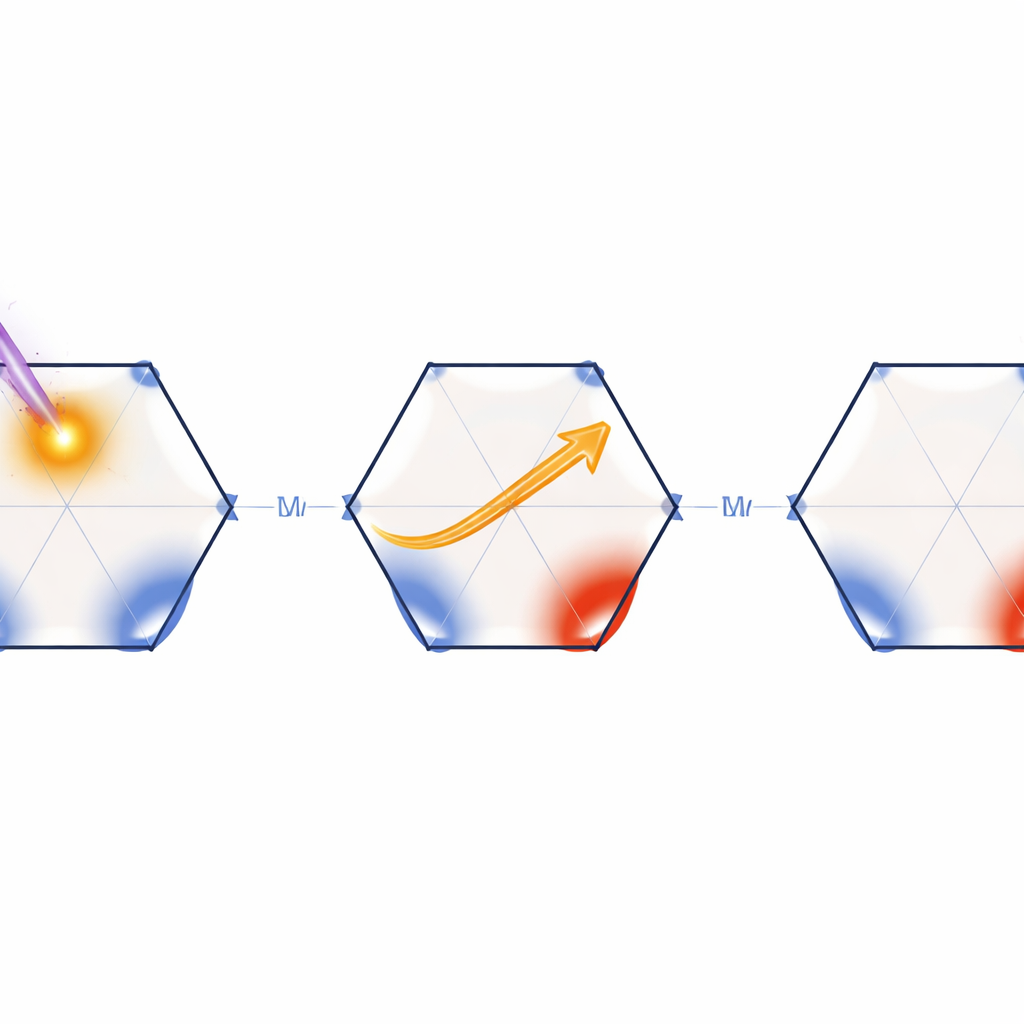
To move the excited electrons from the saddle point into a low-energy valley, the researchers add a second light component: a longer, weaker terahertz (THz) pulse, polarized at right angles to the ultraviolet beam. This THz field does not create new excitations in the same way; instead, it gently drags the already excited electrons through momentum space along a controlled path. By timing the ultraviolet excitation to coincide with the midpoint of a THz cycle, electrons are first lifted at the saddle point and then carried into one chosen valley. Reversing the sign (direction) of the THz field flips the target valley. Calculations show that this “double-pumped” pulse can produce an almost perfectly one-sided valley population, with very little unwanted excitation elsewhere.
Tuning the Light Knobs for Cleaner Control
The team explores how changing the ultraviolet pulse length and strength, as well as the THz pulse duration, affects the outcome. They define a simple measure of valley purity based on the difference between charge in the two valleys and search for combinations that maximize it. Very short, intense ultraviolet pulses can cause oscillations in which electrons are excited and then de-excited among the three saddles, reducing how much charge ultimately reaches the target valley. Similarly, a THz pulse that is too abrupt generates extra, unwanted excitations along lines in momentum space. By lengthening the THz pulse while keeping its overall displacement fixed, the electric field becomes gentler, these spurious excitations shrink, and valley polarization steadily improves.
Checking the Physics with Advanced Simulations
To ensure that the basic tight-binding model does not miss important subtleties, the authors repeat the simulations using time-dependent density functional theory, a more demanding first-principles method that tracks the full electron density. While both approaches agree on the core effect—strong charge buildup in a single valley—the more advanced method reveals an additional bonus: some of the extra charge created directly by the THz pulse is naturally drained away as the field oscillates, further sharpening the valley contrast. This suggests that earlier simplified calculations may have underestimated how cleanly valley states can be prepared in real graphene.
What This Means for Light-Driven Valleytronics
In plain terms, the study shows that by first exciting a special “saddle” region of graphene with ultraviolet light, and then sliding that excitation into a valley using a carefully tailored THz shove, one can reliably load electrons into just one valley or its mirror twin. The scheme works with linearly polarized light only and requires smaller THz field strengths than approaches that push electrons through the very center of the energy landscape. Because the ingredients—graphene, ultraviolet pulses, and THz sources—are all experimentally accessible, this saddle-point strategy offers a realistic path to ultrafast valley-based information processing in graphene and other gapless “Xene” materials.
Citation: Gill, D., Sharma, S., Elliott, P. et al. Valley polarization of graphene via the saddle point. npj Comput Mater 12, 167 (2026). https://doi.org/10.1038/s41524-026-02096-9
Keywords: graphene, valleytronics, terahertz pulses, ultrafast optics, 2D materials